Perps vs Futures: Which Should You Trade?
Perpetual futures vs dated futures — how they differ in mechanics, cost, and when to use each for crypto trading.
Perpetual futures and dated futures are both leveraged derivatives. Both let you go long or short with margin. Both can get you liquidated. But they differ in mechanics that directly impact your P&L: how they track price, what they cost to hold, when they expire, and where liquidity concentrates.
Most crypto traders default to perps without considering whether dated futures might be a better fit for their specific strategy. This comparison breaks down the structural differences so you can make that choice deliberately.
Core Mechanic: How Each Contract Tracks Price
Perpetual Futures (Perps)
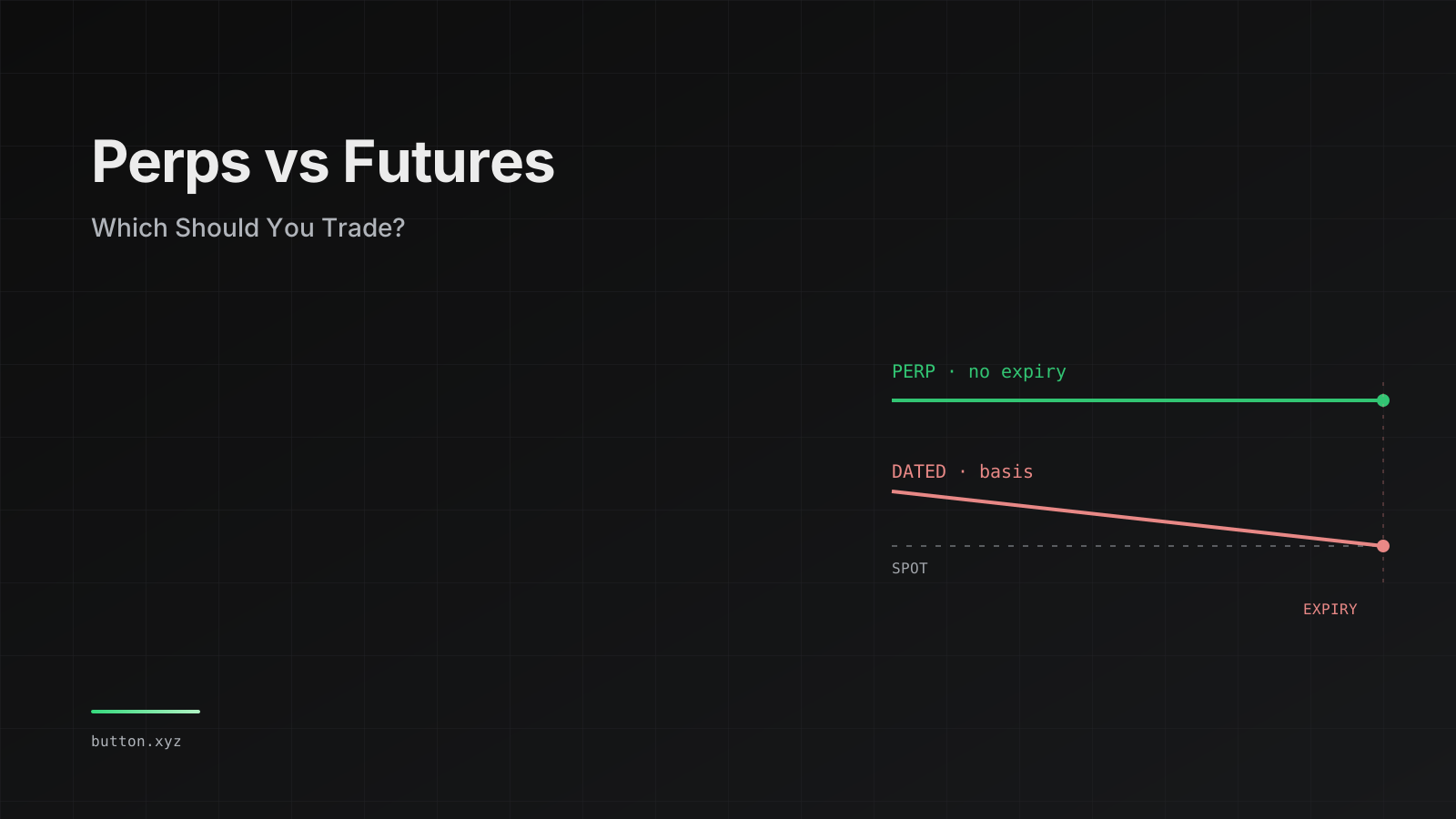
Perpetual futures have no expiration date. The contract stays open indefinitely — you enter when you want and exit when you want. The price is kept in line with spot through the funding rate mechanism: every 8 hours, longs and shorts exchange a payment based on the spread between perp price and spot price.
If the perp trades above spot, longs pay shorts. If below, shorts pay longs. This creates continuous economic pressure to keep the perp price tethered to spot.
Key characteristic: Funding rate is the cost (or income) of holding the position. It's variable — changing every 8 hours based on market conditions. You don't know what holding will cost tomorrow.
Dated Futures (Quarterly/Monthly)
Dated futures expire on a fixed date — typically quarterly (March, June, September, December) on exchanges like Binance or CME. The contract has a defined lifespan. At expiration, it settles to the spot price.
Before expiration, the contract trades at a premium or discount to spot. This spread is called the basis. The basis reflects the market's implied financing cost over the contract's remaining life. As expiration approaches, basis converges to zero — this is basis convergence.
Key characteristic: The cost of holding is priced in at entry. When you buy a quarterly at 2% premium to spot, you know the maximum basis you're paying. No variable funding rate surprises.
Cost Comparison: Funding Rate vs. Basis
This is where the choice gets concrete.
Holding Cost: Perps
A perp long on BTC at 0.03% per-8-hour funding pays:
- Daily: 0.09% ($61.20 on $68,000 notional)
- Weekly: 0.63% ($428)
- Monthly: 2.7% ($1,836)
- Quarterly: 8.1% ($5,508)
But funding isn't fixed. It could drop to 0.01% next week, saving you money. Or spike to 0.10% during a rally, costing 3x the estimate. Funding is a variable-rate loan against your conviction.
Holding Cost: Dated Futures
A quarterly future trading at 2% premium to spot means:
- Total cost for the quarter: 2% ($1,360 on $68,000 notional)
- This is the maximum basis you pay — it's locked in at entry
If perp funding averages 0.03% per period, the quarterly funding cost is ~8.1% ($5,508). The dated future at 2% premium is dramatically cheaper. This is why sophisticated traders watch the perp funding vs. dated basis spread.
When perps are cheaper: During bearish or neutral markets, funding rates compress to near zero or go negative. Holding a perp long costs almost nothing — far less than the 1-2% basis on a quarterly.
When dated futures are cheaper: During bull markets, perp funding spikes as retail leverage piles in. Funding can reach 0.05-0.10% per period, pushing quarterly holding cost to 15-30%. A dated future at 3-5% basis locks in a fraction of that cost.
The arbitrage between these two — going long the cheaper instrument and short the expensive one — is a core institutional strategy. When the spread is wide, capital flows in to compress it.
Expiration: Convenience vs. Rollover
Perps: No Expiration, No Friction
With perps, your position lives until you close it. No calendar to track, no rollover to manage, no settlement to navigate. This is the primary reason perps dominate crypto volume — convenience.
For active perp traders, the lack of expiration means you can hold a conviction position indefinitely (assuming you can afford the funding) and adjust size freely without closing and reopening.
Dated Futures: Forced Settlement
As a dated future approaches expiration, you must either:
- Close the position before settlement (most traders do this)
- Let it settle at the spot price (cash settlement on most crypto exchanges)
- Roll the position — close the expiring contract and open the next quarter's contract
Rolling costs money. The bid-ask spread on both the closing and opening trade, plus the basis difference between the old and new contract. On thin contracts, rollover slippage can be 0.1-0.3%. Four rolls per year add up.
Rollover also introduces timing risk. The old contract's final days have declining liquidity (traders have already rolled), widening spreads. The new contract's early days may have thin depth. Executing the roll at the worst time can cost meaningful P&L.
For most retail traders, perps eliminate rollover friction entirely. For institutions that want fixed-cost exposure, the roll is a manageable operational cost.
Liquidity: Concentration vs. Fragmentation
Perps Win on Liquidity
Because perps never expire, all open interest and trading activity concentrates in a single contract per asset. BTC perp on Hyperliquid has one order book. All makers and takers compete in one venue.
Dated futures fragment liquidity across multiple expirations. BTC March, BTC June, and BTC September all have separate order books. Volume splits across them, widening spreads on each.
Practical impact: BTC perps on major exchanges have $5-20M of depth within 0.5% of mid-price. BTC quarterly futures might have $1-5M. For retail position sizes (<$100K), both are sufficient. For institutional sizes ($1M+), perps offer meaningfully better execution.
Exception: CME Bitcoin Futures
CME's BTC futures are the most liquid dated contract and often have comparable depth to major crypto exchange perps. Institutional traders who need regulated exposure trade CME. But CME has trading hours (unlike 24/7 crypto), higher capital requirements, and no 24/7 liquidity.
Risk Profile Differences
Funding Rate Risk (Perps)
The variable funding rate creates P&L uncertainty. You might enter a long expecting 0.02% funding and find yourself paying 0.10% during a squeeze. Over a multi-week hold, unexpected funding can erode 5-10% of your position.
Defense: Monitor funding rate trends and close positions when funding exceeds your tolerance. Or hedge funding exposure by taking the opposite side on a different exchange with lower funding.
Basis Risk (Dated Futures)
Dated futures can trade at a significant premium or discount to spot, and that basis can widen before it converges. If you buy a quarterly at 2% premium and basis widens to 5% before expiration, your mark-to-market shows a 3% loss — even if spot hasn't moved.
Basis risk is temporary (it converges at settlement) but can trigger margin calls or psychological stops before convergence occurs.
Liquidation Risk
Both instruments carry liquidation risk from leverage. The mechanics are identical — if equity falls below maintenance margin, the exchange closes the position. The difference is that perp positions accumulate funding cost over time, slowly tightening the liquidation buffer, while dated futures have their cost locked in at entry.
When to Choose Perps
- Short-term directional trades (hours to weeks). Funding over a few days is negligible, and perp liquidity gives better execution.
- Active strategy management. You're adjusting position size, adding or reducing frequently. No expiration means no rollover friction.
- Carry trades. Collecting funding rate payments by shorting perps against spot is a perps-only strategy — dated futures don't have this mechanic.
- Any trade on a DEX. Hyperliquid and dYdX only list perpetuals, not dated futures.
- Small to medium position sizes. Perps have the best liquidity for positions under $1M notional.
When to Choose Dated Futures
- Multi-month directional holds. If you're holding a BTC long for 90 days, a quarterly at 3% basis is cheaper than paying 0.03%/period funding (which totals ~8% over 90 days).
- Fixed-cost exposure. You want to know exactly what the position costs upfront, with no variable funding surprises.
- Basis trading. Buying spot and selling the dated future to lock in the basis premium is a clean carry trade with known expiration.
- Institutional mandates. Regulated funds that need cleared, regulated exposure trade CME quarterlies. Perps on crypto exchanges don't meet those compliance requirements.
- Hedging with certainty. If you're a miner or protocol treasury hedging revenue, a dated future gives you a known hedge price at a known date. Perps give you a floating hedge that could become expensive.
The Hybrid Approach
Many professional traders use both:
- Long-term core position in dated futures — lock in basis, avoid funding uncertainty, hold for the quarter
- Short-term tactical trades in perps — scalps, event-driven plays, and funding rate trades that benefit from no-expiration flexibility
- Basis arbitrage between the two — when perp funding significantly exceeds the dated basis, short perps and long dated futures (or vice versa)
This approach captures the cost advantage of dated futures for long-duration holds while keeping perps available for tactical execution.
FAQ
Are perps more expensive than dated futures?
It depends on market conditions. In bull markets with elevated funding (0.05%+ per period), perps are significantly more expensive to hold long than dated futures with 2-5% quarterly basis. In neutral or bearish markets, perp funding compresses to near-zero, making them cheaper. Compare the annualized perp funding rate to the annualized dated basis before choosing.
Can I trade dated futures on Hyperliquid?
No. Hyperliquid only lists perpetual futures. Dated futures are available on Binance (quarterly), OKX, and CME (for BTC and ETH). If you specifically need dated contracts, you'll use a centralized exchange.
Why do perps dominate crypto trading volume?
Convenience, liquidity, and accessibility. No expiration means no rollover management. Single contract means concentrated liquidity. Available on every major exchange including DEXs. And the funding rate mechanism creates carry trade opportunities that attract additional capital. These factors create a self-reinforcing cycle — more volume in perps means better liquidity, which attracts more volume.
What is basis convergence?
Basis convergence is the process by which a dated future's price approaches spot price as expiration nears. A future trading at 3% premium 60 days from expiry will converge to 0% premium at settlement. This convergence is guaranteed — the question is the path it takes. Smooth convergence is ideal; volatile convergence (basis widening before narrowing) creates mark-to-market pain.
Should beginners trade perps or dated futures?
Perps. They're simpler (no expiration to manage), have better liquidity (tighter spreads), and are available on more platforms including DEXs. The variable funding cost is a risk, but for short-duration trades (the right starting point for beginners), funding is negligible. Learn how to trade perps first, then consider dated futures for longer-duration strategies as you gain experience.
Choose Your Instrument
Perps and dated futures solve different problems. Perps give you flexibility, liquidity, and carry trade access. Dated futures give you cost certainty and cheaper long-duration exposure. The right choice depends on your holding period, cost sensitivity, and whether you need the funding rate mechanism.
Run a perp strategy with the agent: for traders choosing the perp route, the AI trading agent handles position sizing, funding rate monitoring, and automated execution — so you capture the perp advantages without the manual overhead.
Related: What are perps? for perpetual futures basics. Crypto perps explained for the technical mechanics. Funding rates guide for understanding the carry cost.