Funding Rates Explained: Perp Trader's Edge
How crypto funding rates work and how active traders use them to generate alpha on perpetual futures.
Funding rates are the mechanism that keeps perpetual futures prices tethered to spot. They're not a side feature—they're the market's heartbeat. If you're trading perps on Hyperliquid or any exchange, understanding funding is the difference between reactive trading and systematic edge.
This guide covers what funding rates are, how they work, why they matter, and how active traders extract alpha from them.
What Are Funding Rates?
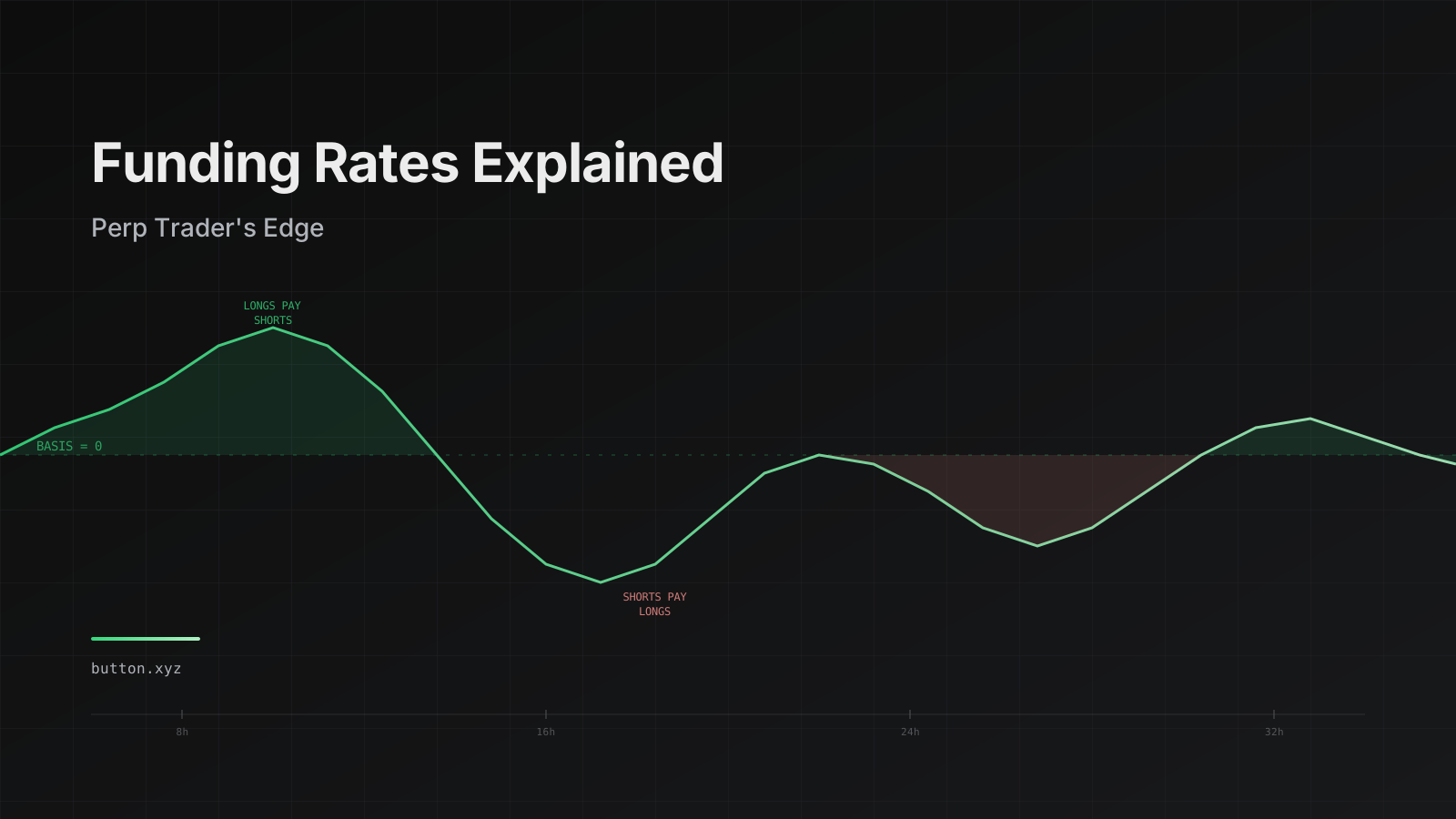
A funding rate is a periodic payment exchanged between long and short traders in a perpetual futures contract. When the perp price trades above spot (positive basis), longs pay shorts. When the perp price trades below spot (negative basis), shorts pay longs.
The exchange doesn't collect this payment. It flows directly between traders. This is the core mechanic that prevents perp prices from deviating significantly from spot.
If a perp trades $100 above spot and there's no cost to being long, arbitrageurs would infinitely long the perp and short spot. Funding rates price in that cost. They rise until holding the perp becomes expensive enough that the arb gets arb'd away. Price discovery happens through pain.
Why Funding Rates Exist
Centralized exchanges (Binance, Bybit) and decentralized ones (Hyperliquid) both use funding rates for the same reason: price discovery at scale. But their mechanics differ.
Traditional exchange funding is calculated hourly or every 8 hours. The formula is:
Funding Rate = (Premium Index − Interest Rate) / Funding Period
The premium index is the difference between perp and spot. If the perp is 0.1% above spot, the premium index is 0.1%. Interest rate is usually negligible (typically 0.01% daily).
On Hyperliquid, funding is continuous. The exchange continuously calculates the funding rate based on real-time mark price and spot index. This creates tighter price tethering and faster response to imbalances.
Positive vs. Negative Funding
Positive funding: Longs pay shorts. This happens when demand to go long exceeds demand to short. Perp price trades above spot. Active traders shorting here collect funding as basis play income.
Negative funding: Shorts pay longs. This happens when short demand exceeds long demand. Perp price trades below spot. Active traders going long here collect funding while waiting to rebalance spot-perp spreads.
A trader holding 1 BTC perp long in positive 0.1% hourly funding earns 0.001 BTC every hour just for holding. That's 24 BTC per 10,000 BTC annually—pure carry income. Scale this across a basis trading operation and it's material.
How the Funding Rate Formula Works
The perpetual funding rate is built from two components:
1. Premium Index: The 8-hour time-weighted average of (Perp Price − Spot Price) / Spot Price
This smooths out single trades and reflects the true average premium over the period.
2. Interest Rate: The opportunity cost of capital, usually 0.01% daily (0.00001 across an 8-hour period)
The formula across an 8-hour funding period:
Funding Rate = (Premium Index − Interest Rate) / Number of Periods Per Day
If premium index is 0.15% and interest rate is 0.01%, the 8-hour funding rate is:
(0.0015 − 0.0001) / 3 = 0.000467 per period ≈ 0.0467% per 8 hours
Over a year, positive longs pay this every 8 hours. Shorts collect it.
Hyperliquid's Implementation
Hyperliquid uses continuous funding instead of discrete 8-hour settlements. The funding rate updates in real-time based on the mark price. This means:
- Funding adjusts immediately to changes in basis
- Arbs can't sandwich funding settlement windows
- Liquidation cascades directly impact funding rates
- API consumers see live funding data, not lagged fixes
For traders, this means tighter basis and faster mean-reversion when funding extremes occur.
Funding Rates as a Sentiment Signal
Funding rates reveal market structure in real-time. They're not just costs—they're signals.
High Positive Funding = Leverage Long Crowding
When funding is consistently +0.05% or higher per period, it tells you:
- Longs are overcrowded relative to shorts
- Spot arbitrageurs are pulling back (arb spreads widened)
- Leverage long capital is still flowing in despite the cost
- Liquidation risk for longs is elevated
During bull runs, funding rates can reach 0.1% per 8-hour period (9.5% annualized). Retail capital piles into longs, ignoring the carry cost. Pros read this as a warning.
Negative Funding = Short Cascade Risk
Negative funding signals forced liquidations of shorts or structural underleverage of shorts:
- Short crowding isn't present despite opportunity (likely margin calls)
- Longs have positional control
- Cascading short liquidations can trigger further negative funding
- Risk of violent long squeeze when short squeeze unwinds
Negative funding −0.05% per period or worse historically precedes volatility expansion.
Using Funding to Read Accumulation/Distribution
Funding rates, combined with open interest trends, reveal whether smart money is accumulating or distributing:
- Rising OI + Positive funding = Distribution phase (professionals shorting into weak hands)
- Rising OI + Negative funding = Accumulation phase (professionals long, shorting scarce)
- Falling OI + Positive funding = Short squeeze in progress
- Falling OI + Negative funding = Long liquidation cascade (panic)
Track funding rate averages over 7-day windows. Compare current funding to the 30-day average. Extremes tend to mean-revert.
Funding Rate Arbitrage
The simplest funding arb is cash-and-carry:
- Spot buy 1 BTC at $42,000
- Perpetual short 1 BTC at $42,100 (positive basis)
- Collect funding for holding short (basis + funding income)
- Close both legs when basis compresses
Your P&L is:
- Basis captured: $100
- Funding collected: 8-hour rate × position size × number of periods
- Spot holding cost: negligible on Hyperliquid (no trading fees on close)
- Liquidation risk: near-zero if properly margined
Over 30 days of positive 0.04% 8-hour funding, 1 BTC shorts earn ~1.44% yield. That's 17% annualized for a near-risk-free arb.
For a detailed breakdown of basis arbitrage mechanics and Hyperliquid-specific strategy, see the funding rate arbitrage guide.
Why Hyperliquid Creates Arb Opportunities
Most centralized exchanges charge taker fees (0.05% on most volume). Hyperliquid charges no trading fees. This changes the arb calculus:
On Binance, a perp-spot roundtrip costs 0.1% in fees. Your basis has to exceed 0.1% just to break even.
On Hyperliquid, there are no taker fees. Any positive basis is profit. This is why basis stays tighter on Hyperliquid—arbs can capture basis at 0.02%, which is impossible on centralized exchanges.
Historical Funding Patterns
Funding rates follow seasonal and event-driven patterns.
Bull Markets
During bull runs (2017, 2021, late 2024), funding rates tend toward the positive:
- Average positive 0.03-0.05% per period
- Spikes to 0.1%+ during final capitulation runs
- Mean-reverts after liquidation cascades clear leverage
Bear Markets
During downtrends, funding oscillates:
- Periods of extreme negative funding (−0.05% or worse)
- Followed by violent snapbacks into positive territory
- OI trends lower as both longs and shorts give up
Volatility Events
Major news (Fed decisions, hacks, bankruptcies) cause funding whipsaws:
- Initial directional move followed by crowding into one side
- Funding spikes as leverage accumulates
- Liquidation cascade triggers violent mean-reversion
Example: March 2023 (SVB collapse) saw negative funding spike to −0.08% as shorts got rekt, then funding inverted overnight as survivors accumulated long positions.
Hyperliquid's Funding Model vs. Centralized Exchanges
Hyperliquid's on-chain insurance fund is the key difference:
Traditional CEX Model
- Insurance fund is optional (Binance has one, others don't)
- In catastrophic liquidations, counterparty risk exists
- Funding rate floors at some extreme negative value (circuit breaker)
Hyperliquid Model
- On-chain insurance fund is backed by vault LPs
- Liquidations are fully collateralized (insurance fund absorbs losses)
- Funding rate can go arbitrarily negative without circuit breaker
- Liquidation cascades hit funding rates harder but faster mean-reversion
This means Hyperliquid funding can provide sharper signals. When you see extreme negative funding on Hyperliquid, you're seeing real liquidation pressure being absorbed by the insurance fund, not just risk management circuit breakers.
For traders, this means:
- Basis arbs capture more value on Hyperliquid
- Funding extremes are more actionable (less noise from circuit breakers)
- Historical funding levels from CEXs don't directly translate (higher extremes possible)
FAQ
What is a crypto funding rate?
A funding rate is a periodic payment between long and short traders in perpetual futures contracts. It keeps the perp price tethered to spot. When perps trade above spot, longs pay shorts. When perps trade below spot, shorts pay longs. The payment happens automatically and flows directly between traders, not through the exchange.
How often do funding rates get paid?
On centralized exchanges like Binance and Bybit, funding settles every 8 hours. On Hyperliquid, funding is continuous—the rate updates in real-time based on the mark price, and traders accrue funding continuously. Check your exchange's specifications for exact timing.
Why would I pay funding if I'm going long?
You pay positive funding because you're taking the long side in an overcrowded market. The trade-off is you get exposure to the asset and collect funding if sentiment reverts. Basis traders specifically go long perps while shorting spot to collect funding as low-risk yield.
Can funding rates predict price moves?
Funding rates are lagging indicators of positioning, not leading price predictors. However, extreme funding rates (very positive or very negative) often precede mean-reversion moves. High positive funding signals overleveraged longs; extreme negative funding signals short squeeze risk. Use funding as part of market structure analysis, not as a standalone signal.
Are funding rates the same across all exchanges?
No. Each exchange calculates funding independently based on its order book and mark price methodology. Funding can vary significantly between exchanges. Hyperliquid's funding is typically tighter (less extreme) than CEXs because of zero trading fees and continuous calculation. If you're arbitraging across exchanges, funding rate differences are a direct cost to the trade.
How do I automate funding rate arbitrage?
Basis arb requires coordinating spot and perp positions, tracking mark prices, and adjusting for funding accrual. Manual execution is slow and error-prone. The smarter approach is to automate basis arb with the agent, which continuously monitors basis spreads, executes legs simultaneously, and closes positions at optimal funding accrual points without manual rebalancing.
Conclusion
Funding rates are the market's price tethering mechanism and a direct signal of leverage positioning. Pro traders read funding as real-time basis sentiment and extract alpha from structural imbalances between spot and perp.
Hyperliquid's zero-fee model and continuous funding calculation create tighter basis and more actionable funding extremes than centralized exchanges. This is why basis arbitrage remains one of the most consistent alpha strategies for active traders.
The edge isn't in predicting funding—it's in reading it as a market signal and automating the trades that capture it systematically.