Funding Rate Sniper: Capture Spikes Automatically
How funding rate sniping works — detect spikes, enter before settlement, exit after, and automate the process for consistent yield.
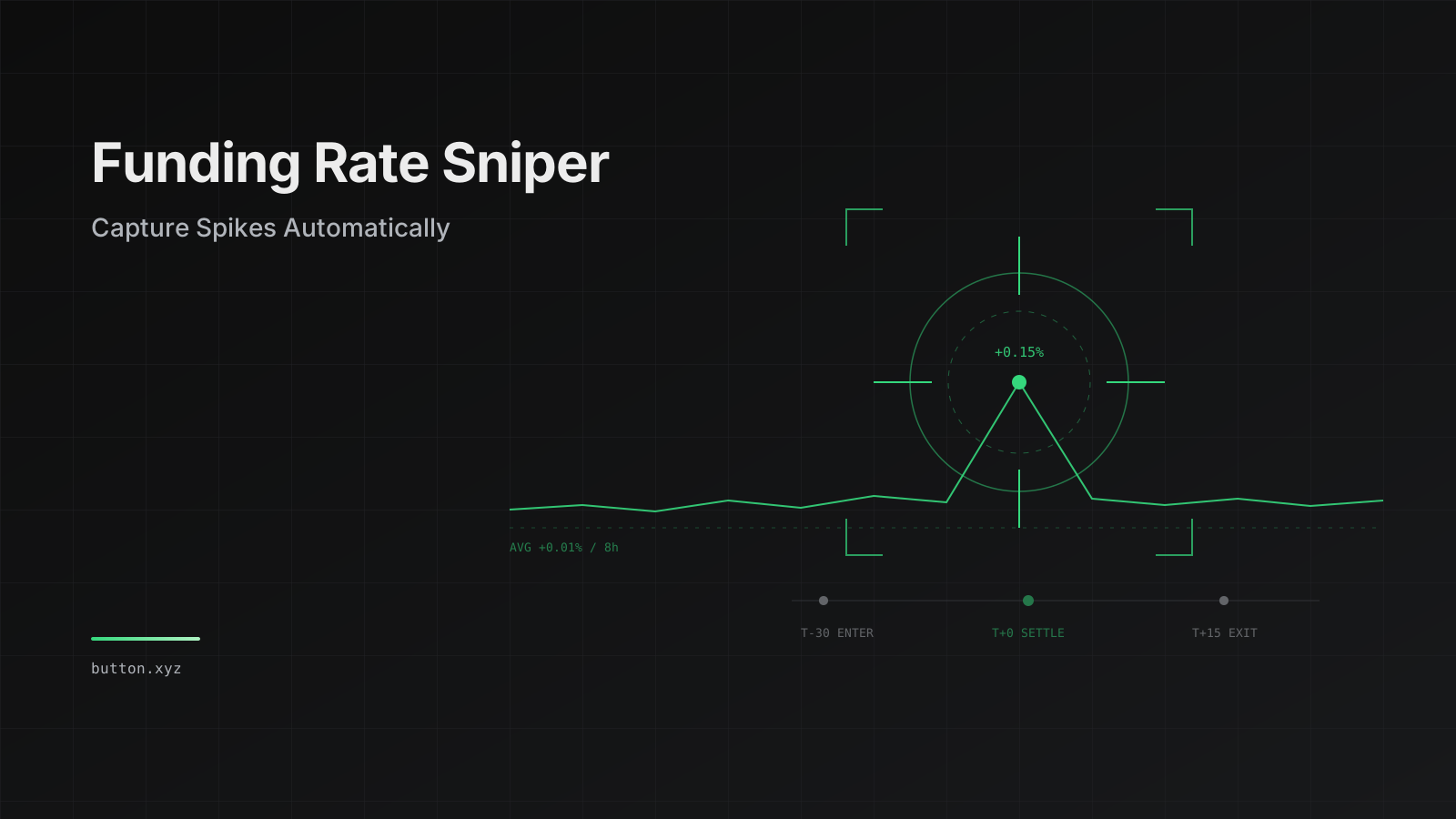
Funding rate sniping is the practice of entering positions shortly before a funding rate settlement specifically to capture an outsized payment, then exiting after settlement. On Hyperliquid, where funding rates run 2-3x higher than centralized exchanges and settlements happen every 8 hours, sniping opportunities appear daily across 100+ perpetual pairs.
The math is simple. If ETH funding is 0.15% for the next 8-hour period — well above the typical 0.01-0.03% — a short position opened 30 minutes before settlement collects 0.15% on its notional. On $100,000 notional, that's $150 in 30 minutes. The position closes after settlement, market exposure lasts minutes, and the yield annualizes to absurd numbers that aren't sustainable but don't need to be — you're capturing a one-time spike, not a long-term rate.
How Funding Rate Sniping Works
The Opportunity Window
Funding rates are calculated and displayed before settlement. On most exchanges, the predicted funding rate for the next period is visible for the entire 8-hour window. When a rate spikes well above average, it signals an imbalanced market — too many longs (positive funding) or too many shorts (negative funding).
The sniper's edge: Enter the paying side's opposite. If funding is highly positive (longs pay shorts), go short before settlement and collect the payment. If funding is highly negative (shorts pay longs), go long before settlement.
Timing:
- T-60 to T-30 minutes: Monitor predicted funding rates across all pairs. Flag any rate above a threshold (e.g., 3x the trailing 7-day average for that pair).
- T-30 to T-5 minutes: Enter position via limit order on the receiving side. On Hyperliquid, the -0.02% maker rebate means entry itself earns fees.
- T+0 (settlement): Funding payment is credited/debited.
- T+1 to T+15 minutes: Exit position via limit order. Again, maker rebate on exit.
Total market exposure: 20-45 minutes. Funding captured: the full settlement amount on your notional.
Why Spikes Happen
Funding rate spikes occur when the market becomes directionally imbalanced:
Narrative-driven surges. A bullish news event (ETF approval rumor, protocol upgrade) causes a rush of long positions. Demand for long exposure pushes the perp price above spot, causing positive funding to spike. Longs are willing to pay elevated funding because they expect price appreciation to exceed the cost.
Liquidation cascades. A sharp price drop liquidates leveraged longs, but the remaining longs are now more concentrated. If the perp price diverges from spot during the cascade, funding can spike in either direction depending on which side was liquidated.
Low-liquidity altcoins. On coins with thinner order book depth, even moderate position-building by a few traders can push funding to extreme levels. A single whale opening a $5M long on a mid-cap altcoin can push funding to 0.5%+ per period.
Event anticipation. Before airdrops, token unlocks, and governance votes, traders pile into directional positions. The anticipated event creates a temporary funding imbalance that reverts after the event resolves.
The Economics
Revenue per snipe:
| Notional | Funding Rate | Revenue | Minus Fees (HL) | Net |
|---|---|---|---|---|
| $50,000 | 0.10% | $50 | -$20 rebate earned | $70 |
| $50,000 | 0.30% | $150 | -$20 rebate earned | $170 |
| $100,000 | 0.10% | $100 | -$40 rebate earned | $140 |
| $100,000 | 0.30% | $300 | -$40 rebate earned | $340 |
Hyperliquid maker rebate (-0.02%) on entry + exit adds $20-$40 per round trip on top of funding income.
Risk per snipe: The primary risk is adverse price movement during the 20-45 minute holding period. If BTC moves 0.5% against your position on $100K notional, that's $500 — more than the funding captured. This is why risk management is the critical factor, not the funding rate itself.
Risk Management for Sniping
Position Sizing
Size positions so that a 1% adverse move doesn't exceed your expected funding capture. If the spike is 0.10% on $100K ($100), a 1% adverse move costs $1,000 — that's a 10:1 risk-to-reward ratio in the wrong direction.
Sizing framework:
- Expected funding capture: notional × funding rate
- Maximum acceptable loss: 3x expected capture
- Implied maximum notional: max loss / max expected adverse move
For a 0.10% spike with a 0.3% max expected move: max notional = $300 / 0.003 = $100,000. For a 0.30% spike: max notional = $900 / 0.003 = $300,000.
Higher spike rates justify larger positions because the risk-reward improves.
Stop Losses
Every snipe should have a hard stop loss. If the market moves beyond your maximum acceptable loss, exit immediately. Don't hold through adverse moves hoping the funding payment makes up for it.
Recommended stops: 2-3x the expected funding capture. On a 0.10% snipe ($100 on $100K), set a stop at $200-$300 loss. The win rate needs to exceed 60-70% for the strategy to be net positive — which it does when you're selective about which spikes to trade.
Selectivity
Not every funding spike is worth sniping. The highest-probability opportunities have these characteristics:
High rate relative to recent history. A pair that typically funds at 0.01% spiking to 0.15% is a better opportunity than a pair that usually funds at 0.10% spiking to 0.15%. The reversion potential is stronger.
Clear imbalance cause. Spikes caused by news events or temporary positioning are more likely to revert. Spikes caused by genuine sustained demand (like during a strong trend) may not revert — the rate could stay elevated.
Sufficient liquidity. You need to enter and exit without significant slippage. On Hyperliquid, BTC and ETH have deep books. Altcoins may have 0.5-1% slippage on large entries, eating into your funding capture.
Multiple pair opportunities. The best sniping windows have spikes across several pairs simultaneously (often during market-wide events). This lets you diversify the directional risk across uncorrelated assets.
Automating the Sniper
Manual sniping is possible but impractical. Funding settlements happen every 8 hours — that's three times per day, including inconvenient hours. Across 100+ Hyperliquid pairs, monitoring each pair's funding rate manually is a full-time job that doesn't scale.
What the Automation Does
- Continuous monitoring. Scans all Hyperliquid pairs' predicted funding rates via the API. Flags rates exceeding configurable thresholds (absolute level and relative to trailing average).
- Opportunity scoring. Ranks flagged pairs by: spike magnitude, historical reversion probability, current liquidity depth, and correlation with other flagged pairs.
- Entry execution. Places post-only limit orders on the highest-scoring pairs T-15 to T-30 minutes before settlement. Maker rebate captured on every fill.
- Settlement capture. Holds through the settlement event. Funding credited automatically.
- Exit execution. Places post-only limit exit orders T+1 to T+15 minutes after settlement. Maker rebate captured again.
- Risk monitoring. Hard stop losses on every position. Maximum aggregate notional across all snipe positions. Maximum loss per session.
Why Automation Matters
Speed: Funding spikes can appear and resolve within the 8-hour window. An automated sniper catches opportunities at 3 AM that a human trader sleeps through.
Scale: Monitoring 100+ pairs simultaneously is trivial for software and impossible for humans. The bot evaluates every pair's funding every minute and identifies opportunities across the full Hyperliquid menu.
Discipline: No emotional decisions. The bot enters only when criteria are met, sizes according to the framework, and exits on schedule. No "holding a bit longer" or "doubling down."
Maker rebate capture: Every entry and exit routes through post-only limit orders. On Hyperliquid's -0.02% maker rebate, the round-trip earns approximately 0.04% on notional — which on a $100K position adds $40 to every snipe, regardless of the funding amount.
Performance Expectations
Funding sniping is a high-frequency, low-per-trade-return strategy. Realistic expectations:
Per-snipe return: 0.05-0.30% on notional. Most snipes are in the 0.08-0.15% range after fees.
Win rate: 65-80%. Not every snipe is profitable — adverse price moves during the holding window can exceed the funding capture. The edge comes from selectivity and sizing.
Monthly return (on deployed capital): 2-6%. This depends on the number of qualifying spikes (market-dependent), capital deployed, and risk parameters.
Drawdown profile: Individual snipes can lose 0.2-0.5% of notional. Maximum drawdown periods occur when the market trends strongly against your snipe direction across multiple sessions. Circuit breakers limit this.
What sniping is not: A get-rich-quick strategy. It's a systematic, repeatable edge that compounds over time. The funding rate inefficiency exists because it requires infrastructure, monitoring, and discipline to capture at scale.
Combining with Other Strategies
Funding sniping works best as one component of a multi-strategy portfolio:
Sniping + carry trades. The sniper captures acute spikes. Funding rate arbitrage captures sustained elevated rates through basis trades. Together, they cover both spike and trend opportunities in the funding market.
Sniping + grid trading. Grid strategies earn maker rebates and spread income during range-bound periods. Sniping adds funding income during volatile periods when funding spikes. The two strategies have complementary performance profiles.
Sniping + delta-neutral portfolio. The base portfolio runs market-neutral carry positions. The sniper adds opportunistic trades during spike events, temporarily increasing directional exposure within risk limits.
FAQ
How much capital do I need for funding sniping?
Minimum $10,000 for meaningful returns (0.10% on $10K = $10 per snipe). $50,000-$100,000 is the practical range for the strategy to justify automation overhead. Larger capital ($200K+) enables multi-pair simultaneous sniping for diversified risk.
Is funding sniping risk-free?
No. You hold directional exposure during the sniping window. Price can move against you, and the loss can exceed the funding captured. Risk management — stop losses, position sizing, and selectivity — is what makes the strategy viable, not the funding rate itself.
Why don't more people do this?
They do — institutional desks run funding arbitrage and sniping at scale. The reason it's not arbed away entirely: it requires infrastructure (API integration, monitoring, automation), capital (meaningful returns need meaningful notional), and discipline (most retail traders can't resist taking directional bets instead of systematic captures). Perp trading involves substantial risk.
What's the best exchange for funding sniping?
Hyperliquid for three reasons: highest baseline funding rates (2-3x CEXs), maker rebate that adds to every trade's P&L, and 100+ pairs providing the widest opportunity set.
Snipe Smarter
Funding spikes are the market's way of pricing imbalance. Sniping is the systematic process of capturing those imbalances before they correct. Automated, disciplined, and properly risk-managed, it's one of the most consistent alpha sources in perps trading.
Run funding rate strategies with the agent: the AI trading agent monitors all Hyperliquid pairs for funding rate spikes, automatically sizes and enters positions before settlement, captures maker rebates on every fill, and exits post-settlement — fully automated sniping with built-in risk controls.
Related: Funding rate for the complete funding mechanism. Funding rate arbitrage for sustained carry strategies. Crypto funding rates for cross-exchange comparison.