AI Trading Agents: What They Are and How to Deploy One
What AI agents do in trading, how they differ from bots, and how to deploy one on Hyperliquid perps.
If you've been following crypto trading infrastructure, you've heard the term "agentic AI" thrown around alongside "trading bots" and "autonomous trading." The problem: they're not the same thing, and the differences matter. A rule-based bot executes fixed logic. A signal service tells you when to trade. An AI trading agent observes the market, reasons through available strategies, makes decisions, and learns from outcomes — all autonomously.
This post breaks down what agentic AI agents actually do, where they excel (funding rate arbitrage, basis trades), where they fail (predicting price direction), and how to deploy one on Hyperliquid perpetuals today. No hype. Real limitations included.
What Is an AI Trading Agent?
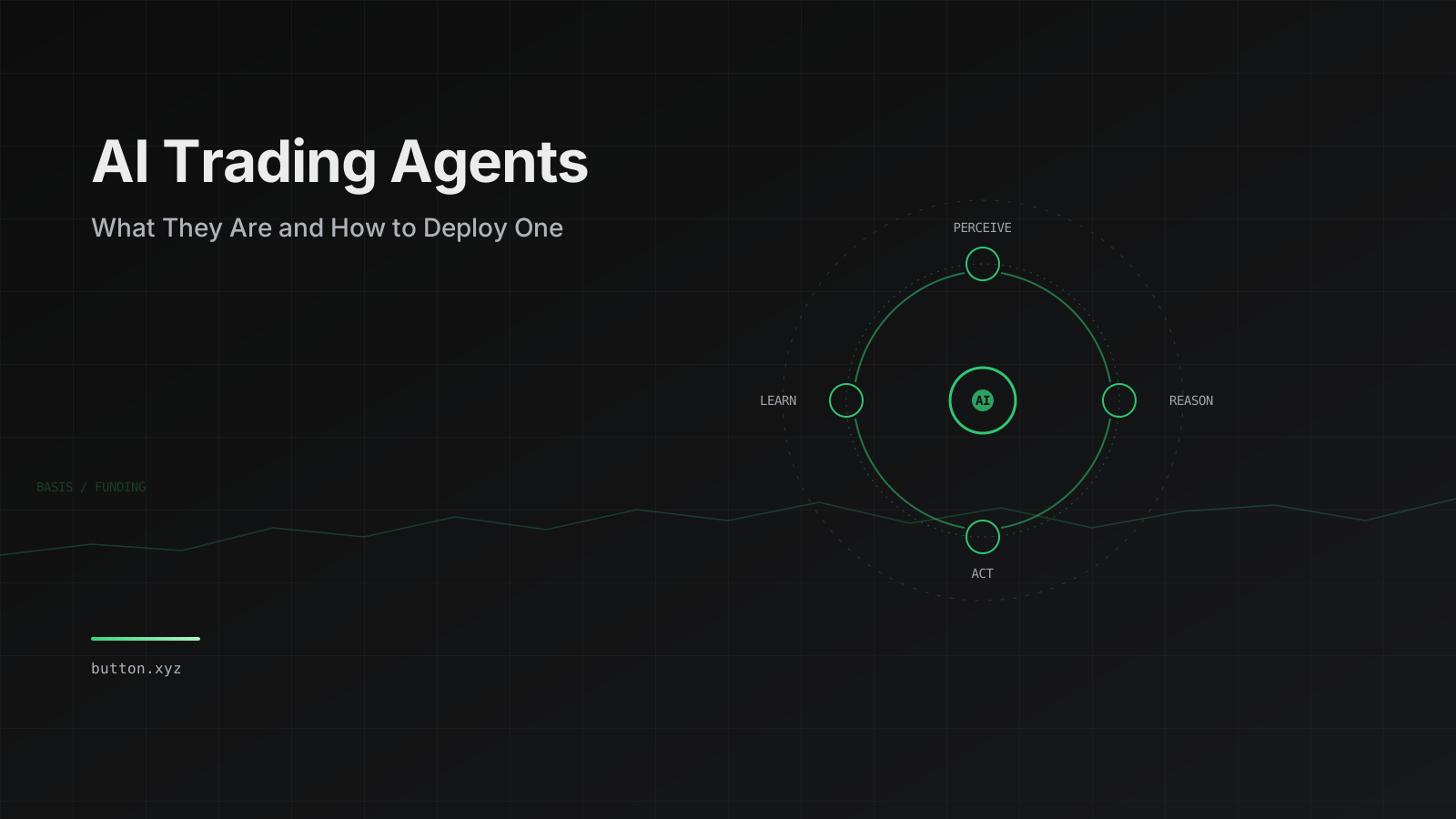
An AI trading agent is software that operates through a loop: it perceives market data, reasons about available strategies, executes trades, and learns from outcomes. Unlike a traditional bot, which runs IF/THEN rules, or a signal service, which requires human decision-making, an agent makes autonomous decisions based on observations and reasoning.
Rule-based bot example: IF price > 200-day MA AND RSI > 70 THEN buy 0.5 BTC. This has no judgment. It fires whenever conditions are met.
AI trading agent example: The agent observes that funding rate on Hyperliquid is 10 bps per 8 hours, spot price is $60,500, and the perpetual is $60,510. It reasons: "The basis is 10 bps and the funding rate is 10 bps over 8 hours. If I short perps and long spot, I capture 20 bps per 8 hours minus slippage (~2 bps) and gas (~1 bps). Net: ~17 bps per 8 hours." It decides to execute. It monitors basis compression. It closes the position when basis tightens.
The agent didn't follow a pre-written rule. It reasoned through conditions, compared strategies, and chose one. It adjusted execution based on real-time market state.
The Agentic Loop: Perceive, Reason, Act, Learn
An agent operates in a cycle. Understanding this cycle is key to knowing what agents can do.
- Perceive: The agent ingests market data — spot prices, perpetual prices, funding rates, order book depth, recent trade volume, volatility estimates. On Hyperliquid, this means querying the exchange API for real-time perp and spot prices, funding rates, and open interest.
- Reason: The agent evaluates this data against its available strategies. Is funding rate arbitrage viable right now? What's the edge? How much capital should it allocate? Are there cross-venue opportunities? It uses language models or trained policies to reason through these decisions.
- Act: The agent executes trades. It places orders, adjusts positions, hedges exposure, or closes trades. Crucially, it sizes positions based on reasoning, not fixed allocation.
- Learn: The agent observes outcomes — did the trade execute? What was slippage? Did the market move against the position? It updates its reasoning model. Over time, it may adjust position sizing, avoid certain strategies if they consistently underperform, or refine entry/exit logic.
This loop repeats — every few seconds or minutes, depending on the strategy.
What Strategies Work Well for Agentic Agents
Agentic agents excel at strategies where the edge is clear and can be calculated (not predicted), execution speed matters but not sub-millisecond, and opportunities are frequent and repeatable.
Funding rate arbitrage is the canonical example. Perpetual contracts on venues like Hyperliquid pay funding — a cash flow between shorts and longs. If funding is positive (longs pay shorts) and you're long, you earn it every 8 hours. If you short perps and long spot, you capture the spread. On Hyperliquid, typical funding runs 5–20 bps per 8-hour period depending on market conditions. A $100k position earning 10 bps per 8 hours = $100k × 0.001 = $100 per cycle. Over a month, that's ~$1,200 in risk-free cash flow (minus slippage and gas).
An agentic agent can monitor funding rates in real time, calculate the real basis (including slippage and transaction costs), decide whether the trade is worth it, size into it, and monitor compression over time. If basis tightens faster than expected, the agent closes early. If a black swan event causes slippage to widen, the agent can hedge or exit.
Basis trading (long spot, short perps) and cross-venue arbitrage (e.g., long on Hyperliquid perps, short on Deribit) are similar — clear edge, frequent opportunities, repeatable execution. For the full playbook, see our funding rate arbitrage guide.
What Agentic Agents Cannot Do
Agentic agents are not fortune tellers. They cannot reliably predict price direction, and attempting to use them for directional trading is a path to losses.
Why? Predicting price direction requires forecasting future market sentiment, macroeconomic shocks, regulatory changes, or black swan events. These are low-predictability, high-variance problems. A language model trained on historical data can generate plausible-sounding narratives about why Bitcoin might move, but these are confabulations (hallucinations), not predictions.
In a 2023 test, a popular LLM-based trading bot was deployed on directional trades (long/short calls on BTC price movement). Over 30 days, it generated 47 trades and lost on 31 of them. The median loss per losing trade: 8%. The median win per winning trade: 2%. It was whipsawed by volatility.
Agentic agents also struggle with:
- Predicting black swans. No amount of reasoning will forecast a regulatory surprise or market circuit breaker.
- High-latency strategies. If your agent takes 200ms to reason and execute, it won't compete with sub-10ms algorithmic traders.
- Strategies requiring deep domain expertise. If the strategy requires understanding obscure tokenomics or governance dynamics, an agent trained on public data will hallucinate.
How to Deploy an Agent on Hyperliquid Perps
Here's a practical walkthrough for running a funding rate arbitrage agent on Hyperliquid.
Prerequisites
- A Hyperliquid account with API keys (read + write).
- A separate exchange account for spot (Kraken, Coinbase, OKX) or Hyperliquid's own spot mechanism.
- Initial capital: at least $10k recommended for meaningful funding capture.
- A server or local machine that can run the agent 24/7 (VPS, Raspberry Pi, cloud VM).
Step 1: Generate API Keys
Log into Hyperliquid. Navigate to Settings > API. Create a new key with read permissions (order book, account info, positions) and write permissions (place orders, cancel orders). Do not enable withdrawal permissions. Store the secret key securely — a password manager or an .env file.
Step 2: Set Up Your Agent Environment
Clone or deploy an agentic framework. Popular options: Anthropic's Claude API with tool use, or a custom agent using the OpenAI API. You'll need real-time market data ingestion (Hyperliquid API), order placement logic (authenticated REST calls), position tracking (open positions, PnL), and risk management (stop-loss, max leverage limits).
Step 3: Define Your Agent's Strategy
Write a prompt that tells the agent what to do. A minimal funding-rate-arbitrage prompt, run every 60 seconds, should instruct it to:
- Check the current perpetual funding rate.
- Check the spot-perp basis (spot price − perp price).
- Calculate net edge: funding rate + basis − expected slippage (2 bps) − gas cost (1 bps).
- If edge > 5 bps over 8 hours, size into the trade: 10x capital allocation per 5 bps of edge.
- Monitor the position. If basis compresses by >50%, close early.
- Every 8 hours, record the outcome and learn: was the prediction accurate?
Hard constraints to include in the prompt: never use leverage greater than 3x; never hold more than $50k of spot if you have perp shorts; if a trade loses more than 2%, close immediately.
Step 4: Connect the Agent to Real Trading
Start in sandbox mode first. Use Hyperliquid's testnet to verify order placement, position sizing, and monitoring work correctly. Run for 1–2 weeks. Fix any bugs. Then deploy to live trading with a small amount of capital ($5k–$10k) and let it run for 1–2 weeks. Monitor outcomes: is actual funding capture close to predicted? Are there consistent losses due to slippage or timing?
Step 5: Monitor and Adjust
Review agent behavior weekly. Check win rate on closed trades, average position hold time, slippage vs. predictions, and any hallucinations (e.g., orders placed at nonsensical prices). Adjust the strategy or risk limits based on outcomes.
Real Limitations: Hallucination, Latency, and Overfitting
Before you deploy, understand what can go wrong.
Hallucination Risk
Language models can generate convincing-sounding but incorrect market analysis or invalid order logic. An agent might reason: "I should short $500k of BTC here because sentiment is bearish" — ignoring that LLMs can't predict sentiment-driven moves. Or it might generate an API call with the wrong order size or malformed JSON.
Mitigation: Use guardrails. After the agent decides to place an order, have a secondary validation layer check: is the order size within risk limits? Is the order type valid? Are there any obvious errors?
Latency
Every second your agent spends reasoning is a second the market moves. If your agent takes 500ms to decide on a trade and the basis tightens in the meantime, you lose money. Latency also compounds with API call round-trips to Hyperliquid.
For funding arbitrage, this is manageable (you have 8 hours to earn the funding, so 500ms reasoning time is negligible). For higher-frequency strategies, it's prohibitive.
Mitigation: Use lightweight models or cached responses for simple decisions. Reserve expensive reasoning for strategic choices.
Overfitting
If you backtest an agent on historical Hyperliquid data and optimize it too tightly ("During the 2023 bull run, funding was 15 bps; I'll size for that"), it will fail when market conditions change. Funding rates spike during volatility. Your agent might be sized too small.
Mitigation: Test on multiple market regimes (bull, bear, sideways). Avoid optimizing for a single period. Use walk-forward validation: train on 2023, test on 2024, retrain with 2024, test on 2025.
Agent vs. Bot vs. Signal Service: A Comparison
| Feature | Rule-Based Bot | AI Trading Agent | Signal Service |
|---|---|---|---|
| Reasoning | No (IF/THEN) | Yes (LLM or trained policy) | N/A (human trader decides) |
| Autonomy | Fully automatic | Fully automatic | Semi (alerts require human action) |
| Adaptability | Low (fixed rules) | High (learns from outcomes) | High (human traders adapt) |
| Speed | Very fast (<1ms) | Moderate (50–500ms) | Slow (human reaction time) |
| Best for | Directional trading, simple conditions | Complex multi-factor decisions, arbitrage | Sophisticated traders, macro |
| Failure mode | Whipsawed by volatility | Hallucination, overfitting | Trader error, signal lag |
| Cost | Low (one-time setup) | Moderate (API calls, compute) | High (subscription + slippage) |
Deploying an Agent on Hyperliquid: Next Steps
To recap: agentic AI agents excel at structured arbitrage opportunities like funding rate capture. They fail at predicting price direction. They can hallucinate, suffer from latency, and overfit to past data. But when deployed carefully on the right strategies — with guardrails, monitoring, and risk limits — they can run 24/7 and capture consistent, low-variance returns.
The walkthrough above covers the technical deployment on Hyperliquid. For deeper context on how funding rates work and why basis trading is profitable, see our perpetual futures guide and funding rate arbitrage playbook. For background on how traditional bots compare, check our crypto trading bots breakdown.
If you're ready to deploy an agent, start small. Sandbox first. Monitor closely. Adjust based on real outcomes.
FAQ
Can an AI agent predict Bitcoin price movements?
No. Agentic LLMs are prone to hallucination when asked to forecast price direction. They can confabulate plausible narratives, but these are not predictions. Agents perform best on repeatable, structural edges (arbitrage) not directional bets.
What's the difference between an agent and an algorithmic trading bot?
An algorithmic bot executes a fixed strategy (buy if price > MA, sell if price < MA). An agent reasons dynamically. It observes conditions, considers multiple strategies, decides which to deploy, and adapts based on outcomes. This flexibility lets agents handle more complex, multi-factor decisions — but it comes at the cost of latency and potential hallucination.
How much capital do I need to start with an agent on Hyperliquid?
At minimum, $5k–$10k for funding rate arbitrage. Smaller positions mean lower absolute profits; larger positions let you capture more upside but increase exposure to slippage and exchange risk. Start small and scale based on observed performance.
Will my agent blow up on a black swan?
Potentially, yes. An agent can't predict tail events (regulatory bans, exchange hacks, circuit breakers). That's why risk limits are essential: never use leverage >3x, never size into a single trade above 5% of capital, always have a stop-loss. A well-configured agent can mitigate tail risk, but not eliminate it.
How often should I update my agent's strategy?
Review performance weekly. Update strategy monthly or after major market regime changes (e.g., shift from bull to bear). Overly frequent updates can cause overfitting; too infrequent updates mean missing opportunities when market conditions change.
Risk Disclosure
Trading cryptocurrency perpetuals involves substantial risk. Leverage amplifies gains and losses. An AI agent can make autonomous trades, placing capital at risk without real-time human oversight. While agents can improve risk-adjusted returns by automating repeatable strategies, they can also execute trades based on hallucinated reasoning, accumulate losses during adverse market moves or black swan events, suffer from latency, overfitting, or API failures, and interact with exchanges that may experience downtime or regulatory action. This article is educational. It is not financial advice. Deploying an agent is your responsibility. Test thoroughly on sandbox/testnet before using real capital. Start with small allocations. Use risk limits, stop-losses, and position monitoring. Do not risk capital you cannot afford to lose.