Funding Rate Arbitrage: Capture Perp Funding at Scale
A step-by-step funding rate arbitrage playbook for crypto perps — the math, the execution, and how to automate the capture on Hyperliquid.
Perpetual futures funding rates are a direct tax on one side of the market. Position yourself on the receiving end. Most traders know this exists but ignore it — manual execution feels like a part-time job. This guide walks through the math, the delta-neutral setup, and why automation is the only way to scale the edge. Ready to automate the capture with the agent? It handles the mechanical work of rebalancing, monitoring, and withdrawing profits automatically.
What Funding Rate Arbitrage Is (and What It Isn't)
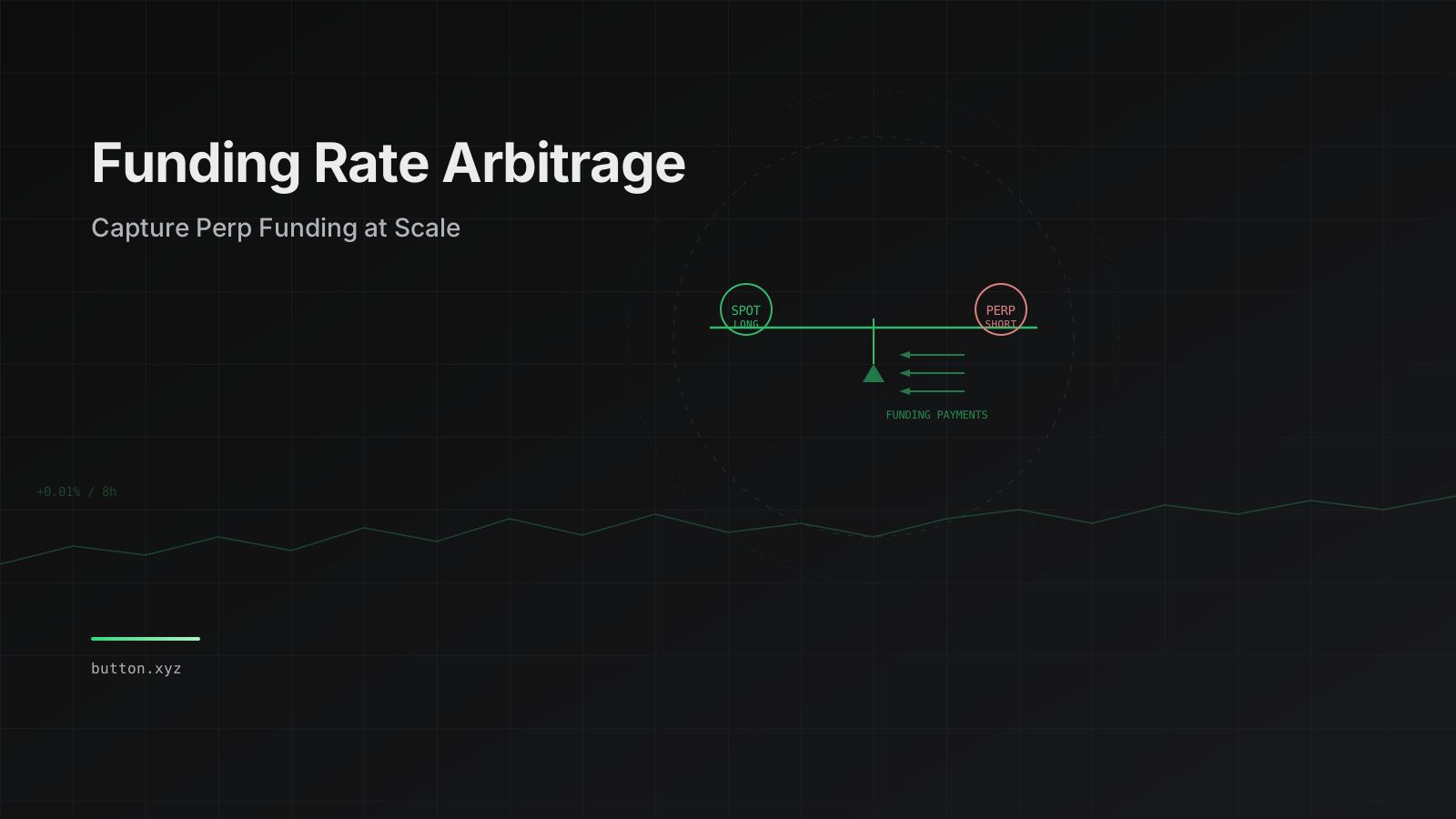
Funding rate arbitrage is the practice of holding a delta-neutral position across the spot and futures markets to capture periodic funding payments. It's not a bet on price direction. It's a bet on the structural imbalance between long and short positions in perpetuals.
When funding rates are positive (the standard state), longs pay shorts every 8 hours. If you're long spot and short the same amount in perpetuals, you pocket that spread three times a day. If rates flip negative (shorts pay longs), you're indifferent — your short perp position still profits.
What this is NOT: passive income, risk-free arbitrage, or a strategy that scales infinitely. The edge decays as more capital piles in. Funding rates compress. Execution costs eat margins. Liquidation risk is real.
What this IS: a systematic, quantifiable edge available to traders who can execute with discipline and low friction.
The Delta-Neutral Setup: Long Spot / Short Perp
The mechanics are simple. Hold equal notional amounts of:
- Long spot: You own Bitcoin, Ethereum, or another asset on the exchange
- Short perpetuals: A short position on the same asset in the perp market
The spot position never moves. It's collateral. The perp position is your income stream.
Example
- Buy 1 BTC at $95,000 (spot)
- Short 1 BTC worth of contracts at $95,000 (perps on Hyperliquid or equivalent)
- Net delta: zero
- Funding payment: 8 hours later, if funding is +0.01%, you collect $95
Every 8 hours, the cycle repeats. Three times a day, you get paid. No price movement needed.
The inverse setup works too: long perps, short spot. This applies when you don't own spot capital yet — you borrow it, execute the arbitrage, and return it. But borrowing costs eat the edge, so this is typically less attractive.
The Math: Converting Funding to Annualized Yield
This is where rigor matters. A 0.01% per-8-hour funding rate doesn't sound like much. But let's calculate the annualized yield.
Formula
- Daily funding rate = 8-hour rate × 3
- Annual funding rate = Daily rate × 365
- APR = (Annual funding rate / Initial capital) × 100
Worked example
- 8-hour funding = 0.01%
- Daily funding = 0.01% × 3 = 0.03%
- Annual funding = 0.03% × 365 = 10.95%
- If you deposit $100,000 and capture that rate, you earn $10,950 in funding payments over a year, before fees
But fees matter. You'll pay:
- Trading fees (maker/taker) on entry and exit: ~0.04–0.10% per leg
- Funding on your perp position: ~0.02% per day (if rates are negative)
- Borrow costs on spot: ~0.01–0.05% per year
- Rebalancing fees (if you drift from delta-neutral): ~0.02% per rebalance
Net result: an effective APR of 8–11% in high-rate environments, down to 2–4% in compressed environments. The variance is real.
Execution on Hyperliquid: Step-by-Step
Hyperliquid offers native perpetuals with tight funding rates and deep liquidity. Start with high-volume assets like BTC or ETH — here's the exact execution path:
Step 1: Fund your Hyperliquid account
- Send USDC or ETH to your Hyperliquid subaccount
- Ensure you have enough for spot purchase + perp margin
- Hyperliquid requires a 5–10x leverage buffer for safety
Step 2: Buy spot (if not already holding)
- On Hyperliquid spot, buy the asset you want to arbitrage (e.g., BTC, ETH)
- Buy at market or limit — speed matters more than 0.05% slippage here
- Confirm the spot holdings in your account
Step 3: Short the perp at identical notional
- Navigate to Hyperliquid perpetuals
- Open a short order equal in notional value to your spot holdings
- Use limit orders if liquidity is thin; slippage costs you directly
- Set your leverage at 2x max — you need margin cushion for liquidation protection
Step 4: Monitor funding and adjust
- Track the 8-hour funding rate on your dashboard
- Every 8 hours, your funding accrues automatically
- If your delta drifts (e.g., perp price moves more than 2%), rebalance by closing and re-opening positions
- Drift typically happens in volatile markets — manage it
Step 5: Exit when rates compress
- If funding drops below 0.005% per 8 hours, edge is thin
- Close perp short, sell spot
- Wait for rates to rise again, or redeploy capital
The full cycle takes 1–2 minutes of active work per day. A crypto trading bot does this automatically.
Funding Flips and Edge Decay: When the Edge Compresses
Here's the hard truth about funding arbitrage: the edge is never stable. It decays predictably.
Funding rates exist because longs and shorts are imbalanced. When funding is high, arbitrageurs flood in. More arbitrage capital means more shorts (to hedge spots), which rebalances the market. As shorts increase, funding pressure decreases. A 0.02% rate becomes 0.01%. Then 0.005%. Then it flips negative.
This is called edge decay, and it's the real constraint on the strategy.
Real example from March 2026
- BTC funding starts at +0.015% per 8 hours (13.7% APR)
- After 24 hours of arbitrage inflows, it drops to +0.008% (7.3% APR)
- After 72 hours, it's +0.003% (2.7% APR)
- It takes 2–3 weeks to rebuild to high rates again
Your capital, sitting in the arbitrage, earns 2.7% APR in the compressed phase. That's acceptable but not exciting. Most traders exit and redeploy elsewhere.
Funding flips (negative funding) are rare in normal markets but possible. If shorts suddenly dominate (e.g., a macro sell-off), funding flips and shorts pay longs. Your short perp position benefits, but that benefit is smaller than the long-rate income you lose.
The key: never assume funding is permanent. Budget for 70–80% of the initial rate. Build a redeployment plan.
Liquidation Risk and Position Management
This is where execution discipline separates profitable traders from liquidated ones.
A delta-neutral position should never liquidate. Your long spot and short perp cancel out. If BTC crashes 20%, your spot loses $20,000 but your short perp gains $20,000. Zero net loss. In theory.
The catch: margin. Hyperliquid prices both your spot and perp positions against your margin. If your account shrinks (from funding swings or fees), your liquidation ratio tightens.
Liquidation scenario
- You deposit $100,000
- Buy $95,000 of BTC, short $95,000 perp
- Your margin ratio: 100 / 95 = 1.05x (5% cushion)
- A 5% liquidation buffer is dangerously low
If you eat $5,000 in fees over 6 months, your margin erodes. Hyperliquid liquidates at ~2x leverage. You're now at 1.02x margin. A tiny adverse move liquidates you.
How to avoid it
- Maintain at least 10x leverage cushion (1.1x margin ratio)
- Deposit $110,000 to hedge a $95,000 position
- Withdraw funding profits quarterly; don't let them accumulate
- Set alerts if your margin ratio drifts below 1.15x
A crypto trading bot handles this automatically — it rebalances margin, sets alerts, and exits if liquidation risk rises.
Basis Risk and Slippage: The Hidden Costs
Basis is the difference between spot and perpetual prices. In a liquid market, basis is tiny (0.01–0.05%). But it's real.
Example
- You buy spot BTC at $95,000
- You short perp at $95,010 (slightly higher)
- Your basis: −$10, or −0.01%
- When you exit, the basis may have widened to −$50
- That's an extra $50 loss
Slippage compounds basis. If you're buying spot with a market order in a thin venue, you slip 0.05–0.10%. If you're shorting perps in Hyperliquid on a volatile day, you slip another 0.03%. Total entry slippage: 0.08–0.13%.
On a $100,000 position, that's $80–$130 in day-one losses.
How to minimize
- Use limit orders on entry (be patient, lose 5 minutes of funding to save 10 bps)
- Execute during high-liquidity windows (Asia open for BTC, US open for alts)
- Choose venues with tight spreads — Hyperliquid is excellent here
If slippage exceeds 0.15% on entry, cancel and wait for better conditions. The edge is thin enough that execution matters.
Why Automation Matters: The AI Agent Advantage
Manual arbitrage requires:
- Monitoring funding rates 3x daily
- Rebalancing if delta drifts more than 1–2%
- Withdrawing profits to avoid liquidation
- Exiting and re-entering when rates compress
- Watching for liquidation signals
For a single position, this is 20 minutes per day. For 10 positions across different pairs, it's a job.
An AI agent solves the friction problem. It:
- Monitors all positions in real time
- Rebalances automatically if delta drifts
- Withdraws profits to maintain margin safety
- Exits positions when rates drop below your threshold
- Alerts you to liquidation risk before it's critical
The agent also executes better slippage. Humans execute during market hours. Agents execute during low-vol windows. On a $100,000 deployment, that's 5–10 bps better execution per entry, or $500–$1,000 per year.
Deploy a trading bot on Hyperliquid and let it run the mechanical parts. You focus on allocation: which assets to arbitrage, when to accept lower rates, when to exit entirely.
For deeper context on funding mechanics and how perpetuals work, see our guide to perpetual futures and crypto trading bot guide.
FAQ
Can I do funding rate arbitrage on a borrowed spot position (short spot, long perp)?
Yes, but it's less attractive. Spot borrowing costs 1–5% annually, depending on the asset. That cost eats most of your funding edge. The traditional setup (long spot, short perp) is preferred because you own the collateral.
What happens if funding goes negative? Do I lose money?
No. If funding flips negative, shorts pay longs. Your short perp position benefits. The income stream just reverses — you're now profiting from your perp short, not from a long-rate capture. Your net return is typically lower, but still positive.
How much capital do I need to start?
Minimum $10,000 to make slippage and fees manageable. At that size, you capture ~$25–$50 per 8 hours in favorable conditions. Below $10,000, fees dominate. Institutional players start at $1M+.
Is there tax on funding payments?
Yes. In most jurisdictions, funding payments are treated as ordinary income, taxed at your marginal rate. In the US, that's income tax, not capital gains. Keep records of every funding payment. Your AI agent can auto-log them.
What if the perp exchange goes down? Is my position safe?
Hyperliquid is non-custodial and on-chain. Your spot collateral lives in your wallet. Perp positions are on-chain contracts. If the exchange's front-end goes down, your positions don't liquidate — they just can't be modified. If the exchange shuts down entirely, you can still withdraw your collateral on-chain. Risk is lower than centralized perpetuals (Binance, FTX), but not zero.
Can I hedge my funding arbitrage position with other strategies?
Yes. If you believe BTC will rise, you can long perps on a different venue while running arbitrage on Hyperliquid. Your arbitrage is delta-neutral, so it doesn't conflict. This lets you capture both funding income and directional upside. But now you're managing two positions — a crypto trading bot helps here too.
Risk Disclosure
Funding rate arbitrage involves significant risks. Perp trading involves substantial risk, and even delta-neutral positions liquidate if margin erodes below the exchange's threshold. Maintain a 10x leverage cushion minimum. The edge decays as capital piles in (budget for 50–70% of initial rates). Basis risk, exchange risk, slippage, and extreme price moves all threaten positions. This strategy is not risk-free arbitrage. It is a systematic, quantifiable edge that requires discipline and careful execution. Do not deploy capital you cannot afford to lose. This is not investment advice.