Crypto Funding Rates: Live Data and Guide
How crypto funding rates work across exchanges, what drives them, and how traders use funding data to find edge in perp markets.
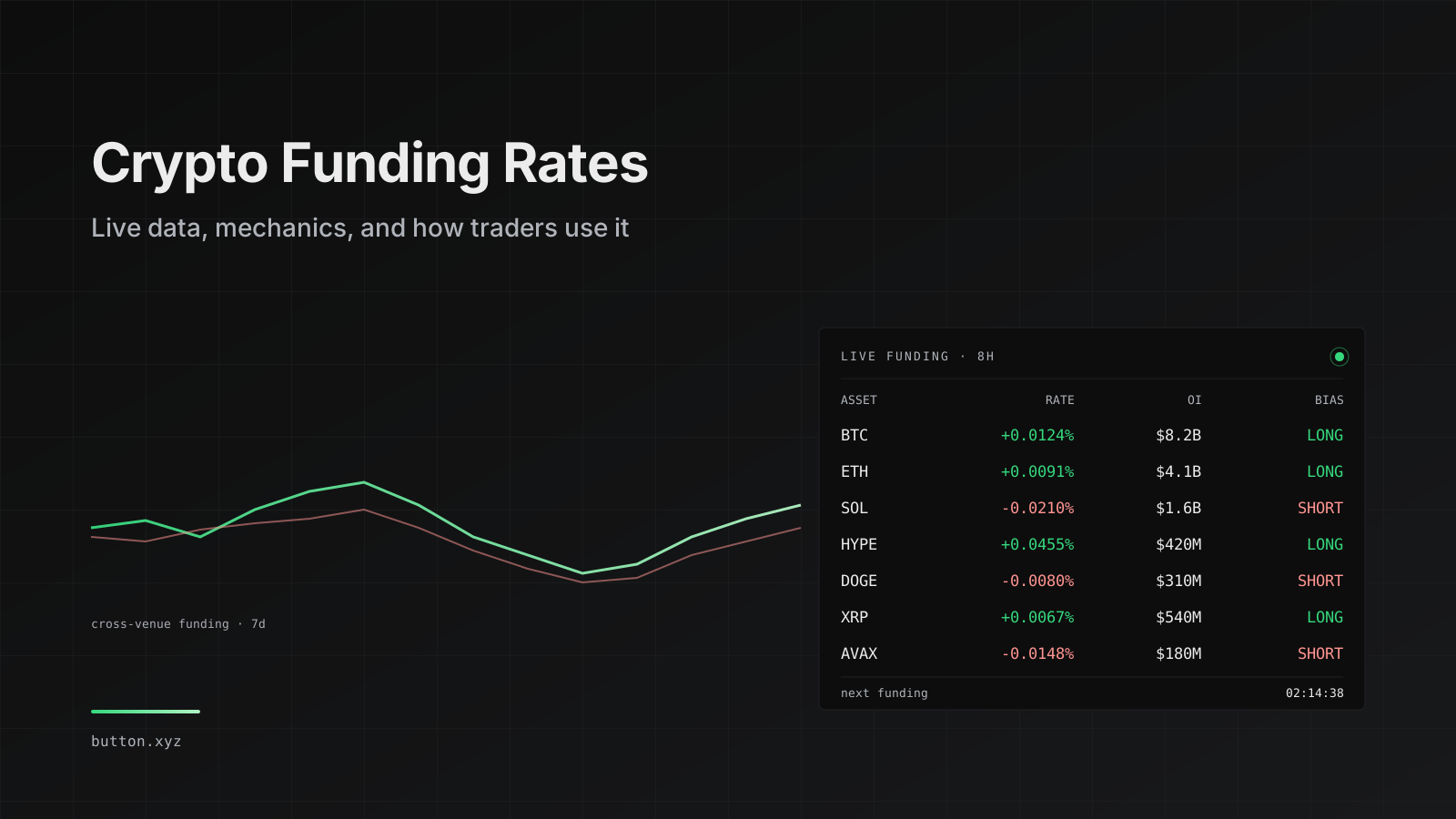
Funding rates are the single most useful real-time signal in crypto derivatives. They tell you which side of the market is crowded, how much leverage is deployed, and whether carry trades are paying. If you trade perpetual futures, monitoring funding rates across venues and assets is not optional — it's the foundation of any systematic edge.
This is the reference page for crypto funding rates: how they work, what drives them, how they vary across exchanges, and how traders use them for alpha generation.
For the detailed funding rate mechanics, see our funding rate deep dive. For carry strategy implementation, see funding rate arbitrage.
How Crypto Funding Rates Work
A funding rate is a periodic payment between long and short traders in a perpetual futures contract. The payment keeps the perp price tethered to spot. When the perp trades above spot (positive premium), longs pay shorts. When below spot, shorts pay longs.
The exchange doesn't collect this payment. It flows directly between traders. This is the critical distinction from exchange fees — funding is a peer-to-peer settlement.
Standard formula (8-hour settlement): Funding Rate = Premium Index + clamp(Interest Rate − Premium Index, −0.05%, 0.05%).
The Premium Index is the time-weighted average of (Perp Price − Spot Price) / Spot Price over the settlement period. The Interest Rate is typically 0.01% per period (negligible).
In practice, the Premium Index dominates. If the perp trades 0.03% above spot, the funding rate is approximately 0.03% — longs pay shorts 0.03% of their position notional every 8 hours.
Annualized calculation: A 0.03% per-8-hour funding rate equals 0.09%/day or ~32.8% annualized. This is the number that carry traders focus on — it tells you the yield for holding the funded side.
Reading Funding Rate Data
Funding rates convey three types of information:
Directional Bias
Positive funding = more longs than shorts (bullish crowding). Negative funding = more shorts than longs (bearish crowding). The magnitude tells you how extreme the imbalance is.
Normal range: ±0.01% per 8 hours (±3.6% annualized). Markets oscillate within this range during calm periods.
Elevated: 0.03–0.05% per period (11–18% annualized). Directional leverage is building. One side is paying the other meaningful carry.
Extreme: >0.05% per period (>18% annualized). Severe crowding. Liquidation cascades often follow within 24–72 hours. This is where carry trades become most profitable — and most dangerous.
Leverage Level
Funding rates correlate with total open interest and leverage usage. When funding spikes, it's usually because traders are opening large leveraged positions without sufficient counterparties on the other side. Tracking funding alongside OI trends gives you a more complete picture:
- Rising OI + rising positive funding: Long leverage increasing, distribution phase
- Rising OI + falling/negative funding: Short leverage increasing, accumulation phase
- Falling OI + elevated funding: Positions unwinding, volatility incoming
- Low OI + near-zero funding: Market dormant, range-bound trading
Cross-Asset Signals
Comparing funding rates across assets reveals where speculative capital is flowing. If BTC funding is 0.01% but SOL funding is 0.08%, leveraged speculation has rotated into SOL. This rotation signal often precedes price moves — when funding gets extreme on an alt, mean-reversion is statistically likely.
Funding Rates Across Exchanges
Funding rates differ across venues because each exchange has its own order book, its own trader base, and its own mark price methodology. These differences are tradeable.
Hyperliquid
Hyperliquid funding rates consistently run higher than centralized exchanges:
- BTC: 4–8% annualized (vs. 2–4% on Binance)
- ETH: 5–10% annualized (vs. 2–5% on Binance)
- Major alts (SOL, AVAX): 10–20% annualized
- Small-cap alts: 20–40% annualized on new listings
Why higher? Hyperliquid's lower depth means less capital absorbing directional flow. Fewer shorts on the book means longs pay more. Maker rebates (−0.02%) also attract liquidity providers who earn on top of funding, reinforcing the carry dynamic.
Settlement: every 8 hours, calculated from the time-weighted basis over the period.
Binance
Binance has the deepest order books, which generally compress funding rates:
- BTC: 2–4% annualized
- ETH: 2–5% annualized
- Major alts: 5–15% annualized
More depth means more shorts available to absorb long demand, keeping the premium tighter. Binance's larger retail base also adds noise — funding can spike briefly on retail FOMO events but reverts faster due to arb capital.
Settlement: every 8 hours.
dYdX
dYdX funding rates sit between Hyperliquid and Binance:
- BTC: 3–5% annualized
- ETH: 4–7% annualized
dYdX uses 1-hour funding settlements (compared to 8-hour on most venues), which creates faster funding rate adjustments and less extreme spikes.
Cross-Exchange Funding Arbitrage
When Hyperliquid BTC funding is 8% and Binance BTC funding is 2%, you can go long BTC perps on Binance (paying 2%) and short BTC perps on Hyperliquid (collecting 8%), capturing the 6% spread. This is cross-exchange funding arb.
The risks: you're long on one exchange and short on another, so margin management gets complex. If BTC moves sharply, one leg can get liquidated while the other profits — you need sufficient margin on both sides. Basis risk between the two exchanges (their mark prices may diverge) adds another variable.
Despite the complexity, cross-exchange funding arb is one of the most consistent strategies for traders with $100K+ across venues.
Historical Funding Rate Patterns
Funding rates follow predictable patterns tied to market cycles and events.
Bull Market Patterns (2021, Late 2024–2025)
During sustained uptrends:
- BTC funding averages 0.02–0.05% per 8 hours (7–18% annualized)
- Alt funding spikes to 0.1%+ per period during euphoria phases
- Funding peaks often precede local tops by 1–3 days
- After correction, funding resets to near-zero before the next leg up
Example: November 2024, BTC broke above $80,000 for the first time. Funding spiked to 0.08% per period (29% annualized) across major exchanges. Within 72 hours, a $2 billion long liquidation cascade dropped BTC 15%. Shorts who entered at peak funding captured both the carry income and the directional move.
Bear Market Patterns (2022, Early 2023)
During downtrends:
- Funding oscillates between slightly negative and slightly positive
- Extreme negative spikes (−0.05% or worse) signal short squeezes incoming
- Prolonged negative funding (days/weeks) indicates structural bearishness
- Open interest trends lower as both sides give up
Example: June 2022 post-Terra/Luna. BTC funding went negative for 14 consecutive days, averaging −0.02% per period. Longs collecting this carry earned ~7% annualized while BTC consolidated before the next leg down. The trade worked — until it didn't (3AC collapse triggered another cascade).
Event-Driven Spikes
Major events cause funding whiplashes:
- Fed rate decisions: Funding spikes 1–2 hours before announcements as traders position
- Exchange hacks/failures: Immediate negative funding spike as shorts pile in
- Protocol upgrades: Pre-event positive funding spike (longs accumulate), post-event reversion
- Large liquidation events: Funding inverts rapidly as the liquidated side evaporates
The pattern is consistent: events create directional crowding → crowding spikes funding → spike triggers reversion. The traders who profit are those positioned to collect carry at extreme funding, not those chasing the directional move.
Top Assets by Funding Rate
Funding rates vary dramatically across assets. As of recent data:
Lowest funding (most stable):
- BTC perp: 0.01–0.03% per period. BTC has the deepest liquidity, the most arb capital, and the tightest spreads. Funding stays compressed.
- Stablecoin pairs: Near-zero funding by design.
Moderate funding:
- ETH perp: 0.02–0.05% per period. Staking yield creates a funding floor. More volatile than BTC funding due to DeFi exposure.
- SOL perp: 0.02–0.06% per period. High ecosystem activity drives leveraged speculation.
Highest funding (most volatile):
- Meme coins (DOGE, PEPE, WIF): 0.05–0.15% per period during hype cycles. Retail leverage piles in; shorts are scarce.
- New listings on Hyperliquid: 0.10%+ per period in the first week. Price discovery and limited shorting create extreme funding.
- Narrative tokens (AI, DePIN, restaking): 0.05–0.10% during rotation events.
The highest-funding assets offer the most carry income but also the most basis risk. A meme coin that pays 0.10% per period can also gap 30% in an hour, wiping a short position. Size to the volatility, not to the yield.
Using Funding Rates for Trading
As a Sentiment Signal
Funding extremes signal positioning extremes. Use the 7-day moving average of funding as a regime indicator:
- 7-day avg > 0.03%: Market is leveraged long. Expect mean-reversion. Shorting has positive expected carry.
- 7-day avg < −0.01%: Market is leveraged short. Short squeeze risk elevated. Going long collects carry.
- 7-day avg near 0%: Neutral positioning. Direction depends on external catalysts.
As a Carry Trade
The simplest funding strategy: buy spot asset, short the perp at equal notional, collect positive funding. This is the basis trade — near-zero directional risk, pure carry income.
On Hyperliquid with BTC funding at 6% annualized, a $200,000 basis position (long $100K spot, short $100K perp) earns ~$12,000/year. With maker rebates on the short leg, effective yield is higher. Scale this across multiple assets and venues, and carry income becomes a meaningful portfolio return stream.
As an Arbitrage Signal
Cross-exchange funding differences are directly tradeable. When Hyperliquid ETH funding is 3x Binance's, the spread is wide enough for cross-venue arb. Monitor funding feeds from multiple exchanges and execute when the spread exceeds your transaction costs (funding accrual timing, margin costs, bridge/transfer friction).
FAQ
What is a good funding rate?
There's no universal "good" — it depends on your strategy. For carry traders, positive funding above 0.03% per period (11% annualized) makes basis trades worth executing. For directional traders, extreme funding (>0.05%) is a signal to fade the crowd. For market makers, stable funding around 0.01% indicates a calm market with predictable revenue.
Where can I check live funding rates?
Most exchanges display current and historical funding rates on their trading interface. Hyperliquid shows real-time funding on each pair's trading page and via the API. Aggregators like Coinglass compile cross-exchange funding data in a single dashboard. For programmatic access, Hyperliquid's WebSocket API streams funding rate updates in real-time.
Do I pay funding if I close before settlement?
On exchanges with 8-hour settlement (Binance, Hyperliquid), you only pay/receive funding if you hold through the settlement timestamp. Close before settlement and you avoid that period's funding. On exchanges with continuous funding (some newer protocols), you accrue funding pro-rata throughout your hold time.
Why do funding rates differ between exchanges?
Each exchange has its own order book, trader base, and mark price methodology. Hyperliquid's thinner depth and higher leverage caps create wider premiums and higher funding. Binance's deeper book compresses premiums. Institutional arb capital flows between exchanges to arbitrage these differences, but friction (bridge time, margin requirements) keeps the spreads from closing completely.
Can funding rates predict crashes?
Not definitively, but extreme positive funding (>0.05% per period for days) has historically preceded major corrections. The logic: extreme funding means extreme long leverage, which creates a pool of liquidations waiting to trigger. When the market dips, those liquidations fire, accelerating the move. Track funding alongside open interest — when both are at extremes, the probability of a sharp reversal increases.
Build Your Funding Rate Edge
Funding rates are the market's real-time report card on positioning and leverage. Reading them systematically — across assets, across venues, across time horizons — gives you information that most traders ignore because they're focused on price.
Automate funding rate strategies with the agent: the AI trading agent monitors funding rates across venues, identifies carry opportunities, and executes basis trades and cross-exchange arbs with automated position sizing and risk management. Connect wallet and let the agent turn funding data into systematic income.
Go deeper: Funding rates explained for the full mechanics. Funding rate arbitrage for strategy implementation. Perps trading playbook for broader strategy frameworks.