Liquidation Calculator for Crypto Perps
Calculate your liquidation price for perpetual futures. Understand margin, leverage, and how far price can move before your position gets liquidated.
Liquidation is the single biggest account killer in perpetual futures. A trader opens a leveraged position, the market moves against them, and the exchange force-closes the position before margin hits zero. It happens in seconds, often during the exact volatility spike the trader expected to profit from — just in the wrong direction first.
Knowing your liquidation price before you enter a trade is not optional. It's the first risk check. This page explains the math, walks through worked examples at every common leverage level, and covers the differences across venues like Hyperliquid and Binance.
How Liquidation Works
When you open a leveraged perpetual futures position, you deposit margin (collateral) and the exchange lends you the rest. If the market moves against you and your equity drops to the maintenance margin threshold, the exchange liquidates your position — selling it at market price to prevent your account from going negative.
The process:
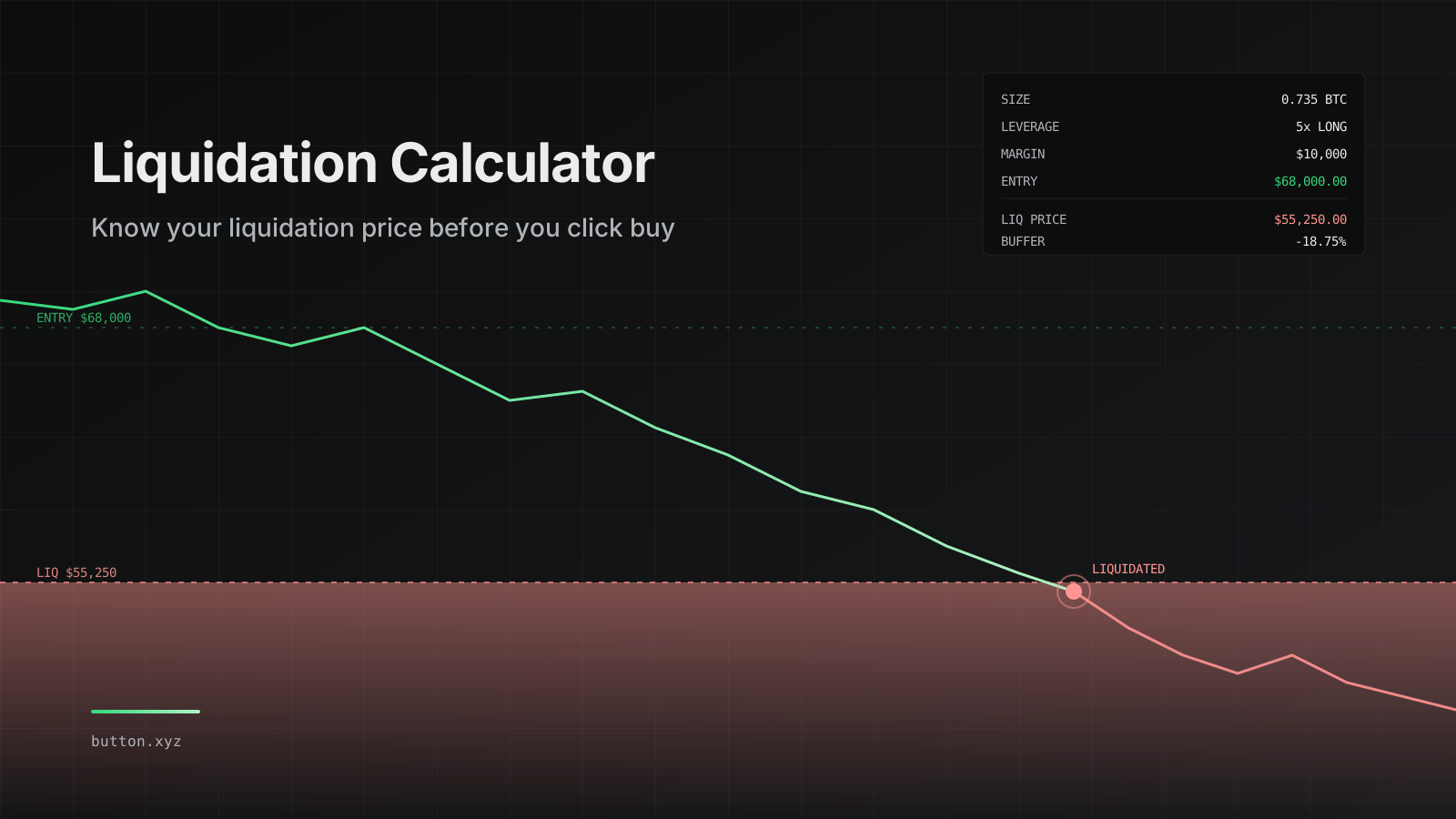
- You open a position. Deposit $10,000 margin, open a 5x long BTC at $68,000. Notional exposure: $50,000.
- Price moves against you. BTC drops to $55,000. Your unrealized loss: $50,000 × (($68,000 − $55,000) / $68,000) = $9,559.
- Equity check. Your equity = $10,000 − $9,559 = $441. If maintenance margin is $500 (1% of $50,000), you're below threshold.
- Liquidation triggers. The exchange closes your position immediately. You lose most or all of your $10,000 margin.
The liquidation engine doesn't wait for you to add margin or close manually. It's automated and instant. On Hyperliquid, liquidations are processed on-chain by the protocol's liquidation engine. On centralized exchanges, the matching engine handles it internally.
The Liquidation Price Formula
For a long position:
Liquidation Price = Entry Price × (1 − Initial Margin Rate + Maintenance Margin Rate)
For a short position:
Liquidation Price = Entry Price × (1 + Initial Margin Rate − Maintenance Margin Rate)
Where:
- Initial Margin Rate = 1 / Leverage (e.g., 5x leverage = 20% initial margin)
- Maintenance Margin Rate = the minimum equity percentage required (varies by exchange and position size)
Maintenance Margin by Exchange
Hyperliquid:
- BTC/ETH: 0.5% for positions under $1M notional, scaling up for larger positions
- Major alts: 1% base
- Small-cap alts: 2–5% base
Binance:
- BTC: 0.5% for Tier 1 (up to $500K), scaling to 5% at $50M+
- ETH: 0.5% base, similar tiered scaling
- Alts: 1–2.5% base depending on pair
The maintenance margin rate directly affects your liquidation price. A 0.5% rate gives you slightly more room than a 2% rate at the same leverage.
Worked Examples: Every Common Leverage Level
All examples assume: Long BTC at $68,000, maintenance margin rate of 1%.
2x Leverage (50% initial margin)
- Margin deposited: $34,000
- Notional: $68,000
- Liquidation price: $68,000 × (1 − 0.50 + 0.01) = $68,000 × 0.51 = $34,680
- Buffer: 49% below entry
- Daily risk (BTC ~3% daily vol): Extremely safe. Would take a historic crash to liquidate.
3x Leverage (33.3% initial margin)
- Margin deposited: $22,667
- Notional: $68,000
- Liquidation price: $68,000 × (1 − 0.333 + 0.01) = $68,000 × 0.677 = $46,036
- Buffer: 32.3% below entry
- Daily risk: Very safe for swing trades. Can hold through multi-week drawdowns.
5x Leverage (20% initial margin)
- Margin deposited: $13,600
- Notional: $68,000
- Liquidation price: $68,000 × (1 − 0.20 + 0.01) = $68,000 × 0.81 = $55,080
- Buffer: 19% below entry
- Daily risk: Moderate. BTC can drop 19% in a bad week. Requires active monitoring.
10x Leverage (10% initial margin)
- Margin deposited: $6,800
- Notional: $68,000
- Liquidation price: $68,000 × (1 − 0.10 + 0.01) = $68,000 × 0.91 = $61,880
- Buffer: 9% below entry
- Daily risk: High. BTC drops 9% regularly during corrections. A single bad day can liquidate.
20x Leverage (5% initial margin)
- Margin deposited: $3,400
- Notional: $68,000
- Liquidation price: $68,000 × (1 − 0.05 + 0.01) = $68,000 × 0.96 = $65,280
- Buffer: 4% below entry
- Daily risk: Extreme. BTC moves 4% on a normal volatile day. Scalp-only, never hold overnight.
50x Leverage (2% initial margin)
- Margin deposited: $1,360
- Notional: $68,000
- Liquidation price: $68,000 × (1 − 0.02 + 0.01) = $68,000 × 0.99 = $67,320
- Buffer: 1% below entry
- Daily risk: Near-certain liquidation on any timeframe beyond minutes. One tick of slippage can end the position.
The Sigma Framework for Sizing
Professional traders don't pick leverage arbitrarily. They size positions so the liquidation price sits outside a statistical probability threshold.
The rule: Your liquidation price should be at least 3 standard deviations (3σ) from current price based on daily volatility.
For BTC with ~3% daily implied volatility:
- 1σ = 3% ($2,040 at $68,000)
- 2σ = 6% ($4,080)
- 3σ = 9% ($6,120)
- 5σ = 15% ($10,200)
A 3σ buffer means your liquidation price is $61,880 or lower — which corresponds to approximately 10x leverage or less. A 5σ buffer puts liquidation at $57,800 — roughly 6x leverage.
For ETH at ~4–5% daily vol, the same 3σ framework means keeping leverage under 7x. For altcoins at 8–10% daily vol, safe leverage drops to 3–4x.
This framework explains why professional perps traders rarely exceed 5x for positions held longer than a few hours. The math doesn't support it.
Cross-Margin vs. Isolated Margin and Liquidation
Your margin mode directly affects liquidation behavior.
Isolated margin: Each position has its own margin. If your BTC long gets liquidated, only the margin allocated to that position is lost. Your ETH position and remaining account balance are untouched.
Cross-margin: Your entire account balance serves as margin for all positions. This means positions are harder to liquidate (more collateral backing them), but a liquidation on one position can drain your entire account.
On Hyperliquid, cross-margin is the default. On Binance, you can choose per position.
Practical impact on liquidation price:
- Isolated at 10x: Liquidation if BTC drops 9% (only position margin at risk)
- Cross at 10x with $50,000 account: Liquidation at a much larger drop (entire account backs the position), but if liquidation does trigger, you lose everything
Most professional traders use cross-margin for correlated positions and isolated margin for high-conviction asymmetric bets.
Liquidation Cascades
Individual liquidations are a personal problem. Cascading liquidations are a market structure problem.
When a large leveraged position gets liquidated, the exchange dumps the position at market price. This pushes the price further in the direction of the liquidation, triggering other traders' liquidation prices. Each liquidation feeds the next.
Example: BTC drops 3% from $68,000 to $65,960. Traders at 20x leverage (liquidation at $65,280) get wiped. Their liquidated positions sell into the market, pushing BTC to $64,500. Now 15x traders ($63,733 liquidation) are in the zone. Their liquidations push it to $62,000. The cascade continues until either buying absorbs the flow or leverage is fully flushed.
On Hyperliquid, the insurance fund absorbs liquidation shortfalls. On centralized exchanges, auto-deleveraging (ADL) can clip profitable positions to cover losses. Understanding which mechanism your venue uses matters when cascades hit.
Defense against cascades:
- Keep liquidation price 3–5σ from current price
- Avoid adding to losing positions (tightens your buffer)
- Reduce leverage during high-OI, high-funding environments (cascade preconditions)
- Don't trade during low-liquidity hours (2–6 AM UTC) when cascades run further
Funding Rate Impact on Liquidation
Funding rates slowly erode your margin over time, pulling your effective liquidation price closer.
If you're long BTC at 5x and funding is 0.05% per 8 hours (positive — longs pay shorts), you pay 0.15%/day on your notional position. On a $68,000 notional, that's $102/day deducted from your margin.
Over 10 days: $1,020 gone from your margin. Your effective margin drops from $13,600 to $12,580, tightening your liquidation buffer from 19% to ~17.5%.
Over 30 days at elevated funding, your buffer can shrink by 3–5 percentage points without the price moving at all. This silent margin erosion liquidates over-leveraged traders who "held through the dip" but forgot about funding costs.
Always factor cumulative funding into your liquidation math, especially for positions held longer than 48 hours.
FAQ
What is a liquidation price?
The price at which your exchange force-closes your leveraged position because your equity has dropped to the maintenance margin threshold. For a long, it's below your entry. For a short, it's above. The exact price depends on your leverage, entry price, and the exchange's maintenance margin requirements.
Can I avoid liquidation by adding more margin?
Yes — adding margin increases your equity and pushes your liquidation price further away. On Hyperliquid and Binance, you can add margin to an open position at any time. But chasing a losing position with more margin is how traders turn a 20% loss into a 100% loss. Only add margin if your thesis is intact and you sized the original position too aggressively.
Do I owe money after liquidation?
On most platforms, no. Liquidation closes your position before equity reaches zero. The insurance fund covers any shortfall. You lose your deposited margin but don't have a negative balance. Exception: on some poorly designed venues, socialized losses or auto-deleveraging can affect other positions.
Why was I liquidated even though price came back?
Because liquidation is irreversible. If BTC drops to your liquidation price for even one second — due to a wick, cascade, or low-liquidity slippage — the position is closed. It doesn't matter that price recovered 5 minutes later. This is why buffer matters more than direction.
What leverage should beginners use?
Start at 2–3x. This gives a 30–49% buffer before liquidation, which is enough to survive normal volatility and learn how the mechanics work without catastrophic losses. Many experienced traders never exceed 5x for swing positions.
Size Positions, Not Leverage
The liquidation calculator isn't a planning tool — it's a survival tool. Every leveraged position carries a price at which you lose everything. Knowing that number before entry, and sizing your position so it's statistically unlikely to hit, is the foundation of risk management.
Run a perp strategy with the agent: the AI trading agent calculates liquidation prices, sizes positions to your volatility tolerance, and monitors margin health in real-time — so you never get surprised by a cascade.
Go deeper: Perps trading playbook for position sizing frameworks. How to trade perps for execution basics.