AI Risk Management for Crypto Trading
How AI-driven risk management protects crypto portfolios — dynamic sizing, liquidation prevention, correlation monitoring, and drawdown control.
Most traders focus on entries. The ones who survive focus on risk management. In perpetual futures trading, the difference between a profitable year and a blown account is rarely about picking the right direction — it's about controlling position size, managing liquidation buffers, cutting losses, and maintaining the ability to trade tomorrow after today goes wrong.
AI adds a dimension to risk management that no manual process or static rule set can match: continuous, multi-factor, adaptive monitoring across every position simultaneously. A human trader can check their leverage once a day. An AI risk engine evaluates portfolio risk every minute — adjusting, warning, and intervening before drawdowns become disasters.
The Risk Hierarchy
Risk management isn't one thing. It's a layered system where each layer catches what the previous one misses:
Layer 1: Position-Level Risk
The most granular layer — each individual position has its own risk parameters.
Liquidation buffer monitoring. Every open perpetual position has a liquidation price. The distance between the current price and the liquidation price is the buffer. AI monitoring tracks this buffer in real time across all positions and triggers alerts or automatic deleveraging when the buffer compresses.
Static approach: Set a mental note — "my liquidation is at $58,000" — and check the dashboard occasionally.
AI approach: Continuous monitoring of the liquidation buffer as a percentage of entry price. When buffer falls below 25%, the system alerts. Below 15%, it automatically reduces position size by 30-50%. Below 10%, it closes 80% of the position. These thresholds adjust based on current volatility — in low-vol periods, tighter buffers are acceptable. In high-vol periods, wider buffers are required.
Dynamic stop losses. Traditional stops are fixed — "close at $65,000." AI stops adjust to volatility. When BTC daily range is $1,500, a $2,000 stop provides 1.3x ATR (average true range) buffer. When daily range expands to $4,000 (during a vol spike), that same $2,000 stop sits at 0.5x ATR — almost guaranteed to get hit by noise. The AI widened the stop to $5,000 (1.25x ATR) three hours ago when volatility started expanding.
Take-profit adjustment. Symmetrically, take-profit targets adjust to market conditions. In a trending market, partial take-profits at 1:1 and 2:1 risk-reward let winners run. In a range-bound market, tighter take-profits at 0.5:1 to 1:1 capture frequent small gains.
Layer 2: Portfolio-Level Risk
Individual positions might each look fine while the portfolio as a whole is dangerously exposed.
Correlation monitoring. If you're long BTC, ETH, SOL, and AVAX perps — that's four "different" positions that move together. During a crash, they all drop simultaneously. Your "diversified" four-position portfolio behaves like one massive, leveraged long.
AI correlation monitoring calculates rolling 7-day correlations between all open positions. When correlation spikes above a threshold (e.g., 0.8 across 3+ positions), the system reduces the most redundant position. This keeps portfolio-level risk aligned with actual diversification, not nominal position count.
Net directional exposure. Across all positions, what's the net long or short exposure? A portfolio with $100K in long perps and $30K in short perps has $70K net long exposure. The AI tracks this in real time and alerts when net exposure exceeds configurable limits.
This matters for hedging: If you run a delta-neutral carry trade alongside a directional momentum strategy, the AI ensures the momentum leg doesn't grow so large that it overwhelms the carry trade's neutrality. Total portfolio delta should match your intended risk profile.
Sector concentration. Beyond asset correlation, the AI monitors sector exposure. Long BTC + long ETH + long SOL is concentrated in L1 tokens. Adding an L1 governance proposal short or a DeFi sector position adds genuine diversification. The system tracks sector tilts and suggests or enforces diversification when concentration exceeds limits.
Layer 3: Drawdown Management
The single most important risk management function. Drawdown management determines whether a losing streak is an inconvenience or a career-ending event.
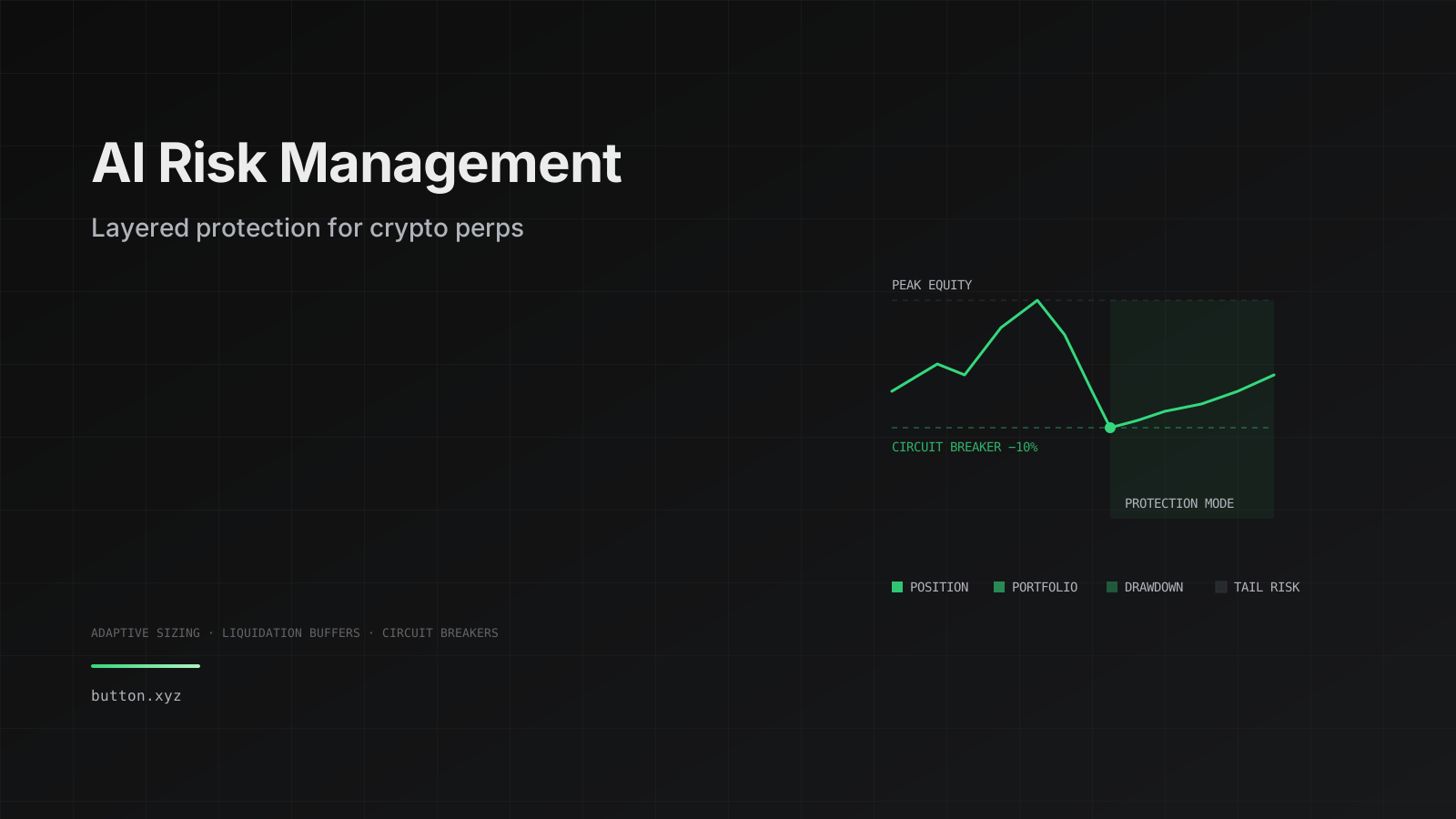
Rolling drawdown circuit breaker. If the portfolio declines more than a configured percentage from its peak equity (e.g., 10%), the system enters "protection mode":
- All positions reduce by 50%. This halves ongoing risk immediately.
- No new positions can be opened. Capital preservation takes priority over opportunity capture.
- Leverage ceiling drops. Maximum allowed leverage reduces by half.
- Recovery period. The system remains in protection mode until equity recovers to within 5% of the peak, or until a configurable cooldown period expires.
Why this matters: Without a circuit breaker, a losing trader often increases risk — doubling down, moving stops, adding leverage — trying to recover losses. This turns a 10% drawdown into a 30% drawdown into a blown account. The automated circuit breaker removes human emotion from the worst-case scenario.
Kelly criterion sizing. The AI uses a modified Kelly criterion to determine maximum position size based on historical win rate and average win/loss ratio. If recent performance shows a 60% win rate with 1.5:1 average win/loss, Kelly suggests betting approximately 15% of capital per trade. The system uses fractional Kelly (usually 0.25-0.5x Kelly) for additional conservatism.
As performance degrades (win rate drops, loss sizes increase), Kelly automatically reduces position sizing. This creates a natural deceleration mechanism — the system takes smaller positions during losing streaks and larger positions during winning streaks, which is the opposite of what emotional traders do.
Layer 4: Tail Risk Protection
The first three layers handle normal market conditions. Layer 4 handles extreme events — the 5-sigma moves that shouldn't happen but do.
Flash crash detection. When price drops more than 5% in under 5 minutes, the AI system enters emergency mode. All limit orders are cancelled (preventing fills at extreme prices), all stop-losses tighten to prevent gap-through losses, and new order submission is paused until volatility subsides.
Funding rate anomaly detection. When funding rates swing to extreme levels (0.5%+ per period, or deep negative), something abnormal is happening. The system reduces exposure on the affected pair and alerts the trader. Extreme funding often precedes liquidation cascades or market manipulation events.
Exchange-level monitoring. Track Hyperliquid system status, API latency, and order book depth. If API latency spikes above 5 seconds, or if order book depth drops below normal levels, the system reduces exposure. Infrastructure problems can prevent you from exiting positions when you need to.
Cross-exchange divergence. When the BTC price on Hyperliquid diverges from Binance by more than 0.5%, something is wrong with one venue's price discovery. The system alerts and reduces position sizes until the spread normalizes.
AI vs Rule-Based Risk Management
Static rules work. Simple stops, fixed leverage limits, and position size caps prevent most blowups. But they have blind spots that AI covers:
| Risk Factor | Static Rules | AI-Enhanced |
|---|---|---|
| Position sizing | Fixed % per trade | Adaptive (Kelly, volatility-scaled) |
| Stop losses | Fixed price levels | Dynamic (ATR-adjusted, volatility-aware) |
| Liquidation buffer | Check manually | Continuous monitoring, auto-deleverage |
| Correlation | Not monitored | Real-time cross-position analysis |
| Drawdown response | None (or manual) | Automated circuit breaker with recovery protocol |
| Regime adaptation | Same rules always | Adjusts parameters to market conditions |
| Flash crash | Same stops | Emergency mode with order cancellation |
| Multi-asset | Each position independent | Portfolio-level aggregate risk view |
The AI advantage isn't replacing good rules — it's adapting them to changing conditions and monitoring across dimensions that humans can't track simultaneously.
Implementation on Hyperliquid
Hyperliquid's architecture supports AI risk management particularly well:
Cross-margin with risk monitoring. Hyperliquid's cross-margin mode lets the AI engine manage a unified margin pool across all positions. The system allocates margin dynamically — increasing buffer for volatile positions, releasing margin from stable positions.
Post-only maker execution. When the risk engine needs to reduce a position, it routes through post-only limit orders at favorable prices rather than market-selling into the book. On a $100K position reduction, this earns approximately $20 in maker rebates versus paying $50 in taker fees — a $70 difference per risk management action.
API-level monitoring. The Hyperliquid API provides real-time position data, funding rate feeds, and order book snapshots. The risk engine processes this data continuously without manual intervention.
Account-level risk parameters. Hyperliquid allows setting maximum leverage per account. The AI system uses this as a hard ceiling that even software bugs can't exceed — a defense-in-depth approach where the exchange itself enforces the outermost risk limit.
Configuring Your Risk Framework
Risk parameters should reflect your personal risk tolerance, capital, and strategy:
Conservative (capital preservation priority):
- Maximum portfolio leverage: 2x
- Drawdown circuit breaker: 7%
- Minimum liquidation buffer: 30%
- Maximum per-asset exposure: 25%
- Kelly fraction: 0.25x
Moderate (balanced growth and protection):
- Maximum portfolio leverage: 3x
- Drawdown circuit breaker: 10%
- Minimum liquidation buffer: 20%
- Maximum per-asset exposure: 35%
- Kelly fraction: 0.35x
Aggressive (return maximization with guardrails):
- Maximum portfolio leverage: 5x
- Drawdown circuit breaker: 15%
- Minimum liquidation buffer: 15%
- Maximum per-asset exposure: 45%
- Kelly fraction: 0.5x
Even the aggressive profile has hard limits. The AI operates within these constraints — it can suggest allocations up to the limits but can't exceed them. The difference between profiles is how much room the AI has to maneuver, not whether it has guardrails.
FAQ
Can AI prevent all losses?
No. Risk management reduces the size and frequency of large losses — it doesn't eliminate losses entirely. Trading is inherently uncertain. The goal is ensuring that no single loss or losing streak threatens your ability to continue trading.
What if the AI risk system itself fails?
Defense in depth. The AI risk layer is one of multiple layers. Exchange-level position limits (hard leverage caps on Hyperliquid), account-level margin monitoring, and deterministic stop-loss orders all function independently. If the AI layer goes offline, the other layers still protect your capital.
Is AI risk management worth it for small accounts?
Yes, proportionally. A $5,000 account benefits from the same risk principles as a $500,000 account — position sizing, drawdown limits, and liquidation buffer monitoring. The AI implementation automates what a disciplined trader should do manually.
How does this compare to just using stop losses?
Stop losses protect individual positions. AI risk management protects the portfolio — correlations, aggregate exposure, drawdown trajectory, and regime-appropriate sizing. Stop losses are one component. A full risk framework has 10+ components working together.
Protect the Capital, Capture the Returns
Returns are what traders chase. Risk management is what keeps them trading. The AI risk layer doesn't constrain returns — it ensures you're still in the market to capture them after the inevitable bad days. Continuous monitoring, adaptive sizing, and automated circuit breakers turn risk management from an afterthought into a structural advantage.
Deploy risk-managed strategies with the agent: the AI trading agent runs carry, grid, and directional strategies on Hyperliquid inside a multi-layer risk framework — adaptive sizing, liquidation buffer monitoring, drawdown circuit breakers, and correlation-aware portfolio management.
Related: Liquidation calculator for liquidation mechanics. Isolated vs cross margin for margin mode selection. AI perp trading bot for the automation framework.