The Case for Growing the Equity Perps Market
The stock market is the deepest pool of capital in human history, and it still keeps banker's hours. Weekly equity-perp volume grew 5.7× in four months this year — and it's still a rounding error next to what it should be. The case for building the market that finishes what traditional finance started.

The stock market is the deepest pool of capital in human history, and it still keeps banker's hours. Nine-thirty to four, Monday through Friday, closed on Presidents' Day. Meanwhile, the perpetual future — the simplest, most liquid derivative crypto ever produced — trades around the clock, around the world, and settles without anyone asking your zip code. Putting equities inside that wrapper is one of the most obvious ideas in markets right now. It's also one of the most underbuilt.
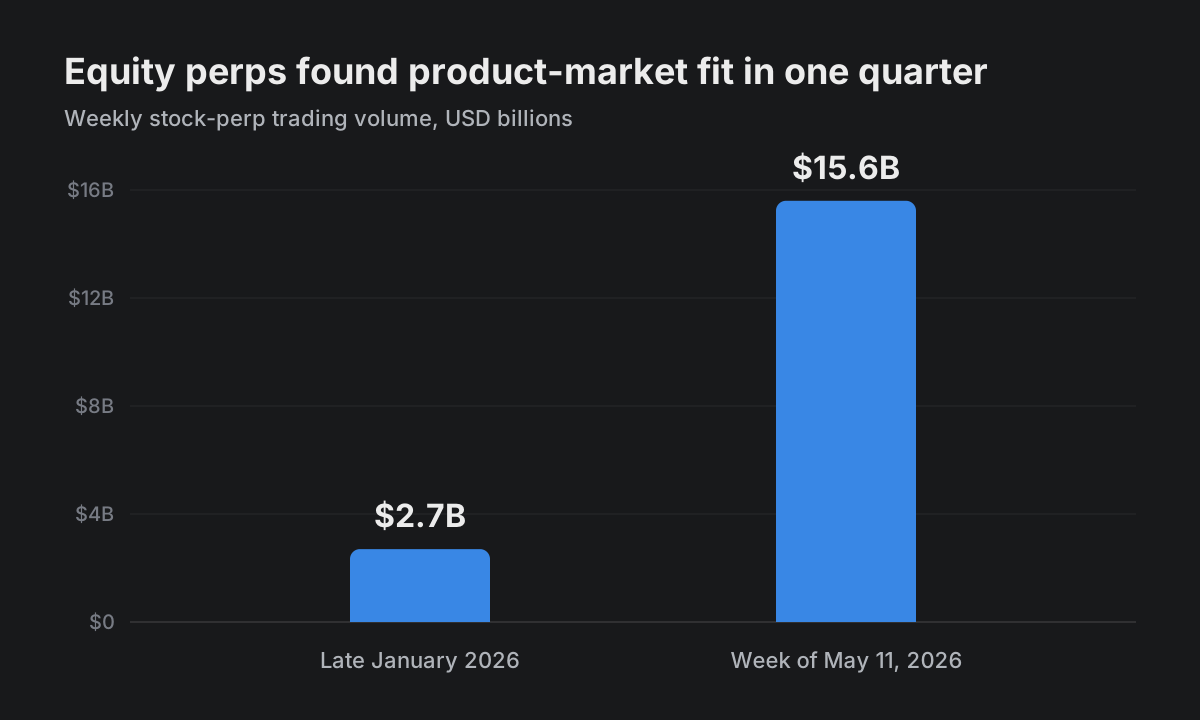
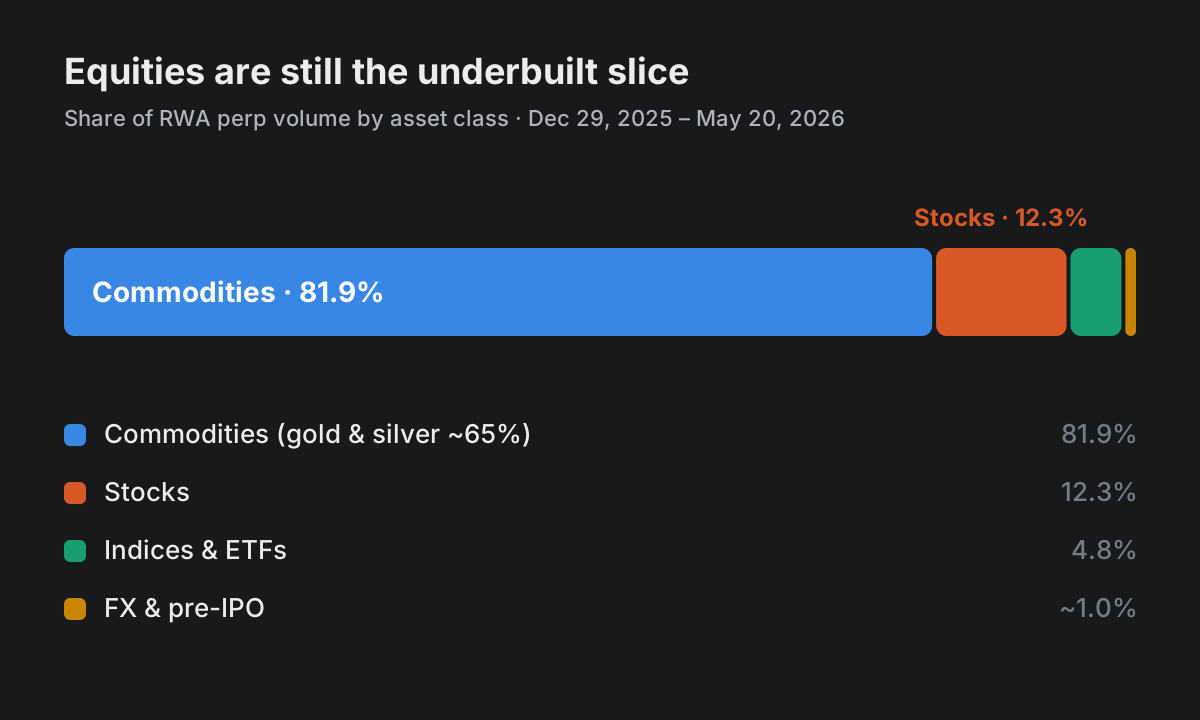
The early numbers say the demand is real. Weekly volume in equity perps grew roughly 5.7x in four months this year — from about $2.7 billion in late January to $15.6 billion by mid-May. Stocks went from around 5% of the real-world-asset perps category to 28% over the same stretch, and the category as a whole is running about $46 billion a week across venues, with Hyperliquid's HIP-3 markets alone clearing $119 billion cumulative. Nobody marketed this into existence. Traders found it because it solved problems the traditional stack refuses to solve.
| Metric | Value | Note |
|---|---|---|
| Weekly equity-perp volume | $15.6B | ↑ 5.7× in four months |
| Stocks' share of RWA perps | 28% | ↑ from 5% in January |
| RWA perps, weekly (all venues) | $46B | 17 venues, 4-wk avg |
| Hyperliquid HIP-3, cumulative | $119B | 14.5% of category |
Dec 29, 2025 – May 17, 2026 · Source: CoinMarketCap Research, "RWA Perpetuals: State of the Market," May 2026.
Start with the most basic problem perps solve: time. NVDA reports earnings at 4:20pm Eastern and the stock gaps 8% before most people are allowed to touch it. If you hold cash equities, your only move is to watch. With a perp, you can hedge at 4:21, or at 2am on Sunday when a tariff headline drops. Markets don't stop producing information when the exchange closes; the exchange just stops letting you act on it. Perps close that gap, and "you can manage risk whenever risk shows up" should not be a controversial product feature in 2026.
Then there's access. If you're a 24-year-old in Lagos or Jakarta or Karachi, owning U.S. equities means navigating a broker that may not serve your country, FX conversion, custody friction, and account minimums. The S&P 500 has been the best-performing large asset class of the modern era, and most of the world participates in it approximately never. A perp is just a price and a funding rate. It gives anyone with a stablecoin balance exposure to American equity performance — long or short — without asking permission from a legacy intermediary that was never going to grant it anyway.
Shorting deserves its own mention. In the traditional market, expressing a negative view means locate requirements, borrow fees, margin approval, and the occasional squeeze engineered by the borrow desk itself. On a perp, a short is symmetrical with a long. That's not a loophole; that's what honest price discovery looks like. The same logic extends to companies that don't trade at all — SpaceX perps already exist, giving the market a live price on the most valuable private company in the world years before any IPO. That price is information, and the world is better off with it than without it.
Now, the honest part — because the case for growing this market is not the case for pretending it's finished. Most equity perps today ignore dividends and corporate actions, which bakes structural premiums and discounts into the contracts. Oracle latency around earnings prints is a real attack surface. And single-name equity derivatives sit closer to securities law than anything crypto has shipped at scale, which means the regulatory surface area is growing exactly as fast as the volume is. If someone tells you these are solved problems, they're selling you something.
But these are engineering and policy problems, not reasons to leave the market small. And the policy door is opening: in May, the CFTC formally approved the first U.S.-listed perpetual future — a bitcoin contract on a regulated exchange — and said perpetual structures can fit inside the existing framework when properly built. The distance between "regulated bitcoin perp" and "regulated equity perp" is real, but it's a distance, not a wall. The right response is to build toward it: contracts that handle dividends correctly, oracles hardened for earnings volatility, venues that want surveillance rather than tolerate it.
Here's the thing about the current $15 billion a week: it's a rounding error. U.S. equity options alone trade multiples of that every day. Which means we're not looking at a mature market — we're looking at the first four months of one. Every structural advantage perps brought to crypto — always-on trading, symmetrical shorting, capital efficiency, global reach — applies at least as well to equities, on a vastly larger base of underlying assets that people actually understand.
The stock market's hours were set by the constraints of a trading floor in lower Manhattan. Those constraints are gone. The infrastructure to trade the world's best companies continuously, globally, and in both directions now exists and is compounding fast. Growing the equity perps market isn't a bet against traditional finance. It's finishing the job traditional finance started — and doing it on rails that never close.
Data: CoinMarketCap Research, "RWA Perpetuals: State of the Market" (May 2026); Crypto.com Research, "Equity and Commodity Perpetuals" (Jan 2026); Proskauer, "Opening the Door to Perps: The CFTC Approves U.S.-Listed Perpetual Futures" (2026).