How SpaceX's Lockup Ladder Could Reshape the September 2026 Nasdaq-100 Rebalance
SpaceX is already in the Nasdaq-100. The September question is whether its expanding float raises its index share count — and whether that passive bid can absorb 1.55 billion newly sellable shares. Mid-case: roughly $4.9 billion of forced buying, against a supply pool where a 2% sell-through cancels it out.
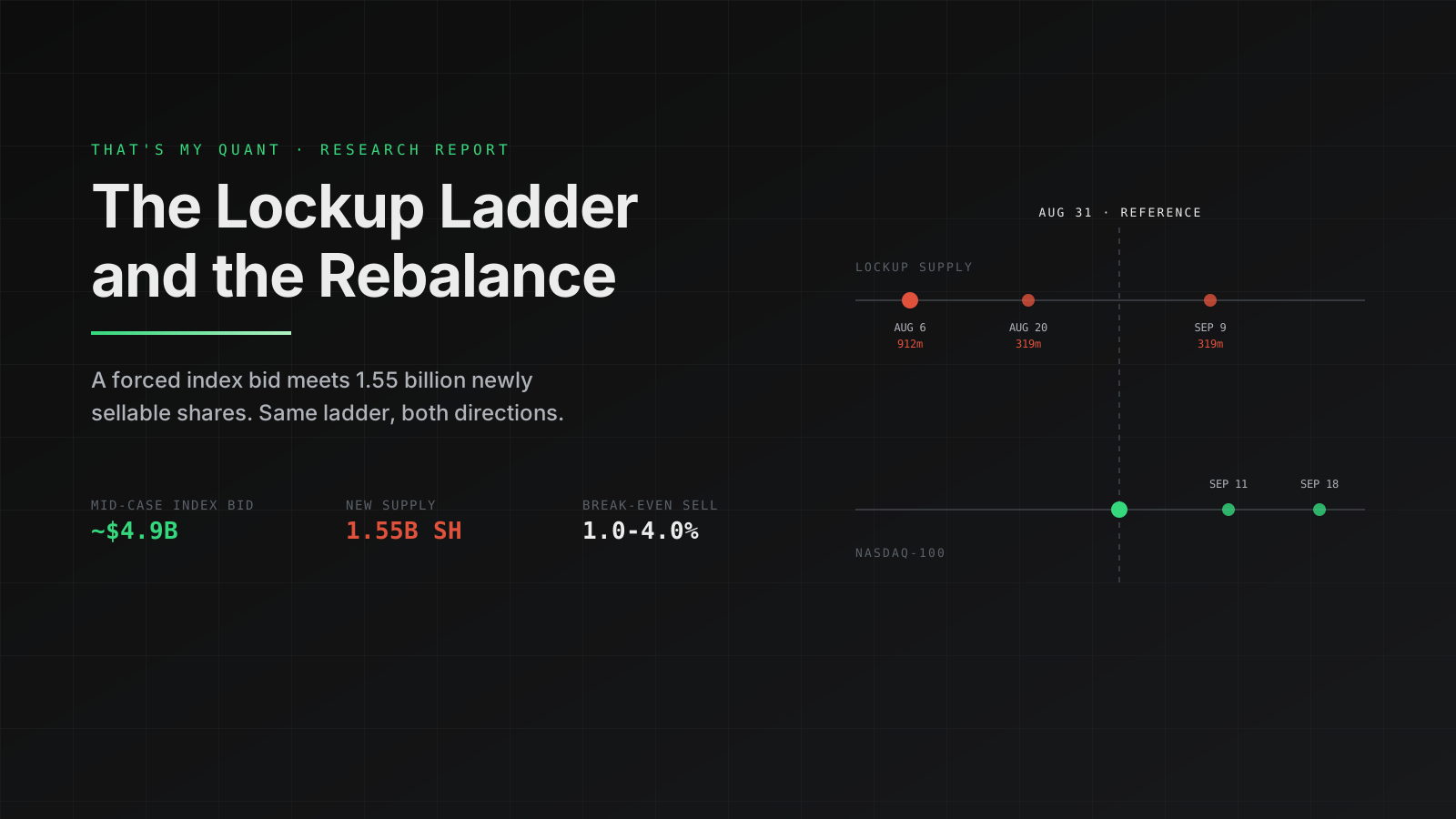
Forward-looking event study and scenario analysis. Prepared August 19, 2026. This is research, not investment advice.
SpaceX's $SPCX September index event is not another inclusion trade. The company is already in the Nasdaq-100. The new question is whether its rapidly expanding public float will cause Nasdaq to increase the number of SpaceX shares represented in the index at the September quarterly rebalance — and whether that passive demand will be large enough to absorb selling by newly unlocked shareholders.
The timing makes this unusually interesting. Approximately 911.5 million shares became eligible for sale after SpaceX's second-quarter results on August 6. A further 319.0 million shares are scheduled to unlock on August 20, before Nasdaq's August 31 rebalance reference date. Another 319.0 million shares unlock on September 9, after the reference date but before the September 18 implementation close.
That creates a split event. The August releases may increase SpaceX's recognized free float and therefore its Nasdaq-100 weight. The September 9 release can increase tradable supply without necessarily being reflected in the September index calculation. In short, the lockup creates both the forced bid and the potential offer.
Under a mid-case assumption that Nasdaq recognizes half of the August-unlocked shares as free float, this analysis estimates SpaceX's Nasdaq-100 weight could rise from roughly 0.65% to 1.27%. Against more than $800 billion of Nasdaq-100-linked assets, that implies approximately $4.9 billion of incremental benchmark demand, equal to about 34 million shares at a reference price of $143.87.
The range is wide. If Nasdaq recognizes only 25% of the August releases, modeled demand falls to about $2.5 billion. At 100% recognition, it rises to about $9.8 billion. Those figures are scenarios, not a forecast of the official pro forma. The decisive variable is not how many shares are legally unlocked; it is how many Nasdaq classifies as free-floating and incorporates into its index share count.
The September calendar
The relevant dates are:
| Date | Event | Approximate shares newly eligible | September relevance |
|---|---|---|---|
| August 6 | Q2 earnings-linked release | 911.5 million | Before Nasdaq reference date |
| August 20 | Day-70 lockup release | 319.0 million | Before Nasdaq reference date |
| August 31 | Nasdaq quarterly reference date | — | Determines the rebalance share snapshot |
| September 9 | Day-90 lockup release | 319.0 million | After reference; before implementation |
| September 11 | Expected Nasdaq announcement | — | Sixth trading day before effectiveness |
| September 18 | Implementation close | — | Trackers trade at or into the close |
| September 21 | Rebalance effective | — | First open after the third Friday |
| September 24 | Day-105 lockup release | 319.0 million | After the September rebalance |
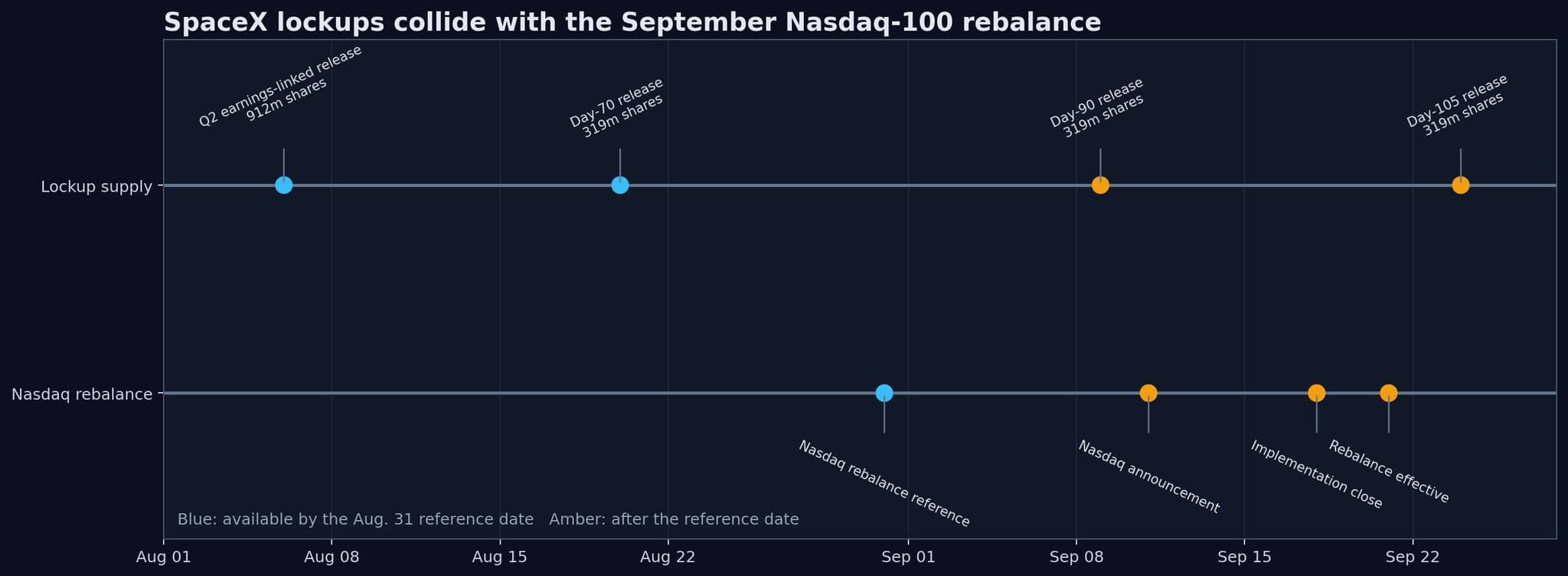
The lockup schedule is disclosed in SpaceX's offering materials and reproduced in an investor-governance letter quoting the prospectus. It permits up to 20% of the eligible pool to be released after second-quarter earnings, then 7% tranches on the 70th, 90th, 105th, 120th, and 135th days after the prospectus, followed by a larger third-quarter release and the remaining 180-day expiry. Sources: SpaceX prospectus filing and the Maryland Comptroller / Council of Institutional Investors letter.
The first release was not merely theoretical. Reporting after the August 6 results said more than 900 million shares became newly eligible for sale. The stock nevertheless rose 6.1% that day, a reminder that an unlock is permission to sell, not proof that shareholders actually sold. Source: Associated Press report.
Nasdaq's calendar is equally important. Its methodology uses the last trading day of August as the reference date for the September share adjustment. Changes are announced after the close on the sixth trading day before the effective date and take effect at the market open on the first trading day after the third Friday. For September 2026, that points to an August 31 reference, a September 11 announcement, a September 18 implementation close, and a September 21 effective date. Source: Nasdaq-100 methodology.
Why the float change can multiply the index share count
SpaceX entered public markets with a very small float relative to its total capitalization. The final offering, including the underwriters' option, sold 638.9 million Class A shares. SpaceX's offering materials showed approximately 7.38 billion Class A shares and 13.08 billion total Class A and Class B shares outstanding after the offering. Source: SpaceX IPO closing announcement.
Nasdaq does not simply use full market capitalization for a new, low-float direct listing or IPO constituent. Under the current Nasdaq-100 methodology, when free float is below one-third of shares outstanding, the index security shares can be based on the lesser of total shares outstanding and three times free-floating shares. Nasdaq describes this as a mechanism that allows index weight to rise as float broadens, rather than assigning a giant full-cap weight to a stock that trackers cannot readily buy. Source: Nasdaq methodology explanation.
Using the 638.9 million-share offering float, the simplified initial index share count is therefore:
I₀ = min(7.38bn, 3 × 638.9m) = 1.917bn sharesFor September, define ρ as the share of the August 6 and August 20 releases that Nasdaq recognizes as additional free float. The modeled recognized float is:
F₁ = 638.9m + ρ × (911.5m + 319.0m)and the modeled September index share count is:
I₁ = min(7.38bn, 3 × F₁)This treatment deliberately excludes the September 9 tranche from the September share snapshot because it occurs after the August 31 reference date. It also avoids equating "unlocked" with "free float." Shares held by founders, officers, directors, controlling holders, strategic owners, or other restricted parties may remain outside Nasdaq's free-float calculation even when contractual selling restrictions expire.
Scenario results
The July implementation-weight assumption is 0.65%, the midpoint of contemporaneous estimates that put SpaceX's initial Nasdaq-100 weight at approximately 0.5%–0.8%. Nasdaq said more than 200 products with over $800 billion in assets tracked the index when SpaceX entered it. Sources: Nasdaq inclusion announcement and a contemporaneous weight estimate.
That July weight is drifted to 0.59% before applying the September float adjustment. From the July 6 implementation close through the completed August 18 close, SPCX fell from $160.42 to $143.34 while QQQ fell from $722.82 to $717.51. The relative price factor was therefore approximately 0.900. Sources: SPCX price history and QQQ price history.
| August unlocks recognized as free float | Estimated SPCX weight | Weight increase | Incremental passive demand | Shares at $143.34 |
|---|---|---|---|---|
| 0% | 0.59% | 0.00 pp | $0.0bn | 0.0m |
| 25% | 0.86% | 0.28 pp | $2.2bn | 15.6m |
| 50% | 1.14% | 0.56 pp | $4.5bn | 31.1m |
| 75% | 1.42% | 0.83 pp | $6.7bn | 46.5m |
| 100% | 1.69% | 1.11 pp | $8.9bn | 61.9m |
The table starts from the drifted 0.59% weight and prices at the August 18 close; the headline figures quoted at the top of this piece start from the undrifted 0.65% July weight. Same mechanism, two vintages of the starting point — which is itself a reminder of how sensitive the output is to inputs that move daily.
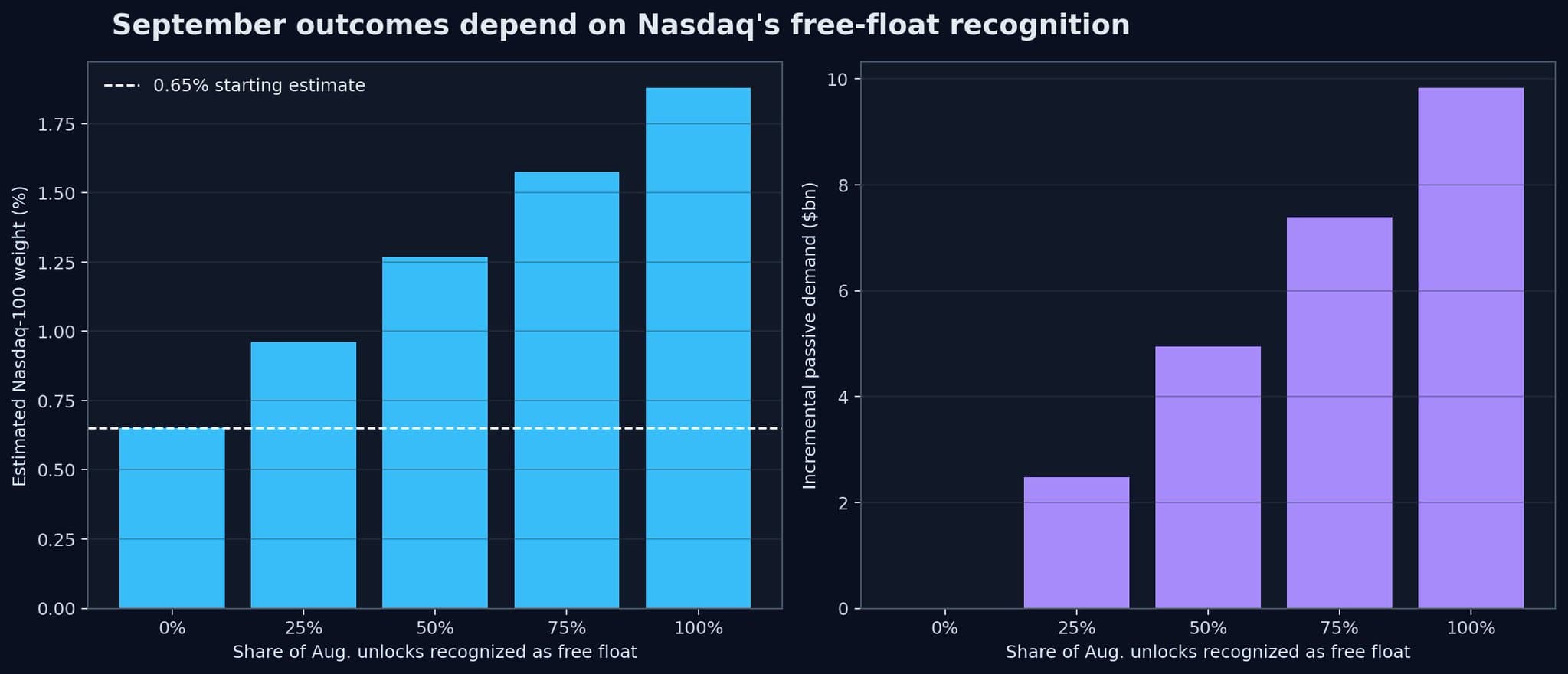
These estimates should be read as a sensitivity map. They do not account for price changes before implementation, active benchmarkers that pre-position, sampling funds, derivatives, creations and redemptions, or adjustments to other constituents. Nor do they claim that all $800 billion is perfectly replicated. Their purpose is to show how strongly the result depends on Nasdaq's treatment of the new float.
Even the upper scenario remains below the Nasdaq-100's individual-company weight caps, so the low-float share adjustment — not the headline weight cap — is the binding mechanism in this simplified model.
The index bid is large; the unlock is much larger
By the September 18 implementation close, the August 6, August 20, and September 9 releases together make approximately 1.55 billion additional shares eligible for sale. Against that pool, the modeled benchmark purchase is surprisingly small in share terms:
| Nasdaq recognition scenario | Modeled passive purchase | Share of new supply eligible by implementation |
|---|---|---|
| 25% | 15.6m shares | 1.0% |
| 50% | 31.1m shares | 2.0% |
| 75% | 46.5m shares | 3.0% |
| 100% | 61.9m shares | 4.0% |
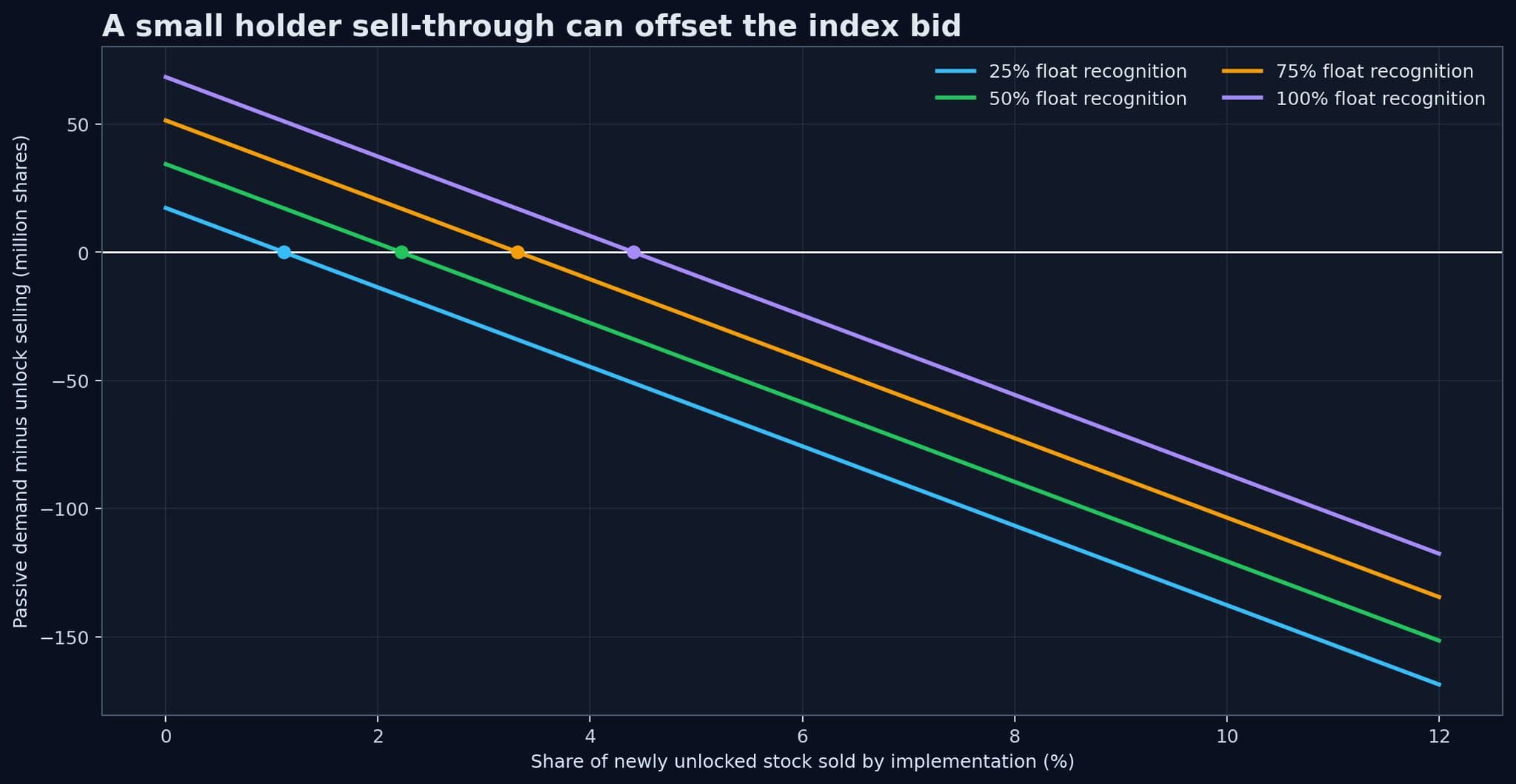
This is the article's most important result. A roughly $4.5 billion index order sounds enormous, but the supply overhang is larger still. In the middle scenario, sales of only about 2.0% of the newly eligible shares would match the estimated passive purchase. At full float recognition, the break-even sell-through rate is still only about 4.0%.
That does not mean the stock must fall. Long-term holders may sell very little, transactions may occur through blocks rather than on exchange, and a broader investor base may absorb shares well before index implementation. The point is more disciplined: the sign of the net flow cannot be inferred from index demand alone.
The September 9 tranche sharpens that ambiguity. Because it falls after Nasdaq's reference date, it can add 319 million shares of potential supply without receiving an offsetting September index-share adjustment in the base case. If the August tranches are only partially recognized, the mismatch becomes even larger.
Why this is mainly a Nasdaq event — not a generic September index event
The phrase "September index rebalance" can be misleading because index providers use different share cutoffs.
FTSE Russell's Global Equity Index Series also implements its September review on September 21, but its published 2026 timetable sets July 31 as the quarterly free-float and shares-in-issue cutoff, with final files issued September 4. The August SpaceX unlocks therefore arrive too late for the ordinary September FTSE review, absent an exceptional update. Source: FTSE GEIS 2026 review timetable.
The Russell US indexes have moved to semiannual reconstitution in June and November. Their next scheduled broad reconstitution is therefore in November, not September. Source: FTSE Russell semiannual reconstitution announcement.
MSCI may process investability and share changes under its own review rules, but the clearest September mechanical catalyst is Nasdaq's explicit August 31 share reference. The clean event-study design should therefore treat the Nasdaq-100 implementation close as the primary event and other provider changes as potential confounders, not assume all benchmarks rebalance SpaceX simultaneously.
What July teaches about September execution
SpaceX's initial Nasdaq-100 inclusion provides a useful calibration. On July 6 — the last close before membership became effective — SPCX rose 3.21% in the final 30 minutes, while QQQ fell 0.30%. The relative final-half-hour move was therefore +3.52%, and full-day SPCX volume was 2.3 times its prior five-session median.
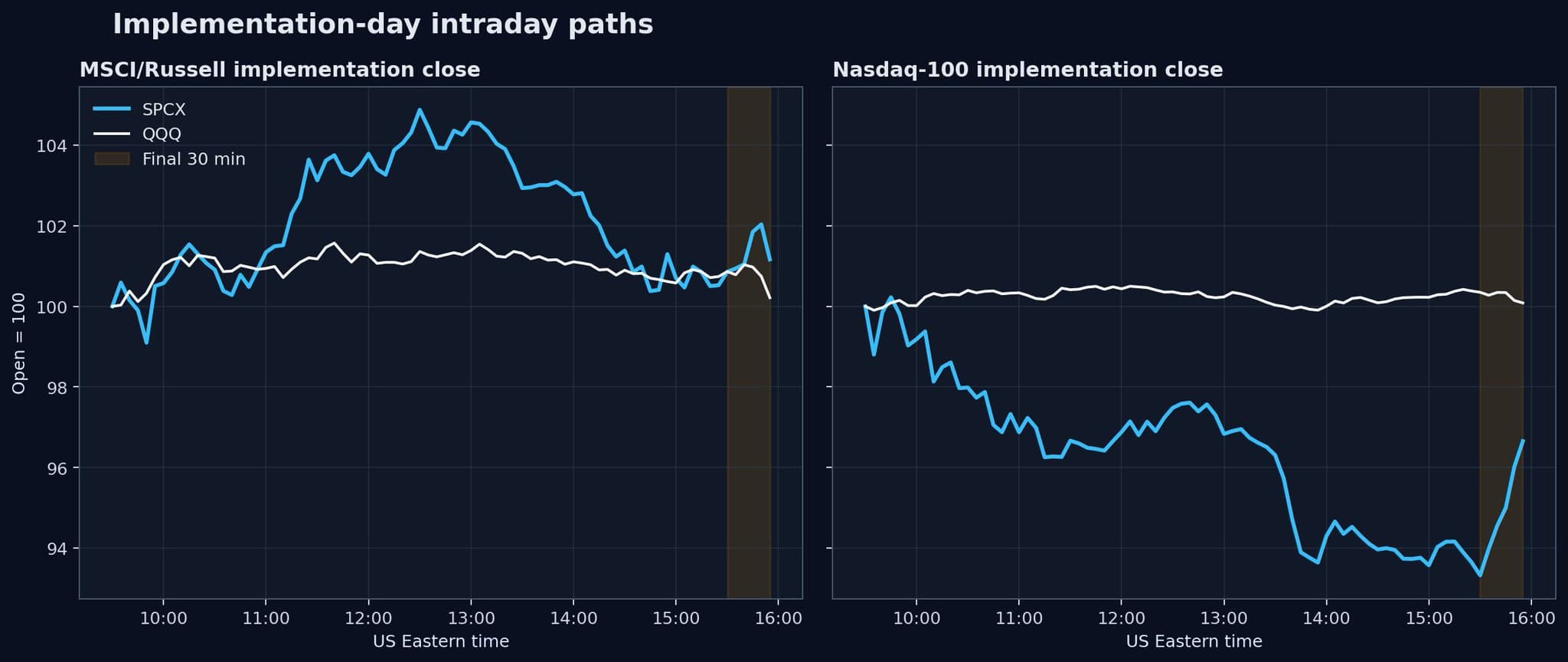
The move did not persist. SPCX fell 6.83% the next day and 13.27% over its first five index sessions. This does not prove that September will repeat the pattern; the stock and information set are different. It does show that benchmark demand can be highly concentrated at the implementation close and then disappear when the tracking obligation has been satisfied.
For September, daily close-to-close returns will be an incomplete measure. The more informative evidence will be the final hour, the official Nasdaq Closing Cross, auction imbalance messages, closing-auction volume, and any post-close block activity. A large closing print combined with a reversal on September 21 would be consistent with temporary implementation pressure. A sustained move accompanied by broad volume would suggest discretionary demand is absorbing the float as well.
Forward event-study design
The event study should separate four hypotheses instead of treating September as one date.
1. Lockup-supply hypothesis
Measure SPCX returns, volume, borrow, and block activity around August 6, August 20, and September 9. The treatment is the legal expansion of shares eligible for sale. The null is that unlocks have no abnormal price or liquidity effect because holders do not sell or the market fully anticipates them.
2. Reference-date anticipation hypothesis
Study August 20 through August 31 for evidence that traders pre-position for a larger Nasdaq share count. A positive SPCX return relative to QQQ and a space-sector basket, especially with rising closing volume, would be consistent with anticipated index demand. It would not identify the official free-float decision, which remains unknown until Nasdaq publishes the rebalance.
3. Announcement hypothesis
Use the September 11 close-to-next-close return to measure surprise in the announced index share count or pro forma weight. The useful explanatory variable is the difference between the official result and the market-implied scenario — not the raw weight alone.
4. Implementation-pressure hypothesis
For September 18, estimate SPCX's excess return during the last 60, 30, 15, and 5 minutes against QQQ and matched high-beta space equities. Record official auction volume and imbalance data. Then measure reversal from the implementation close to September 21, plus one-, five-, and 20-session post-event windows.
The main diagnostic quantities are:
Relative return[a,b] = (1 + R_SPCX,[a,b]) / (1 + R_benchmark,[a,b]) − 1

Flow intensity = estimated index purchase shares / 20-day median volume (or closing-auction ADV)
The second measure is more informative than demand in dollars. A $5 billion order can be easily absorbed in one security and highly disruptive in another. The relevant denominator is liquidity at the time and venue where trackers must trade.
What to watch before September 18
The scenario can be updated in real time with a short list of observables:
- Nasdaq's official pro forma index shares and SpaceX weight after the September 11 announcement.
- Any filing or index data-vendor update distinguishing legally unlocked stock from recognized free float.
- QQQ and other large tracker holdings, including whether positions rise before September 18.
- Exchange-reported blocks, closing-auction volume, and Nasdaq imbalance messages.
- Securities lending utilization, borrow cost, and short interest around the August 20 and September 9 releases.
- Insider transactions, Rule 144 activity, and company or holder disclosures that reveal actual sell-through.
- SPCX volume relative to the 20-day median and relative performance versus QQQ and a space-sector basket.
Once Nasdaq publishes the official index share count, the model's free-float-recognition parameter should be replaced with the observed value. At that point, the passive-demand estimate can be recomputed using the September 18 price and current tracker assets.
Risks to the thesis
The analysis has six material limitations.
- Unlocking is not the same as free float. Nasdaq can exclude affiliated or strategic holdings, and the public data do not reveal its final classification in advance.
- Unlocking is not the same as selling. The 1.55 billion-share supply figure is capacity, not an order forecast.
- Linked assets are not identical to cash replication. Some products sample the index, use derivatives, hold cash, or pre-trade changes.
- Price is endogenous. A higher SpaceX price increases its index weight but reduces the number of shares required for a given dollar purchase. The $143.87 reference is only a common measuring stick.
- Other constituent changes matter. Nasdaq's quarterly caps and simultaneous share adjustments can shift SpaceX's final weight even when its own index shares are estimated correctly.
- The company is newly public. Earnings, launch activity, Starlink developments, valuation debate, and general risk appetite may overwhelm index mechanics in any event window.
Conclusion
The September 2026 SpaceX trade is a contest between two mechanical forces created by the same lockup ladder. On one side, a wider recognized float can lift the index share count and force trackers to buy — roughly $2.5 billion to $9.8 billion depending on how much of the August supply Nasdaq counts.
But by implementation, approximately 1.55 billion new shares will have become eligible for sale. Only 1.1%–4.4% sell-through is required to match the modeled index purchase. The September 9 release adds to that supply after Nasdaq's reference date, when it may be too late to increase the September index share count.
The clean conclusion is therefore not "the rebalance is bullish" or "the lockup is bearish." It is that September converts uncertainty about free-float recognition into a large closing-flow event, while the lockup makes that flow unusually easy for shareholder selling to absorb.
The official Nasdaq share count will determine the size of the bid. Holder behavior will determine whether it matters after the close.
SPCX trades on Button as a perpetual — USDC-margined, settled on-chain via trade.xyz on Hyperliquid, with up to 10x leverage. The live market is at SPCX — SpaceX. Related reading: The Great SpaceX Unlock.
This research report is educational and informational only. It is not financial advice, a recommendation, or an offer to buy or sell any security or derivative. Scenario analysis relies on assumptions that may prove wrong, and past patterns do not guarantee future results. Perpetual futures trading carries substantial risk of loss, including possible total loss of collateral. Consider your own circumstances before trading.