Isolated vs Cross Margin for Perp Traders
Isolated vs cross margin explained — how each mode affects liquidation, risk, and capital efficiency for perpetual futures trading.
Margin mode is the most consequential setting most traders never think about. It determines what happens when a position moves against you: do you lose the margin allocated to that one trade, or does the exchange tap your entire account to keep the position alive?
The answer depends on your strategy, your portfolio structure, and your risk tolerance. This comparison breaks down isolated and cross margin with worked examples, liquidation math, and practical guidance for perpetual futures traders.
What Is Isolated Margin?
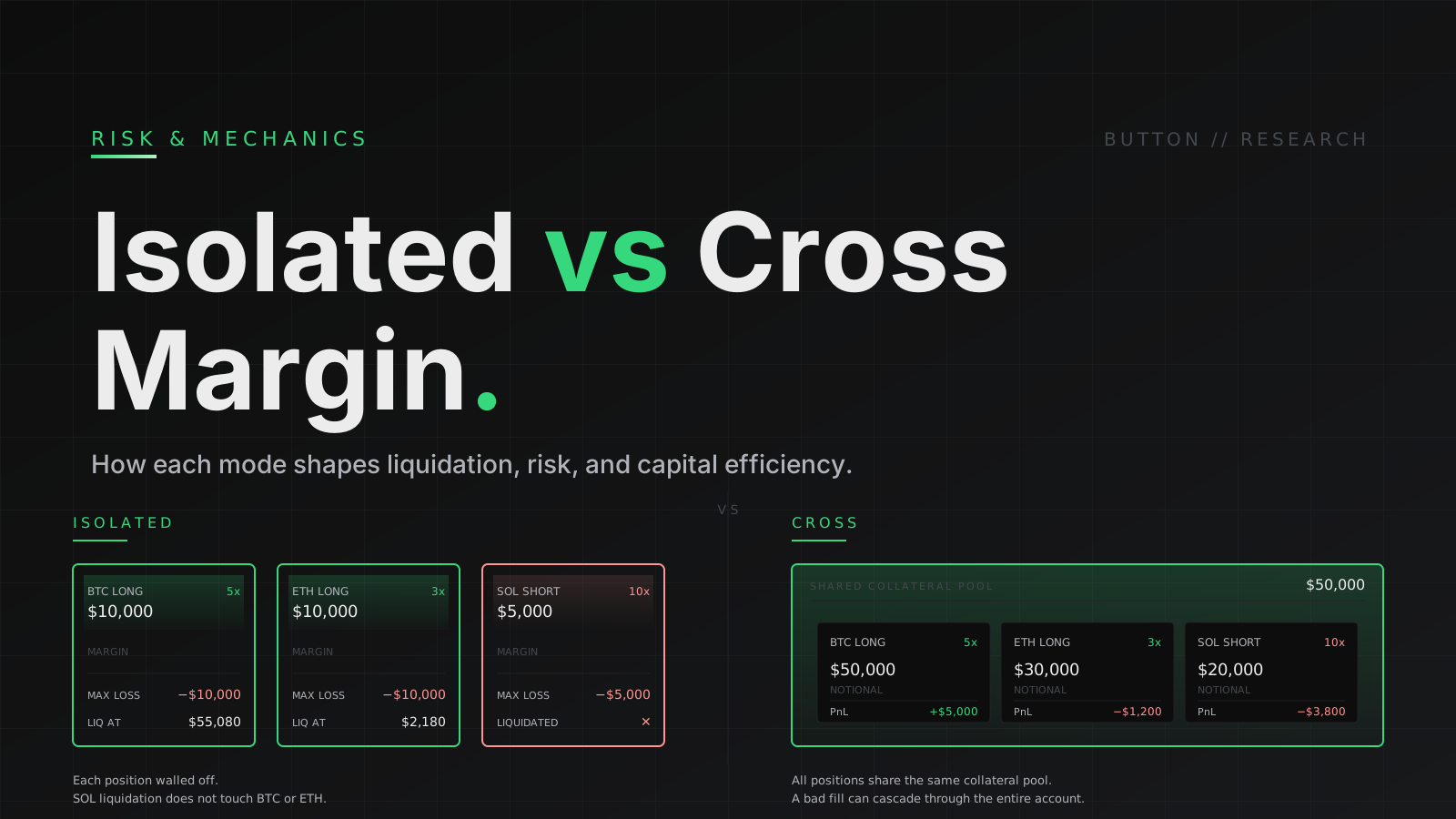
In isolated margin mode, each position has its own dedicated collateral. When you open a 5x long BTC with $10,000 in isolated margin, only that $10,000 backs the position. Your account balance, other positions, and unrealized profits are completely walled off.
If the position gets liquidated: You lose the $10,000 allocated to it. Nothing else is touched. Your ETH position, your SOL position, and your remaining $40,000 account balance are safe.
The mental model: Isolated margin treats each position as an independent bet. Each trade lives or dies on its own margin. You know the maximum loss before you enter: it's exactly the margin you allocate.
Isolated Margin Liquidation Example
- Account balance: $50,000
- Open isolated BTC long: $10,000 margin, 5x leverage, $50,000 notional
- Entry: $68,000
- Maintenance margin: 1% ($500)
Liquidation price: $68,000 × (1 − 0.20 + 0.01) = $55,080
If BTC drops to $55,080:
- BTC long liquidated: lose $10,000
- Remaining account: $40,000 (untouched)
- Other positions: unaffected
The loss is contained. You sized the bet, and the bet lost. The portfolio survives.
What Is Cross Margin?
In cross margin mode, your entire available account balance serves as collateral for all open positions. When you open a 5x long BTC with cross margin, the full $50,000 in your account backs that position — not just the margin directly allocated to it.
If the position moves against you: The exchange draws from your available balance to maintain the position. Your liquidation price is further away because more collateral backs the trade.
If liquidation triggers: Your entire account is at risk. A single liquidated position can drain your balance to zero.
The mental model: Cross margin treats your portfolio as one unified risk pool. Positions share collateral. This is more capital-efficient but exposes the full account to correlated risk.
Cross Margin Liquidation Example
- Account balance: $50,000
- Open cross-margin BTC long: 5x leverage, $50,000 notional (using $10,000 initial margin, but $50,000 total backing it)
- Entry: $68,000
- Maintenance margin: 1% ($500)
Effective liquidation price: $68,000 × (1 − ($50,000/$50,000) + 0.01) = $68,000 × 0.01 = $680
That's theoretical — in practice, BTC would never reach $680. With cross margin, the entire $50,000 backs a $50,000 notional position, so the effective leverage is 1x even though you opened at "5x." The position is nearly un-liquidatable.
But if you open multiple positions using the same cross-margin pool:
- BTC long: $50,000 notional
- ETH long: $30,000 notional
- SOL long: $20,000 notional
- Total notional: $100,000 on $50,000 equity = 2x portfolio leverage
Now a 40-50% market-wide crash liquidates everything — and you lose all $50,000. The positions are correlated (crypto tends to crash together), so the portfolio-level risk is much higher than any individual position suggests.
Head-to-Head Comparison
Capital Efficiency
Cross margin wins. In cross mode, unrealized profits from one position can margin another. If your BTC long is up $5,000, that $5,000 backs your ETH position too. You can run more positions with the same capital.
In isolated mode, each position's margin is locked. A $10,000 allocation to BTC can't support your ETH position even if BTC is up 20%.
Practical impact: A trader with $50,000 can run 3 positions at 5x in cross mode ($250,000 total notional). In isolated mode, they'd allocate $15,000 per position ($225,000 total at 5x) and have $5,000 idle. Cross mode is 10-15% more capital-efficient for multi-position portfolios.
Liquidation Risk
Isolated margin wins. Maximum loss per position is capped at allocated margin. Cross mode exposes the full account.
A single bad trade in cross mode can cascade: the losing position drains margin, which tightens liquidation prices on other positions, which causes those to liquidate too. This is how accounts go from "one losing trade" to "zero balance" in minutes.
Risk Isolation
Isolated margin wins. If you're running a high-conviction 10x short on a volatile alt alongside a conservative 2x BTC long, isolated margin ensures the risky alt trade can't sink the safe BTC position. In cross mode, the alt going wrong puts everything at risk.
Portfolio Management Complexity
Cross margin wins. One pool of capital, one set of risk parameters. No need to manually allocate margin to each position or rebalance when positions change size. Professional trading desks run cross margin because it simplifies portfolio management.
Isolated mode requires active margin management — adding margin when positions are winning (to increase size), monitoring each position's individual liquidation price, and rebalancing allocations across trades. It's more work.
Hedging Efficiency
Cross margin wins. If you're long BTC and short ETH as a pairs trade, cross margin offsets the risk naturally. The BTC and ETH positions partially hedge each other, and the shared margin pool reflects that reduced net risk. In isolated mode, each leg carries full standalone liquidation risk despite being hedged.
When to Use Each Mode
Use Isolated Margin When:
- Trading high-leverage alts. A 10x short on a meme coin can gap 30% against you. Isolated margin caps your loss at the allocated amount.
- Testing new strategies. Allocate small isolated margin to test a strategy without risking your main balance.
- Running uncorrelated positions. If your BTC long and your SOL short are independent thesis, isolating them prevents contamination.
- You want predictable max loss. Before entry, you know exactly how much you can lose. No surprises.
Use Cross Margin When:
- Running a hedged portfolio. Long/short pairs, basis trades, delta-neutral strategies — cross margin offsets correlated positions and reduces overall liquidation risk.
- Trading majors at moderate leverage. A 3x BTC long backed by your full account is extremely hard to liquidate. Cross margin gives you maximum buffer on high-conviction, low-leverage positions.
- Managing multiple positions actively. Professional perps traders who monitor portfolio heat in real-time use cross margin for efficiency.
- Maximizing capital efficiency. When every dollar of margin counts — scaling a working strategy, deploying dry powder across multiple opportunities — cross margin lets you do more with less.
How Margin Modes Work on Different Venues
Hyperliquid
Hyperliquid defaults to cross margin. All positions share the same margin pool. The platform supports adjustable leverage per position within the cross-margin framework — you can open BTC at 5x and ETH at 3x in the same cross account.
Isolated margin is available by creating sub-accounts or adjusting position-level settings. The implementation is straightforward but requires manual allocation.
Practical tip: On Hyperliquid, use cross margin for your core strategy (basis trades, moderate-leverage directional) and separate sub-accounts with isolated margin for high-risk plays.
Binance
Binance lets you toggle between isolated and cross margin per position. You can run BTC cross and ETH isolated in the same account. This flexibility is useful for mixed portfolios.
Fee note: Margin mode doesn't affect fees on either platform. You pay the same maker/taker rates regardless.
dYdX
dYdX uses cross margin by default with portfolio margining. Positions are automatically cross-collateralized. This is efficient for multi-leg strategies but means you can't isolate individual position risk without separate accounts.
Common Mistakes
Using cross margin with high leverage on altcoins. Cross margin at 10x on a volatile alt exposes your entire account to a 10% gap. This is the fastest way to zero.
Ignoring portfolio-level leverage in cross mode. Each position looks safe individually (3x here, 2x there), but the sum might be 8x portfolio leverage. Track total notional / total equity as your real leverage number.
Over-allocating isolated margin and leaving no dry powder. If you split $50,000 into 5 isolated positions of $10,000 each, you have zero margin to add if a position goes against you. Keep 20-30% unallocated as reserve.
Switching modes mid-position. Most exchanges let you switch, but it changes your liquidation price instantly. Switching from isolated to cross lowers liquidation risk (more margin). Switching from cross to isolated can trigger immediate liquidation if the isolated margin isn't sufficient.
FAQ
Which margin mode is safer?
Isolated margin is safer per-position — your maximum loss is capped. Cross margin is safer per-position in terms of liquidation distance (more collateral), but riskier at the portfolio level (one liquidation can cascade). For traders who prioritize predictable max loss, isolated is safer. For traders managing hedged portfolios, cross margin is safer overall.
Can I use both modes at the same time?
On Binance, yes — you can set each position independently. On Hyperliquid, the default is cross, but you can use sub-accounts for isolated positions. On dYdX, cross is the only option.
Does margin mode affect funding rate payments?
No. Funding rates are calculated on position notional regardless of margin mode. A $100,000 BTC long at 0.01% funding pays $10 per period whether it's isolated or cross-margined.
What happens to unrealized profits in cross margin?
Unrealized profits in cross mode increase your available margin, which means they back your other positions. If your BTC long is up $5,000, you have $5,000 more margin for ETH. But if BTC reverses and the profit evaporates, your ETH margin tightens too. Unrealized profits in isolated mode stay locked to that position.
Should I switch to cross margin as I get more experienced?
Most professional traders use cross margin because it's more capital-efficient and they actively manage portfolio-level risk. But experience alone isn't enough — you need real-time portfolio monitoring, drawdown limits, and the discipline to cut positions before cascading liquidation. If you don't have those systems, isolated margin is safer regardless of experience.
Choose the Right Mode for Your Strategy
Margin mode isn't a universal preference — it's a strategy-level decision. Isolated margin for high-risk, asymmetric bets. Cross margin for hedged portfolios and capital efficiency. The wrong mode for your strategy costs you either through unnecessary capital lockup or unexpected account-wide losses.
Run a perp strategy with the agent: the AI trading agent manages margin allocation, monitors portfolio-level leverage, and adjusts position sizing based on your risk tolerance — automatically choosing the right risk framework for each strategy.
Related: Liquidation calculator for position-level math. Perps trading playbook for strategy frameworks. How to trade perps for execution basics.