AI Trading Strategies for Crypto Perps
Six AI-enhanced trading strategies for crypto perpetual futures — how intelligence layers improve carry, grid, momentum, and risk management.
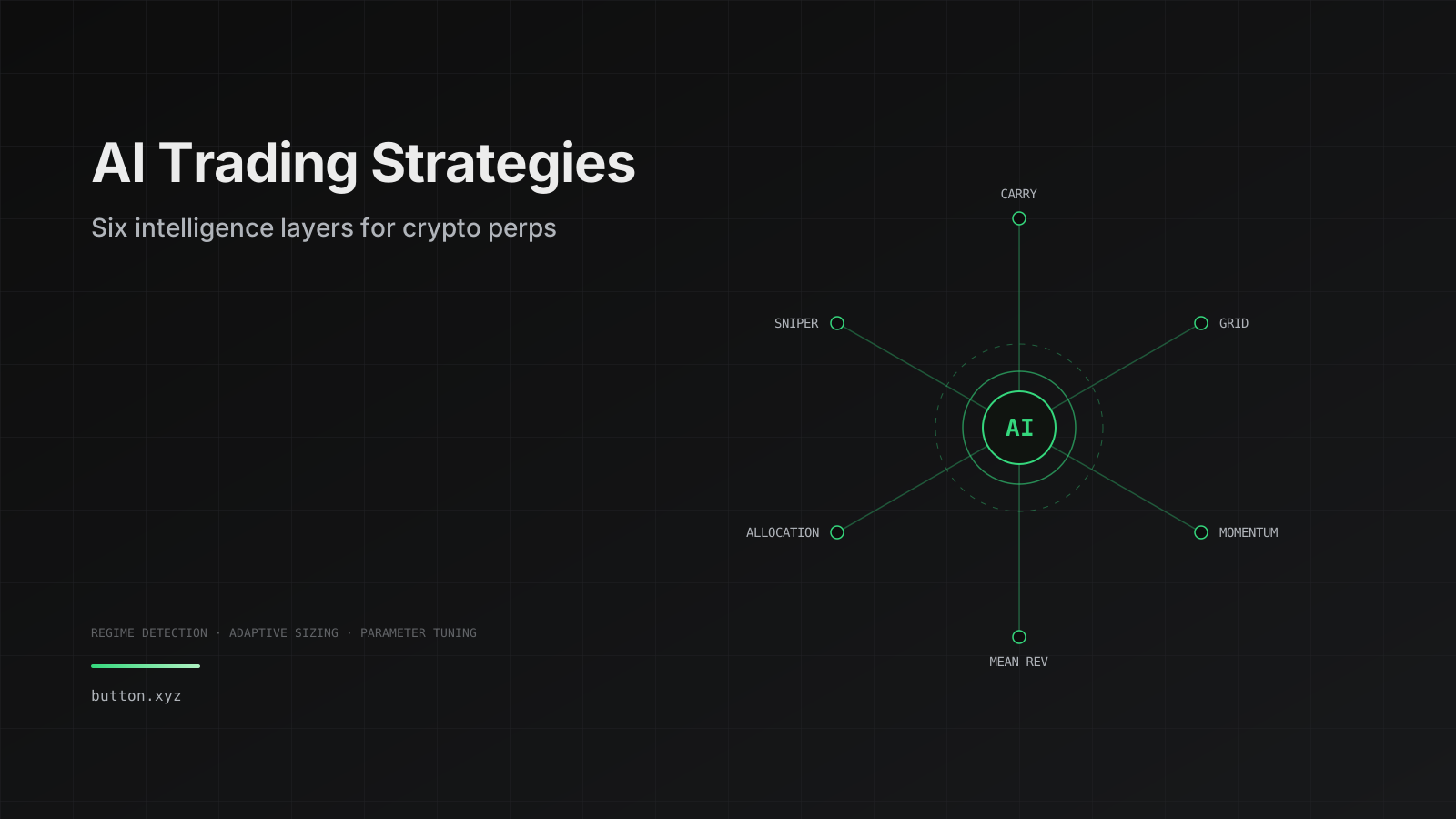
Every strategy in this guide works without AI. Grid trading, carry trades, momentum following, and mean reversion are well-established approaches that have been profitable for decades. What AI adds isn't a new strategy — it's an intelligence layer on top of existing strategies that improves parameter selection, timing, regime adaptation, and risk management.
The distinction matters. A "strategy powered by AI" that can't explain the underlying edge without referencing AI has no edge. A proven strategy enhanced by AI-driven parameter optimization, regime detection, and adaptive sizing has a compounding advantage over its static version.
Here are six strategies where the AI layer creates measurable improvement, specifically for perpetual futures trading on Hyperliquid.
1. AI-Enhanced Carry Trade
Base strategy: Funding rate arbitrage — long spot, short perp, collect funding payments. Market-neutral yield averaging 8-15% annualized on Hyperliquid.
What AI adds:
Dynamic pair selection. Instead of running the carry on BTC and ETH exclusively, the AI layer monitors funding rates across all 100+ Hyperliquid pairs and identifies the highest risk-adjusted opportunities. Some weeks, SOL funding is 3x BTC funding. Some weeks, an altcoin offers 0.5% per 8 hours for a few days during a narrative pump.
Static carry trades miss these opportunities because they're locked into fixed pairs. The AI agent re-evaluates pair selection daily, rotating capital toward the highest-yield opportunities while maintaining diversification constraints.
Entry timing. The AI layer analyzes funding rate trends and identifies when a high rate is likely to persist versus revert. A funding spike to 0.10% might last one settlement (bad carry entry) or persist for a week during a sustained narrative trade (excellent carry entry). Pattern analysis on historical funding behavior, combined with context awareness (what's driving the spike), improves entry timing.
Exit signals. When funding compresses toward zero or flips negative, the carry trade's yield disappears. AI monitoring detects compression earlier than fixed thresholds by analyzing the rate of change and contextual factors (declining open interest, cooling narrative, increasing short positioning).
Performance improvement: AI pair rotation and timing adds 3-5% annualized yield over static BTC-only carry, based on backtested results. The improvement comes from capturing altcoin funding spikes and avoiding periods when BTC carry yields are compressed.
Risk: Perp trading involves substantial risk. Carry trades are market-neutral when properly hedged but carry basis risk if the spot and perp legs diverge. AI monitoring of the spread reduces but doesn't eliminate this risk.
2. AI-Adaptive Grid Trading
Base strategy: Grid trading — place buy limit orders below current price and sell limit orders above, capturing spread on each fill. On Hyperliquid, every limit fill earns the -0.02% maker rebate.
What AI adds:
Dynamic grid width. In low-volatility environments (BTC 20-day realized vol below 30%), tight grids (0.3-0.5% spacing) maximize fill frequency. In high-volatility environments (vol above 60%), tight grids get run over — price blasts through the grid in one direction, leaving the bot with one-sided inventory. AI-driven volatility assessment adjusts grid width in real time.
Asymmetric grids. When the AI's regime classifier detects a trending market, the grid shifts asymmetrically — more levels in the trend direction (wider stops), fewer counter-trend levels (tighter profit targets). This reduces inventory buildup against the trend while capturing pullback fills.
Grid pause logic. During extreme volatility events (10%+ moves in hours), grids can accumulate massive one-sided inventory. The AI layer detects anomalous volatility and pauses the grid, preventing further adverse fills until the market stabilizes. A static grid has no mechanism for this — it keeps filling orders into the abyss.
Performance improvement: AI-adaptive grids reduce maximum drawdown by 30-40% compared to fixed-parameter grids while maintaining similar total return. The improvement is primarily defensive — avoiding the worst-case scenarios that make static grids blow up.
3. Momentum Following with AI Regime Gating
Base strategy: Trend/momentum following — enter long when price trends up (moving average crossover, breakout, or similar signal), short when price trends down. Cut losers fast, let winners run.
What AI adds:
Regime gating. Momentum strategies work in trending markets and get destroyed in range-bound markets (whipsaw losses from false breakouts). The AI regime classifier determines whether the current environment is trend-friendly before allowing momentum entries.
When the classifier reads "trending," momentum signals proceed to execution. When it reads "range-bound" or "transitioning," momentum entries are blocked. This single filter — trade momentum only in trending regimes — eliminates 50-70% of whipsaw losses.
Cross-asset confirmation. Before entering a BTC long momentum trade, the AI checks: Is ETH confirming the trend? Is SOL? Are funding rates rising (indicating increasing long demand)? Is volume expanding? Multi-asset confirmation reduces false signal entries.
Adaptive sizing. Position size scales with trend strength and regime confidence. A high-confidence trending regime with strong cross-asset confirmation gets 1.5x base size. A borderline regime with mixed signals gets 0.5x or is skipped entirely.
Performance improvement: Regime gating typically improves momentum strategy Sharpe ratios by 0.3-0.5 by eliminating the worst-performing periods. The win rate improvement is modest (5-10%), but the loss reduction is significant.
4. AI-Driven Mean Reversion
Base strategy: Mean reversion — when price deviates significantly from a moving average or fair value model, bet on reversion. Buy the dip, sell the rip.
What AI adds:
Fair value modeling. Instead of using a simple moving average as the "mean," the AI synthesizes multiple inputs: volume-weighted average price, funding rate implied sentiment, on-chain metrics (exchange inflows/outflows, whale activity), and cross-exchange price differentials to estimate a dynamic fair value.
Context-aware entry. Not all deviations revert. A 5% BTC dip after a regulatory crackdown announcement is a fundamentals-driven move that may not revert quickly. A 5% BTC dip caused by cascading liquidations on a single exchange during low-volume hours often reverts within hours. The AI layer distinguishes between these by analyzing the cause of the deviation.
Scaling logic. Mean reversion strategies that go all-in at the first deviation signal often suffer when the deviation deepens. AI-driven scaling enters 25% at the first signal, adds 25% if the deviation widens to 1.5x, adds the remaining 50% only if the deviation hits 2x while the reversion thesis remains intact. This averaging-in approach improves average entry price.
Performance improvement: Context-aware mean reversion outperforms simple moving average reversion by reducing entries into non-reverting moves (news-driven, structural breaks). Improvement is primarily in win rate (70-75% vs 55-60% for naive mean reversion) rather than win size.
5. Multi-Strategy Portfolio with AI Allocation
Base strategy: Run multiple strategies simultaneously — carry, grid, momentum, mean reversion — to diversify return sources and reduce drawdown.
What AI adds:
Dynamic capital allocation. In trending markets, shift capital toward momentum and reduce grid allocation. In range-bound markets, maximize grid and carry allocation. During high-volatility events, reduce overall exposure and increase cash reserves.
The AI allocator re-evaluates strategy weights every 4-12 hours based on regime classification, recent strategy performance, and market conditions. This replaces the static 25/25/25/25 split with an adaptive allocation that tilts toward the strategies most likely to perform in the current environment.
Correlation monitoring. Strategies that appear diversified can become correlated during market stress (all strategies lose simultaneously in a crash). The AI monitors real-time strategy correlation and reduces overlapping positions. If momentum and grid strategies are both building long exposure on BTC, the allocation engine caps combined BTC long exposure.
Rebalancing triggers. Rather than rebalancing on a fixed schedule (monthly, quarterly), the AI triggers rebalancing when strategy performance diverges significantly from expectations or when regime shifts make the current allocation suboptimal. Event-driven rebalancing responds faster than calendar-driven.
Performance improvement: AI-allocated multi-strategy portfolios show 20-30% lower maximum drawdown and 10-15% higher risk-adjusted returns compared to equal-weight allocations, based on Hyperliquid backtests.
6. AI Funding Rate Sniping
Base strategy: Funding rate sniping — enter positions before funding rate settlements to capture outsized payments, exit after settlement.
What AI adds:
Pattern recognition. Historical analysis identifies which types of funding spikes revert (good for sniping) versus persist (bad for sniping). The AI classifies each spike by its cause and historical reversion probability before entering.
Multi-pair optimization. When multiple pairs spike simultaneously, the AI selects the optimal subset based on: spike magnitude, historical win rate, current liquidity, and correlation between pairs. Diversifying snipe positions across uncorrelated assets reduces per-session variance.
Adaptive thresholds. The minimum funding rate threshold for entry adjusts based on market regime. During calm periods, smaller spikes are worth sniping (lower risk of adverse moves). During volatile periods, only extreme spikes justify the exposure.
Performance improvement: AI-optimized sniping improves win rate from ~65% (fixed threshold) to ~75% (adaptive threshold with pattern recognition) and reduces average loss per losing snipe through better sizing.
Implementation on Hyperliquid
All six strategies benefit from Hyperliquid's structural advantages:
Maker rebate (-0.02%). Every limit order fill earns fees rather than paying them. Grid trading, carry trade entries/exits, and sniper entries all route through post-only limit orders. Across 1,000+ monthly fills, the rebate contribution is substantial.
High funding rates. Carry trades and funding sniping yield 2-3x more on Hyperliquid than on CEXs. This is the primary reason these strategies perform better here than on Binance.
100+ pairs. More pairs = more opportunities for the AI to find optimal carry pairs, funding spikes, and uncorrelated grid pairs. The opportunity set is wider than any other DEX.
API access. The Hyperliquid API supports batch orders, post-only routing, and real-time market data — everything needed for automated multi-strategy execution.
FAQ
Can I run AI strategies without coding?
Yes. The AI trading agent provides pre-built AI strategy execution on Hyperliquid. Connect your wallet, select strategies and risk parameters, and the agent handles the rest.
How much capital do I need?
Minimum $5,000 for a single strategy. $20,000+ for multi-strategy portfolios where diversification benefits materialize. $100,000+ for the full suite including funding sniping at scale.
What's the expected return?
Strategy-dependent. Carry: 8-15% annualized. Grid: 15-30% annualized (variable). Momentum: highly variable (-20% to +100%). Multi-strategy blended: 15-25% annualized target with 10-15% maximum drawdown. These are targets, not guarantees.
Do AI strategies work in bear markets?
Some do. Carry trades work when funding is positive (common even in bear markets as remaining longs pay elevated funding). Momentum strategies profit from shorts. Grid strategies work in range-bound periods. Mean reversion captures bounce trades. The multi-strategy approach is designed to find opportunities regardless of direction.
Deploy Intelligence on Strategy
The AI layer isn't the strategy — it's the edge that makes existing strategies perform better. Parameter optimization, regime awareness, adaptive sizing, and multi-source analysis compound into measurably better risk-adjusted returns compared to static automation.
Deploy AI strategies with the agent: the AI trading agent runs carry, grid, momentum, and sniping strategies on Hyperliquid with adaptive AI allocation, regime-aware parameter tuning, and maker-rebate optimization.
Related: Perps trading for the base strategy framework. What is agentic trading for the AI architecture. Hyperliquid trading bot for venue-specific automation.