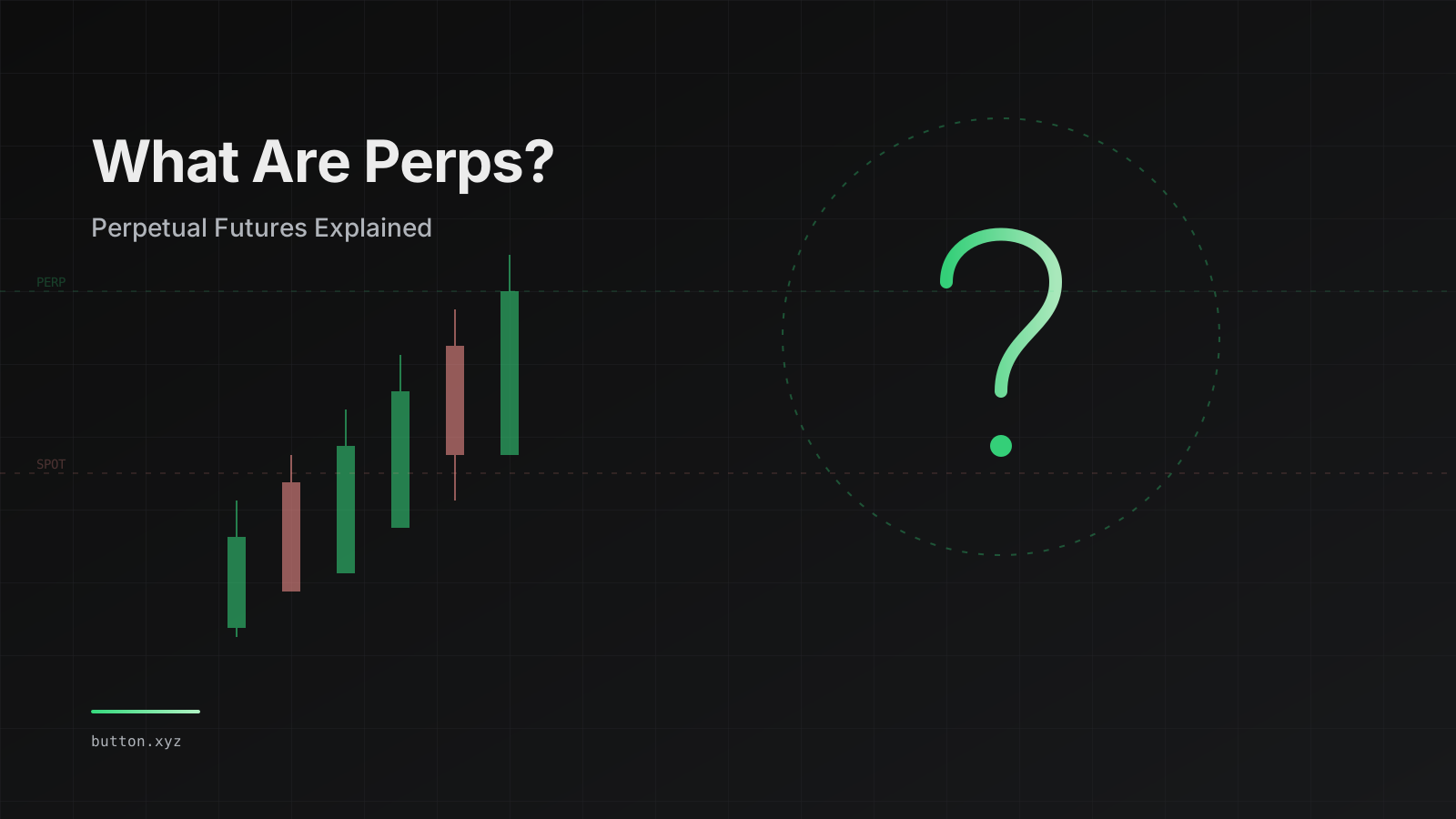
What Are Perps? Perpetual Futures Explained
Perpetual futures explained: what perps are, how they differ from spot trading, and why they dominate crypto derivatives volume.
Perps dominate crypto. Over 90% of derivatives trading volume flows through perpetual futures contracts. Yet many traders move into perpetuals without fully understanding how they work—or why they're fundamentally different from spot trading and dated futures.
This post breaks down what perps are, how the funding rate mechanism keeps them tethered to spot price, and why on-chain platforms like Hyperliquid are reshaping where traders access them.
What Are Perps?
Perpetual futures (perps) are leveraged contracts that let you trade crypto directionally without owning the asset. Unlike dated futures that expire on a specific date—like December quarterly contracts on CME or Binance—perpetuals never expire. You enter a position, and you stay in it until you choose to exit.
The word "perpetual" describes the contract structure: it has no maturity date. This single feature changes everything about how the market functions.
Here's the mechanic: perpetual contracts track the spot price of an asset (Bitcoin, Ethereum, altcoins) through a mechanism called the funding rate. Every 8 hours on platforms like Hyperliquid, longs and shorts settle a funding payment between themselves. If Bitcoin is trading above the fair value, longs pay shorts. If it's below, shorts pay longs. This payment acts as a gravity well—it pulls the perpetual price back toward spot.
The result: perps stay synchronized with the underlying asset's real-time price, regardless of contract duration.
Perps vs. Spot Trading
Spot trading is buying Bitcoin at $67,000 and holding it in your wallet. You own the asset. You pay the market price (plus spread). You keep it indefinitely or sell it whenever you want.
Perps are different in three key ways:
Leverage. Spot trading offers no leverage on most platforms (or margin lending at high rates). Perps offer built-in leverage up to 20x or higher on some exchanges. You deposit margin—say $5,000—and control $100,000 in notional exposure. Leverage amplifies both gains and losses, which is why liquidation risk matters.
No Asset Ownership. You don't own Bitcoin when you trade perps. You're betting on its price direction. This simplifies execution (no custody complexity) but means you can't use the asset for yield farming, staking, or transfers.
Cost Structure. Spot trading costs: asset spread + exchange fee. Perps cost: taker/maker fees + funding rates (if you hold overnight). Funding rates can be positive or negative. If you're long and funding is positive, you pay shorts every 8 hours. If you're short and it's negative, longs pay you. Over weeks of holding, funding can dramatically shift your total cost or profit.
When to use each: Spot for long-term holding and asset ownership. Perps for directional trades, hedging a spot position, or capturing yield through funding rate arbitrage (buy spot, short perps, pocket the funding payment).
Perps vs. Dated Futures
Dated futures are quarterly contracts. Binance has December, March, and June quarterly contracts. These expire on a specific settlement date. As the expiration approaches, the futures price converges to spot—a process called basis convergence.
With perps, there's no expiration convergence risk. Your position doesn't get forced into settlement. This matters operationally:
- No Rollover Friction. Dated futures traders must close a September contract and open a December one. Perps traders stay in the same contract indefinitely.
- Funding Rate Discovery. Perps have an 8-hour funding settlement. Dated futures use basis (the spread between contract and spot). Funding rates attract carry traders: you can hold a stable position and earn daily payments. Dated futures don't offer this.
- Deeper Liquidity. Because perps never expire, liquidity concentrates in a single contract. Dated futures fragment liquidity across multiple expirations, widening spreads.
For most traders, perps are superior to dated futures. The lack of expiration friction and the funding rate mechanism have made them the market's primary derivatives vehicle.
How Funding Rates Work
Funding rates are the engine that keeps perps honest. They're not fees you pay to the exchange—they're payments between traders.
On Hyperliquid, funding settles every 8 hours. The rate is calculated based on the spread between perp price and spot price:
- If perps are trading above spot, longs have profited (on paper) relative to shorts. Longs pay shorts a funding payment to rebalance the market.
- If perps are trading below spot, shorts have profited. Shorts pay longs.
Example: Bitcoin spot is $67,000. The perp is $67,100 (longs pushed it higher). At the next 8-hour settlement, longs pay shorts the difference. This incentivizes shorts to enter, pushing the perp back down.
Over weeks of holding, funding adds up. If you're long Bitcoin and funding is positive (0.02% per 8 hours = 0.18% daily), you earn that rate three times a day. On a $100k position, that's $180/day in passive income—if the position stays underwater.
This is why perps attract carry traders: you can buy spot Bitcoin, short perps at the same size, and pocket the funding rate difference daily with zero directional risk.
For the full mechanics of funding rate calculation and arbitrage strategies, see our deep dive into perpetual futures.
Leverage, Margin & Liquidation
Leverage is the feature that makes perps powerful and risky.
Initial Margin is the collateral you deposit to open a position. On Hyperliquid, you might open a 5x leveraged long with 20% initial margin ($20,000 to control $100,000 notional).
Maintenance Margin is the minimum you must keep to stay in the position. If your collateral drops below this level, you're liquidated. On Hyperliquid, this is typically 5% ($5,000 in the example above).
Liquidation happens instantly and automatically. If your position moves against you and your collateral reaches the maintenance threshold, the protocol closes your entire position at the best available price. You lose your margin, and the protocol auctions it to maintain solvency.
Here's the math: a 5x long position gets liquidated if the price falls 20%. A 10x position liquidates at 10% down. This is why leverage is a double-edged sword. You're betting not just on direction, but on your ability to withstand volatility.
Many traders use 2-5x leverage for steady strategies. Some use 10-20x for conviction trades or short-duration positioning.
Why Perps Dominate Crypto Derivatives
Perps represent over 90% of all crypto derivatives volume. Here's why:
- 24/7 Liquidity. Unlike stock futures (closed 6pm–6am ET), crypto perps trade around the clock. No gaps, no overnight risk.
- No Expiration Stress. You don't have to think about contract roll-over. Hold as long as you want.
- Funding Rate Yield. Carry traders can earn daily yield by arbitraging spot/perp spread. This attracts capital and deepens liquidity.
- Capital Efficiency. Leverage lets you control larger notional with less capital, which appeals to active traders.
- Composability. On-chain perps (Hyperliquid) integrate with other crypto applications, unlocking sophisticated multi-leg strategies.
Where to Trade Perps
Centralized Exchanges (Binance, OKX, ByBit, Deribit):
- Highest liquidity and tightest spreads
- Custody risk: your funds are held by the exchange
- Regulatory exposure: subject to local restrictions
- Best for traders prioritizing execution quality
On-Chain (Hyperliquid):
- Non-custodial: you control your keys, hold your funds
- Transparent order book and settlement on-chain
- Lower counterparty risk
- Growing liquidity; now a top-3 global perp platform
- Composable: integrate perp positions into multi-leg DeFi strategies
For traders seeking self-custody and transparency, Hyperliquid perpetuals offer the on-chain alternative to centralized derivatives.
FAQ
Can you lose more than you invested in perpetual futures?
Yes. Leverage amplifies losses. With a 5x long, a 20% price drop wipes your margin completely. The exchange then liquidates your position, and you lose your entire $20k collateral. You cannot owe money post-liquidation on most platforms (they're designed with clawback protection), but you can lose 100% of what you put in.
How often do funding rates settle, and can they go negative?
On Hyperliquid, funding settles every 8 hours (3 times daily). Rates fluctuate based on market conditions. Positive rates mean longs pay shorts. Negative rates mean shorts pay longs. Both are normal and depend on whether the market is skewed bullish or bearish at any moment.
Is leverage trading regulated?
Regulation varies by jurisdiction. In the US, centralized perp exchanges face regulatory scrutiny; on-chain platforms operate in a grayer area. Check your local rules before opening an account. Many traders use VPNs or offshore platforms, but this carries legal and security risk.
What's the minimum to start trading perps?
Technically, $100–$500 on most platforms. But with that amount, you have almost no margin for error. Most professional traders keep at least $5,000–$10,000 in perp collateral to run strategies without constant liquidation risk.
How do I choose between perps and spot?
Use perps for: short-term directional trades, yield farming through funding rates, hedging a spot position with leverage, and high-capital-efficiency strategies. Use spot for: long-term holding, accessing staking/yield in the protocol, and avoiding liquidation risk.
Ready to Trade Perps?
Perpetuals are the market's primary derivatives vehicle—for good reason. They offer leverage, no expiration friction, and funding rate opportunities that spot trading can't match. Whether you're scaling a directional strategy or capturing carry yield, understanding the mechanics—funding rates, margin, liquidation—is essential to trading them profitably.
Deploy perp strategies with the agent: connect wallet and let automated execution handle entries, exits, and rebalancing. Run a perp strategy with the agent to start trading without manual orders.
Want a deeper dive into funding rate mechanics and arbitrage? Read our comprehensive perpetual-futures guide. For on-chain alternatives, see how to trade on Hyperliquid.