How Do Perpetual Futures Work? Full Breakdown
Step-by-step explanation of how perpetual futures work — margin, leverage, funding, liquidation, and how traders use them to profit in any direction.
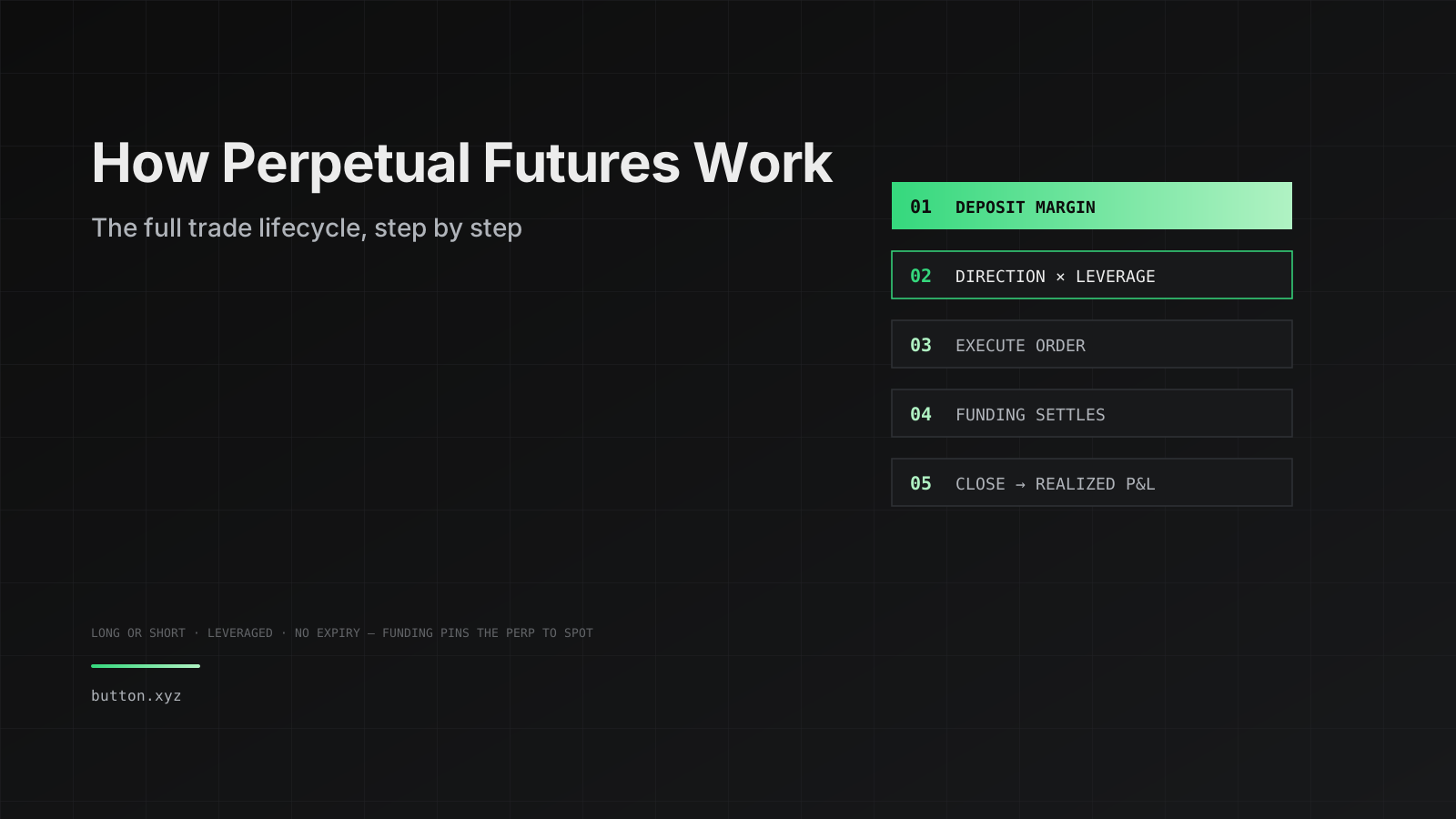
A perpetual future is a bet on an asset's price that never expires. You choose a direction — long (betting price goes up) or short (betting price goes down) — and a leverage multiplier that amplifies your exposure beyond your deposited capital. Every 8 hours, one side of the trade pays the other through a mechanism called the funding rate, which keeps the perpetual's price tracking the actual asset.
That's the 30-second version. Here's exactly how each piece works.
Step 1: Deposit Margin
Before trading, you deposit collateral — called margin — into your exchange account. On Hyperliquid, you deposit USDC. On centralized exchanges, it's typically USDT or USDC. This margin is the capital that backs your leveraged positions.
Example: You deposit $10,000 USDC into your Hyperliquid account. This is your total margin — the maximum amount you can lose (in cross margin mode) or the pool from which you allocate individual position margin (in isolated mode).
Your margin does not earn interest by default. It sits as collateral until you open a position.
Step 2: Choose Direction, Leverage, and Size
You make three decisions when opening a position:
Direction
Long: You profit when price goes up. A long BTC perpetual at $68,000 earns money if BTC moves to $70,000 and loses money if BTC drops to $66,000.
Short: You profit when price goes down. A short BTC perpetual at $68,000 earns money if BTC drops to $66,000 and loses money if BTC rises to $70,000. Short selling — profiting from price declines — is one of the primary reasons traders use perpetual futures instead of spot trading.
Leverage
Leverage multiplies your exposure relative to your margin. At 5x leverage with $10,000 margin, you control $50,000 in notional value.
What leverage does:
- Amplifies profits. A 2% BTC move at 5x = 10% return on your margin.
- Amplifies losses. A 2% adverse move at 5x = 10% loss on your margin.
- Sets your liquidation distance. Higher leverage = closer liquidation price = less room for the market to move against you.
Common leverage ranges:
- 2–3x: Conservative. Suitable for multi-day holds and strategies that need to survive volatility.
- 5–10x: Moderate. Standard for active day trading with defined stops.
- 20–50x: Aggressive. Only for very short-term scalps with immediate exit plans.
See the Hyperliquid leverage guide for specific limits per asset.
Position Size
Your notional position size = margin allocated × leverage.
- $10,000 margin at 5x = $50,000 notional
- $10,000 margin at 10x = $100,000 notional
The notional determines your actual exposure — the dollar amount of the underlying asset your position tracks. Funding payments are calculated on notional, not margin.
Step 3: Order Execution
Once you've decided direction, leverage, and size, you submit an order:
Market Orders
Execute immediately at the best available price. Fast but you pay the spread (the gap between the bid and ask price) plus taker fees. On Hyperliquid, the taker fee is 0.05%.
When to use: Urgent entries/exits. When speed matters more than price precision. When the order book is deep enough that slippage is minimal.
Limit Orders
Set a specific price. The order sits on the order book until someone trades against it. On Hyperliquid, limit orders earn the maker rebate: -0.02%. You're paid to provide liquidity.
When to use: Non-urgent entries where you want price precision. Grid strategies. Any strategy that can wait for the price to come to you. Active traders on Hyperliquid route most orders through limits to capture the rebate.
Post-Only Orders
A limit order that's guaranteed to be a maker order (it won't match immediately). If the limit price would cause immediate execution, the order is cancelled instead. This guarantees you earn the -0.02% maker rebate on Hyperliquid — you never accidentally pay the 0.05% taker fee.
When to use: All non-urgent orders on Hyperliquid. The difference between maker and taker is 0.07% per trade. Over 100 trades on $100K notional, that's $7,000 in fee savings annually.
Step 4: Holding the Position
Once your position is open, three things happen continuously:
Unrealized P&L
Your position's value changes with every price tick. If you're long BTC at $68,000 with $50K notional and BTC moves to $68,500, your unrealized P&L is +$367.65 ($50,000 × $500/$68,000). This P&L is "unrealized" — it doesn't become real profit or loss until you close the position.
In cross margin mode, unrealized P&L from one position affects available margin for other positions. A winning position frees up margin; a losing position consumes margin.
Funding Rate Settlements
Every 8 hours (00:00, 08:00, 16:00 UTC on most exchanges), the funding rate settles. If funding is positive (the typical case in bull markets), longs pay shorts. If negative, shorts pay longs.
The payment is automatic. You don't need to do anything — the exchange debits or credits your margin at settlement time.
How much you pay or receive:
Funding Payment = Position Notional × Funding RateOn a $50,000 notional position at 0.02% funding rate: $50,000 × 0.0002 = $10 per settlement.
Why this matters: If you hold a long position for a week at 0.02% funding (3 settlements per day), you pay: $10 × 3 × 7 = $210. Your trade needs to profit more than $210 just to break even on funding costs. See crypto funding rates for the complete mechanics.
Margin Monitoring
Your margin ratio — the relationship between your margin and your position's unrealized loss — determines how close you are to liquidation. The exchange monitors this continuously.
Healthy margin: Your unrealized loss is a small fraction of your margin. Plenty of buffer.
Warning level: Your unrealized loss is consuming a significant portion of margin. Some exchanges send alerts. Consider adding margin or reducing position size.
Liquidation trigger: Your margin ratio hits the maintenance margin requirement. The exchange closes your position forcibly. See the liquidation calculator for your specific numbers.
Step 5: Closing the Position
You close a position by taking the opposite trade. If you're long, you sell. If you're short, you buy. The difference between your entry price and exit price (adjusted for funding paid/received and fees) is your realized P&L.
Closing example:
- Entry: Long BTC at $68,000, 5x leverage, $10,000 margin, $50,000 notional
- BTC moves to $71,400 (5% increase)
- Exit: Close the long at $71,400
P&L calculation:
- Price gain: ($71,400 - $68,000) / $68,000 = 5%
- Notional P&L: $50,000 × 5% = $2,500
- Funding paid (assume 3 days at 0.02%/8h): $50,000 × 0.0002 × 9 = $90
- Fees (entry + exit, assume maker): $50,000 × -0.0002 × 2 = -$20 (earned $20)
- Net P&L: $2,500 - $90 + $20 = $2,430 (24.3% return on $10,000 margin)
The same 5% BTC move with spot (no leverage) on $10,000 would yield $500 (5% return). Leverage turned a 5% move into a 24.3% return — but remember, a 5% adverse move would have resulted in a similar loss.
How Perpetual Futures Track Spot Price
The funding rate mechanism is the anchor. Without it, the perpetual future's price could drift anywhere — traders might push it 10% above spot on buying enthusiasm alone.
The feedback loop:
- Traders buy perps aggressively → perp price rises above spot (premium develops)
- Positive funding rate kicks in → longs start paying shorts
- Paying funding discourages new longs → buying pressure decreases
- Earning funding attracts new shorts → selling pressure increases
- Perp price converges back toward spot
This happens continuously, keeping the perp within 0.1–0.5% of spot under normal conditions. During extreme events, the premium can widen temporarily, but the funding incentive always works to close the gap.
Worked Example: Complete Trade
Here's a full trade lifecycle on Hyperliquid:
Setup: Trader deposits $20,000 USDC. Decides to long ETH at $3,800 with 3x leverage.
Entry:
- Margin allocated: $15,000 (keeping $5,000 as reserve)
- Notional: $45,000 (3x × $15,000)
- ETH exposure: 11.84 ETH ($45,000 / $3,800)
- Entry via post-only limit at $3,798 → earns maker rebate of $9 ($45,000 × 0.02%)
- Liquidation price (isolated margin): approximately $2,550 (-33% from entry)
Day 1–3: ETH trades between $3,750 and $3,850. Position fluctuates between -$150 and +$600 unrealized. Three funding settlements at 0.015% each: trader pays $6.75 × 3 = $20.25 per day. Total funding over 3 days: $60.75.
Day 4: ETH breaks out to $4,100. Unrealized P&L: $45,000 × ($4,100 - $3,798) / $3,798 = +$3,571.
Exit: Trader closes via post-only limit at $4,095. Earns maker rebate of $9.
Final P&L:
- Gross profit: $45,000 × ($4,095 - $3,798) / $3,798 = $3,516
- Funding paid: ~$80 (4 days)
- Maker rebates earned: $18 (entry + exit)
- Net profit: $3,454 (23% return on $15,000 margin in 4 days)
FAQ
Do I need to own the actual crypto to trade perps?
No. You trade with USDC (or USDT) as collateral. You never buy or sell the actual BTC, ETH, or other assets. You're trading a derivative — a contract that tracks the asset's price. See perps vs spot for when to use each.
Can I lose more than I deposit?
No. The liquidation mechanism closes your position before your losses exceed your margin. In isolated margin mode, maximum loss equals your allocated margin. In cross margin mode, maximum loss equals your entire account balance.
What happens if I hold through a funding settlement?
If you're on the paying side (long in positive funding, or short in negative funding), money is deducted from your margin. If you're on the receiving side, money is added. The payment happens automatically — no action required from you.
Are perpetual futures legal?
Availability varies by jurisdiction. Most major crypto exchanges offer perpetual futures globally, but they may be restricted in certain countries (notably the US for non-accredited investors). Hyperliquid is a decentralized exchange that doesn't require KYC, operating on-chain.
What's the minimum to start trading perps?
On Hyperliquid, there's no hard minimum beyond gas fees for the initial deposit (a few dollars). Practically, $500–$1,000 is a reasonable starting amount to learn with. See how to trade perps for the step-by-step guide.
The Complete Picture
Perpetual futures combine leverage, short selling, and capital efficiency into a single instrument. Deposit margin. Choose direction, leverage, and size. Manage the position through funding settlements and P&L fluctuations. Close when your thesis plays out or your risk limit is hit. That's the entire lifecycle — and it runs 24/7 with no expiration.
Run perpetual futures strategies with the agent: the AI trading agent handles execution, funding management, and risk monitoring on Hyperliquid — from carry trades to directional plays to grid strategies, with maker-rebate optimization on every order.
Related: Perpetual futures for the comprehensive reference. How to trade perps for the practical walkthrough. What are perps for the instrument overview.