Hyperliquid Leverage: Guide to Every Setting
How leverage works on Hyperliquid — max leverage per pair, margin modes, liquidation mechanics, and the settings that keep you solvent.
Leverage on Hyperliquid lets you control a larger position than your deposited capital would otherwise allow. Deposit $10,000, trade up to $500,000 in notional at 50x leverage. The math amplifies both gains and losses proportionally — a 2% move at 50x means a 100% gain or a 100% loss.
Understanding exactly how Hyperliquid's leverage system works — the tiers, margin modes, liquidation mechanics, and the settings that matter — is the difference between using leverage as a tool and having it destroy your account.
Leverage Tiers by Asset
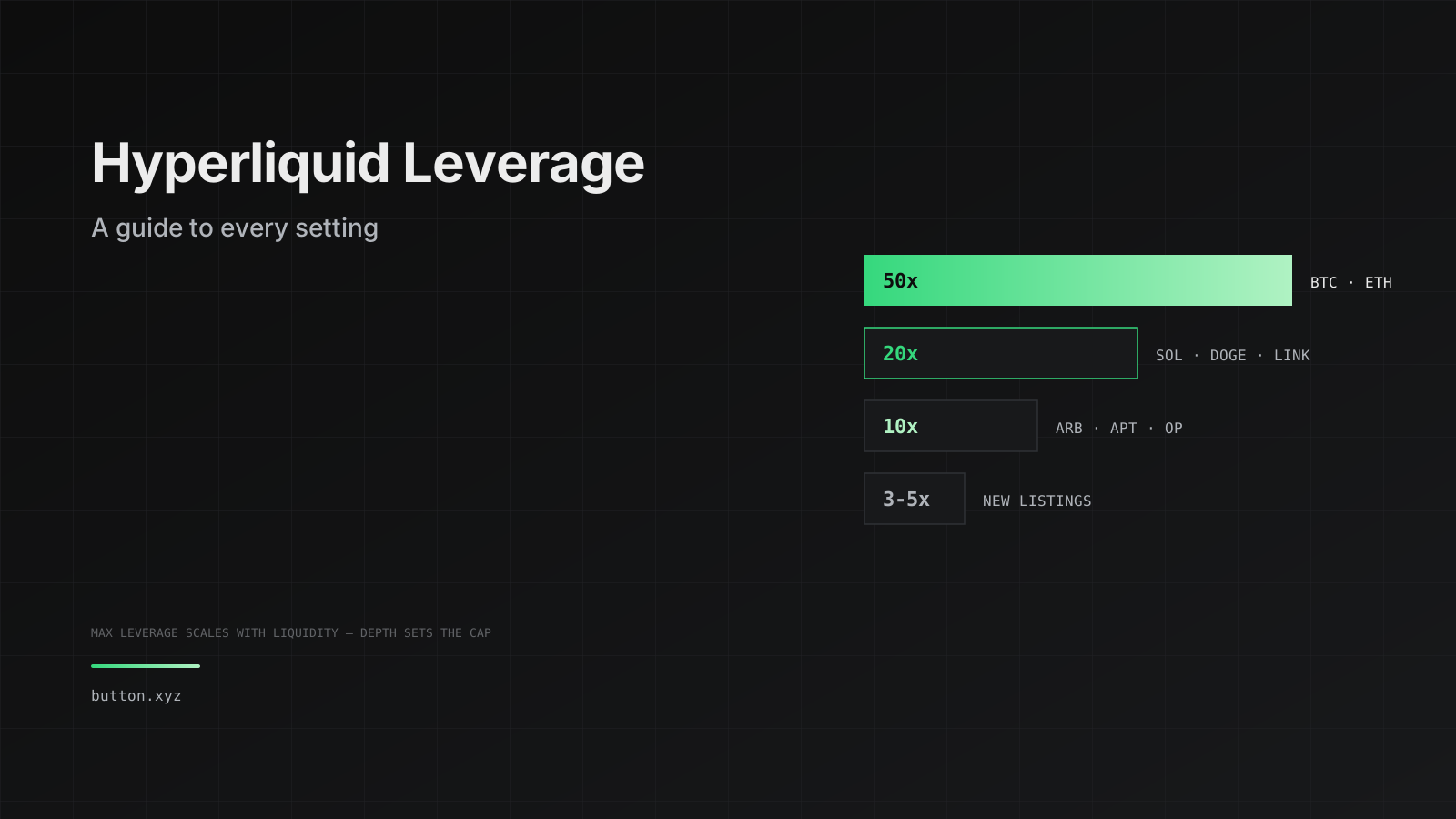
Hyperliquid sets different maximum leverage limits based on asset liquidity and volatility. More liquid assets allow higher leverage because they're less likely to gap through liquidation prices:
Major Assets (Highest Leverage)
| Asset | Max Leverage | Typical Spread | 24h Volume |
|---|---|---|---|
| BTC | 50x | 0.01% | $1–3B |
| ETH | 50x | 0.01% | $500M–1.5B |
BTC and ETH have the deepest order books on Hyperliquid — $5–10M of depth within 0.5% of mid price. This depth means liquidation engines can close positions without significant slippage, supporting higher leverage.
Large-Cap Assets
| Asset | Max Leverage | Typical Spread |
|---|---|---|
| SOL | 20x | 0.02–0.03% |
| DOGE | 20x | 0.03% |
| AVAX | 20x | 0.03% |
| LINK | 20x | 0.03% |
Liquid enough for substantial positions but with wider spreads than BTC/ETH. Liquidations at high leverage can cause 0.5–1% slippage on large positions.
Mid-Cap Assets
| Asset | Max Leverage | Typical Spread |
|---|---|---|
| ARB | 10x | 0.05% |
| APT | 10x | 0.05% |
| OP | 10x | 0.05% |
| INJ | 10x | 0.05% |
Reduced leverage limits reflect thinner order books. At 10x, a 10% adverse move triggers liquidation. Mid-cap tokens can move 10%+ in a day, so 10x is already aggressive for these assets.
Small-Cap / New Listings
| Asset | Max Leverage | Typical Spread |
|---|---|---|
| Newer listings | 3–5x | 0.1–0.5% |
| Low-liquidity pairs | 3x | 0.2–1% |
The most volatile assets get the lowest leverage caps. This is protective — 3x leverage on a token that can move 30% in a day is already equivalent to the risk of 50x on BTC.
Margin Modes
Hyperliquid supports two margin modes that fundamentally change how leverage and liquidation work:
Cross Margin
How it works: Your entire account balance acts as margin for all open positions. If one position moves against you, available margin from other positions (and unused balance) automatically backstops it.
Advantage: Capital-efficient. A $50,000 account can support a $100,000 BTC long and a $50,000 ETH short simultaneously, with each position's unrealized P&L affecting the overall margin pool. You don't need to pre-allocate margin to each position.
Risk: A single bad position can drain your entire account. If your BTC long moves sharply against you, it can consume margin meant for other positions — potentially triggering cascading liquidations of all positions as available margin evaporates.
Best for: Experienced traders running multiple correlated strategies who want maximum capital efficiency. Carry traders whose positions are naturally hedged (long spot, short perp on the same asset). See isolated vs cross margin for a detailed comparison.
Isolated Margin
How it works: Each position has a fixed, dedicated margin pool. A $100,000 BTC long at 10x isolated has exactly $10,000 backing it — no more, no less.
Advantage: Risk containment. If your BTC long is liquidated, you lose exactly $10,000 of allocated margin. Your ETH position, SOL position, and remaining balance are untouched.
Risk: Less capital-efficient. You need to pre-allocate margin to each position. Margin sitting idle in one position can't help another position that's under pressure.
Best for: Newer traders who want to cap risk per trade. Multi-asset strategies where positions are uncorrelated. Any situation where you want to guarantee "maximum loss = X" on a specific trade.
Switching Between Modes
On Hyperliquid, you can switch between cross and isolated margin per position. The switch takes effect immediately but requires that the position's margin ratio stays healthy after the switch. You can't switch to isolated margin if the allocated amount would put the position immediately into liquidation territory.
Liquidation Mechanics
How Liquidation Works
When your position's margin ratio falls below the maintenance margin requirement, Hyperliquid's liquidation engine closes the position:
- Maintenance margin breach: Your unrealized loss has consumed enough margin that the position is no longer safe to hold.
- Partial liquidation (if applicable): For large positions, Hyperliquid may liquidate a portion first rather than the entire position. This reduces the position to a sustainable size.
- Full liquidation: If partial liquidation isn't sufficient, the full position is closed at the best available price.
- Insurance fund: If the liquidation execution price is worse than the bankruptcy price (resulting in a loss beyond the trader's margin), the insurance fund covers the deficit. This prevents the loss from being socialized to other traders.
Liquidation Price Calculation
Your liquidation price depends on: entry price, leverage, margin mode, and maintenance margin rate.
Simplified formula (isolated margin, long position):
Liquidation Price = Entry Price × (1 − 1/Leverage + Maintenance Margin Rate)
At 10x leverage with a 0.5% maintenance margin on a $68,000 BTC entry:
Liquidation = $68,000 × (1 − 0.10 + 0.005) = $68,000 × 0.905 = $61,540
A $6,460 drop (9.5%) triggers liquidation. Use the liquidation calculator for exact numbers with your specific parameters.
Buffer Management
The distance between current price and liquidation price is your buffer — the margin of safety before liquidation triggers. Professional traders manage buffer, not leverage:
Minimum recommended buffers:
| Volatility Environment | Minimum Buffer |
|---|---|
| Low vol (BTC < 30% annualized) | 15% |
| Normal vol (30–50%) | 20% |
| High vol (50–80%) | 30% |
| Extreme vol (>80%) | 40% or close |
At 10x leverage on BTC, your buffer is approximately 9.5%. In a normal volatility environment, that's below the 20% recommendation — meaning 10x is too much leverage for overnight holds in normal conditions. At 5x, the buffer is approximately 19.5% — just meeting the recommendation.
The AI approach: The AI trading agent continuously monitors liquidation buffers across all positions and adjusts leverage dynamically. When volatility expands, leverage decreases automatically to maintain the target buffer. When volatility contracts, leverage can increase. See AI risk management for the full risk framework.
Leverage Strategy by Use Case
Scalping (Minutes to Hours)
Recommended leverage: 5–20x on BTC/ETH, 3–10x on alts.
Short holding periods mean limited exposure to adverse moves. The key risk is gap moves during your hold. BTC's typical hourly range is 0.5–1% — at 20x, that's a 10–20% swing on your margin per hour. Tight stop losses are essential.
Hyperliquid edge: Every entry and exit via limit order earns the −0.02% maker rebate. At 20x leverage on $200K notional, the round-trip rebate earns $80 — significant for scalpers making 10+ trades per day.
Swing Trading (Days to Weeks)
Recommended leverage: 2–5x on BTC/ETH, 2–3x on alts.
Multi-day holds must survive overnight moves and weekend volatility. BTC's typical weekly range is 5–15%. At 5x, a 10% adverse move costs 50% of your margin — survivable but painful. At 10x, that same move liquidates you.
Funding cost consideration: At 2–5x leverage, the funding rate is charged on notional, not margin. A $100K position at 5x ($20K margin) paying 0.02% funding per 8 hours costs $20 per settlement — $60/day — which is 0.3% of margin daily. Over a 2-week swing trade, that's 4.2% of margin in funding alone.
Carry Trading
Recommended leverage: 2–3x on the perp leg.
Carry trades (funding rate arbitrage) are delta-neutral when properly hedged, so directional risk is minimal. The leverage amplifies funding income: a 3x leveraged perp short earns 3x the funding rate on your margin. At 10% annualized funding, 3x leverage produces 30% on margin.
Risk: Basis risk — the spot and perp prices can temporarily diverge, creating unrealized losses on the perp leg. Low leverage ensures the position survives temporary basis expansion. At 3x, a 15% adverse basis move is needed for liquidation — well beyond normal deviation.
Grid Trading
Recommended leverage: 1–3x.
Grid bots accumulate inventory as price moves in one direction. At high leverage, accumulated inventory can push the position toward liquidation before the grid captures enough spread profits to compensate. Low leverage gives the grid room to work through full price cycles.
Optimal setup on Hyperliquid: 2x leverage, cross margin, with grid parameters set so the grid range covers the expected price range for the next 2–4 weeks. Every fill earns the maker rebate. See Hyperliquid strategies.
Common Leverage Mistakes
Using max leverage "because it's available." 50x leverage means a 2% adverse move liquidates you. BTC moves 2% in under an hour regularly. Max leverage is for hedging and very short-term scalps with immediate stops — not for directional views.
Same leverage for every asset. 10x on BTC (40% annualized vol) is very different from 10x on a meme coin (200%+ vol). Your leverage should be inversely proportional to the asset's volatility.
Ignoring funding at leverage. Funding is charged on notional. At 20x leverage, a 0.02% funding rate costs 0.4% of your margin per settlement — 1.2% per day. If your leveraged long isn't moving up fast enough to cover this, you're bleeding margin to the short side.
Adding leverage to losing positions. If a position is underwater, adding leverage (adding margin and increasing size) makes the next adverse move even more expensive. Reduce or close losing positions — don't average into them with more leverage.
FAQ
What's the maximum leverage on Hyperliquid?
50x for BTC and ETH. 20x for large-cap alts (SOL, DOGE, LINK). 3–10x for mid-cap and small-cap pairs. The limits adjust as liquidity changes — Hyperliquid may increase limits for assets that develop deeper order books.
Can I change leverage on an open position?
Yes. On Hyperliquid, you can adjust leverage on an existing position. Increasing leverage uses existing margin more aggressively (moves liquidation price closer). Decreasing leverage requires adding more margin (moves liquidation price further away).
Is higher leverage always worse?
No. Leverage is a tool. 5x leverage with a 2% stop loss risks 10% of margin — identical to 1x leverage with a 10% stop loss risking 10% of capital. The risk is the same; leverage just determines how capital-efficient the execution is. The problem is using high leverage without stops.
What happens if I get liquidated?
In isolated margin mode: you lose the margin allocated to that position. Other positions and unused balance are unaffected. In cross margin mode: the liquidation may consume available margin from other positions, potentially triggering further liquidations.
Use Leverage, Don't Let It Use You
Leverage amplifies your strategy — it doesn't create one. A profitable strategy at 1x is still profitable at 3x (with higher returns and drawdowns). An unprofitable strategy at 1x loses money faster at 3x. Get the strategy right first, then use leverage to optimize capital deployment.
Run leveraged strategies with the agent: the AI trading agent dynamically adjusts leverage based on volatility regime, maintains liquidation buffers across all positions, and optimizes capital deployment across carry, grid, and directional strategies on Hyperliquid.
Related: Isolated vs cross margin for the margin mode deep dive. Liquidation calculator for liquidation mechanics. Hyperliquid perps for the platform overview.