AI Portfolio Rebalancing for Crypto Traders
How AI-driven portfolio rebalancing works for crypto perps — dynamic allocation, regime-aware weighting, and automated risk adjustment.
Static portfolio allocation — 40% BTC, 30% ETH, 15% SOL, 15% alts — ignores that crypto market conditions change faster than any fixed allocation can handle. A 40% BTC weight during a trending BTC market leaves money on the table. That same 40% BTC weight during an alt-season wastes capital on the slowest-moving asset. And a balanced allocation during a crash means you're fully exposed when cash would be better.
AI portfolio rebalancing replaces fixed allocations with dynamic, regime-aware weighting. The system monitors market conditions, evaluates strategy performance, and reallocates capital based on what's working now — not what worked last quarter. For perpetual futures traders on Hyperliquid, this means automated adjustment of position sizes, strategy weights, and risk parameters across all active positions.
Why Static Allocation Fails in Crypto
Regime Changes Are Extreme
Crypto doesn't transition gradually between regimes. It snaps. BTC can shift from a 15% volatility environment to 60%+ in 48 hours. A portfolio optimized for calm markets — high leverage, tight stops, concentrated positions — blows up in a vol spike. A portfolio optimized for volatile markets — wide stops, low leverage, diversified — underperforms dramatically during a steady trend.
Traditional rebalancing (quarterly calendar rebalance, 5% threshold bands) is too slow. By the time a quarterly rebalance adjusts your allocation, the regime has already shifted and the damage (or missed opportunity) is done.
Correlation Shifts
During calm markets, BTC and altcoins have moderate correlation (0.4-0.6). A portfolio with BTC longs and altcoin longs has genuine diversification. During a crash, everything correlates to 0.9+ — your "diversified" portfolio moves as a single unit downward.
AI rebalancing monitors real-time correlation between positions and reduces exposure when correlation spikes. If your BTC long, ETH long, and SOL long all start moving in lockstep, the system recognizes the diversification benefit has disappeared and reduces total exposure accordingly.
Strategy Performance Varies
A carry strategy that earned 15% annualized last month might earn 2% this month because funding rates compressed. A grid strategy that captured 25% during a range-bound period might lose 5% when the range breaks. Sticking with a fixed allocation across strategies means you're always overweight the underperformer and underweight the outperformer.
How AI Rebalancing Works
Layer 1: Regime Classification
The agentic AI system classifies the current market environment across multiple dimensions:
Volatility regime: Low (<25% annualized), moderate (25-50%), high (50-80%), extreme (80%+). Each level has different optimal leverage, position sizing, and strategy weights.
Trend regime: Strong uptrend, mild uptrend, range-bound, mild downtrend, strong downtrend. Trend strength determines momentum strategy allocation and directional bias.
Funding regime: Elevated positive, normal, depressed, negative. Funding rate levels determine carry strategy allocation and pair selection.
Liquidity regime: Normal, thin (weekends, holidays), crisis (cascade events). Liquidity assessment determines position sizing constraints and stop-loss width.
The regime classifier updates every 1-4 hours using price data, volume, open interest, funding rates, and market microstructure indicators. See what is agentic trading for how the reasoning layer processes these inputs.
Layer 2: Strategy Weight Adjustment
Based on the regime classification, the system adjusts target weights across active strategies:
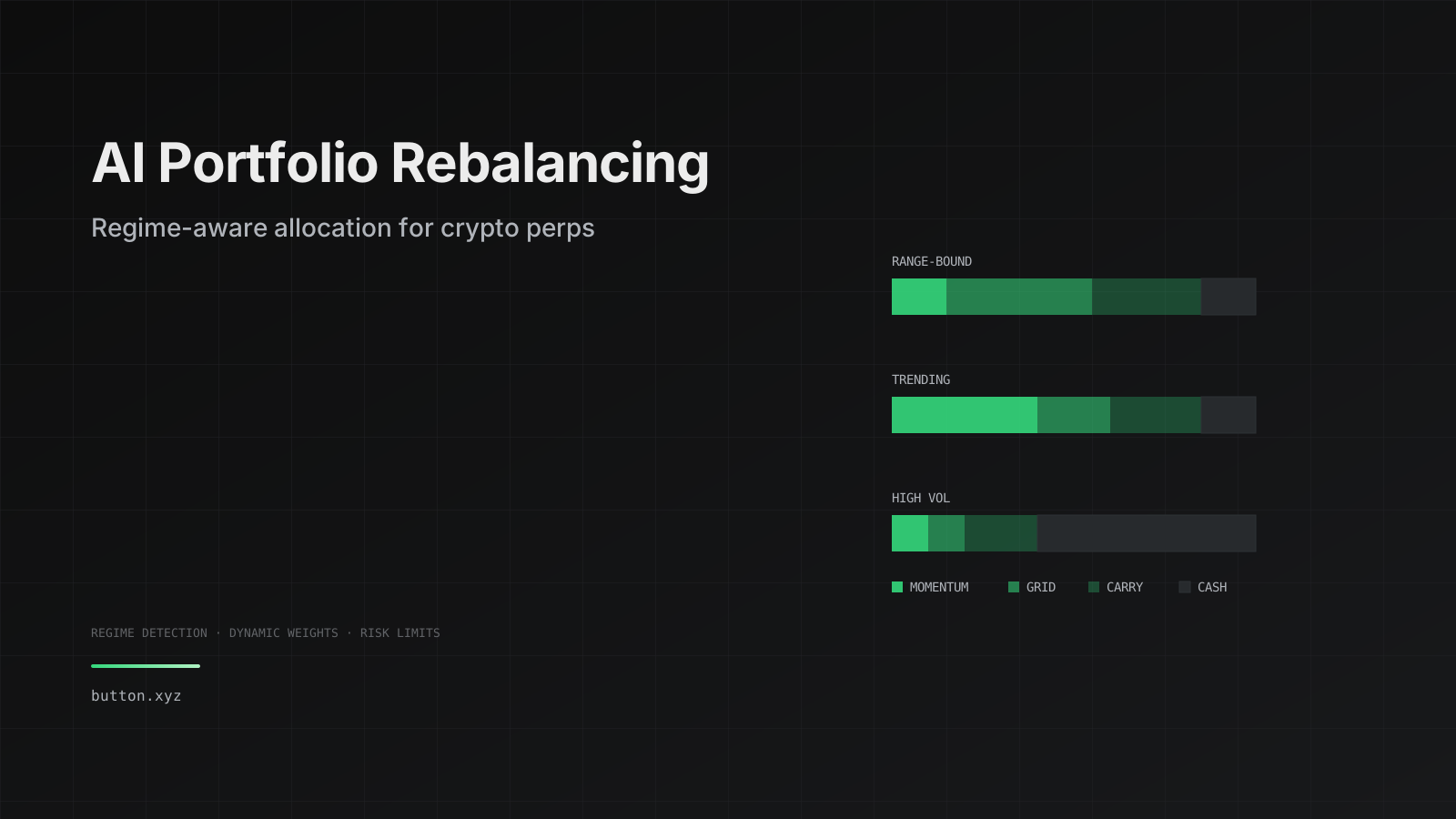
Trending + moderate vol → momentum overweight. Target: 40% momentum, 20% grid, 25% carry, 15% cash. Momentum captures the directional move. Grid works but underperforms in trends. Carry is steady income.
Range-bound + low vol → grid overweight. Target: 15% momentum, 40% grid, 30% carry, 15% cash. Grid captures range fills. Momentum generates whipsaw losses. Carry earns steady yield.
High vol + uncertain direction → cash overweight. Target: 10% momentum, 10% grid, 20% carry, 60% cash. Reduce exposure until the regime resolves. Carry is the safest active strategy. Cash earns zero but avoids drawdown.
Any regime + elevated funding → carry overweight. When Hyperliquid funding spikes across multiple pairs, carry allocation increases to capture the yield opportunity regardless of other regime factors.
Layer 3: Position-Level Rebalancing
Within each strategy allocation, the system adjusts individual positions:
Size adjustment. If BTC carry is allocated $30,000 and ETH carry is allocated $20,000, but ETH funding compresses to near-zero while SOL funding spikes to 0.20%, the system rotates: reduce ETH carry, add SOL carry. This happens automatically based on AI analysis of cross-pair funding opportunities.
Leverage adjustment. As volatility increases, the system reduces leverage on all positions to maintain the same liquidation buffer. If target liquidation buffer is 25% of entry price and vol doubles, leverage must roughly halve.
Correlation trimming. If the portfolio holds long BTC, long ETH, and long SOL perps, and 30-day rolling correlation between all three exceeds 0.85, the system trims the most redundant position (usually the worst-performing of the three) to reduce correlated exposure.
Layer 4: Risk Constraint Enforcement
All rebalancing decisions pass through deterministic risk rules before execution:
Maximum portfolio leverage: Hard ceiling (e.g., 3x). If the AI suggests allocations that would push total leverage above the ceiling, positions are scaled down proportionally.
Maximum per-asset exposure: No single asset exceeds a configurable percentage of total portfolio (e.g., 40%). Prevents concentration risk even when the AI is bullish on one asset.
Maximum drawdown circuit breaker: If the portfolio draws down more than a configured percentage (e.g., 10%) from peak, all positions reduce by 50% and the system enters "recovery mode" — a reduced-risk allocation until performance recovers.
**Liquidation buffer enforcement:** Every position must maintain a minimum distance between current price and liquidation price. The system refuses to add to positions that would compress the buffer below the minimum.
Rebalancing in Practice
Example: Regime Shift from Range to Trend
Initial state: Range-bound regime. Portfolio: 35% grid (BTC), 30% carry (ETH, SOL), 20% momentum (paused — no signal), 15% cash. Total capital $100K.
Day 3: BTC breaks above range with volume. Regime classifier updates to "trending" with moderate confidence.
Rebalance action:
- Grid allocation reduces from 35% → 20% (grid underperforms in trends)
- Momentum activates: 0% → 30% (BTC long, following breakout)
- Carry stays at 30% (unaffected by BTC trend)
- Cash increases from 15% → 20% (slightly more defensive during transition)
Day 7: Trend confirmed with high confidence. Altcoins following BTC upward. Correlation rising.
Rebalance action:
- Momentum increases to 35% (add ETH momentum alongside BTC)
- Grid further reduces to 15%
- Carry stays at 30% (funding has actually increased — carry yield improving)
- Cash holds at 20%
- Correlation monitor flags BTC + ETH momentum exposure → total directional exposure capped
Day 14: Volatility spikes to 70%+ annualized. Trend intact but moves are violent.
Rebalance action:
- All positions reduce leverage by 40%
- Momentum stops widened to accommodate higher vol
- Cash allocation increases to 25% (defensive buffer)
- Grid paused entirely (too volatile for tight grids)
- Carry continues with wider liquidation buffers
This sequence — passive to active to defensive — happens automatically. A human trader might make these adjustments over days. The AI system adjusts within hours.
Rebalancing Frequency
Too frequent: Rebalancing every hour generates excessive trading costs and tax events. Even with Hyperliquid's maker rebates, unnecessary position changes have market impact and execution risk.
Too infrequent: Monthly or quarterly rebalancing misses regime shifts. The market can transition from calm to crisis in days.
Optimal: The AI system evaluates every 1-4 hours but only executes rebalances when the target allocation differs from the current allocation by more than a threshold (e.g., 5% per strategy). This means several adjustments per week during active markets and fewer during stable periods.
Fee Optimization
Every rebalancing trade on Hyperliquid routes through post-only limit orders for the -0.02% maker rebate. The system queues non-urgent rebalances (strategy weight shifts) as limit orders with extended time-in-force, capturing the rebate rather than taking liquidity. Only urgent risk reductions (circuit breaker triggers) use aggressive orders.
Performance Expectations
AI rebalancing is primarily a risk management tool that secondarily improves returns:
Risk reduction: 25-35% lower maximum drawdown compared to static allocation, based on backtested results across 2023-2025 market data.
Return improvement: 5-15% higher risk-adjusted returns (Sharpe ratio improvement of 0.2-0.4). The improvement comes from avoiding the worst drawdowns and tilting toward the best-performing strategy in each regime.
What it won't do: AI rebalancing doesn't predict market direction. It doesn't generate alpha beyond what the underlying strategies provide. It optimizes capital deployment across strategies and protects against regime-inappropriate allocations.
FAQ
How is this different from a robo-advisor?
Traditional robo-advisors rebalance a stock/bond portfolio to fixed target weights. AI portfolio rebalancing adjusts the target weights themselves based on market regime analysis. The allocation is dynamic, not static.
Can I set my own risk parameters?
Yes. Maximum leverage, liquidation buffers, drawdown circuit breakers, and per-asset exposure limits are all configurable. The AI operates within your risk framework — it can suggest aggressive or conservative allocations, but your constraints are hard limits that can't be overridden.
What if the AI makes a bad rebalancing decision?
The deterministic risk layer prevents catastrophic errors. If the AI shifts heavily into momentum right before a crash, the drawdown circuit breaker triggers and reduces all positions. The worst case is a drawdown to your configured maximum — not a wipeout.
How much does rebalancing cost in fees?
On Hyperliquid, rebalancing actually earns fees via maker rebates. Each limit order fill earns -0.02% on notional. A rebalance that shifts $50K between strategies generates approximately $20 in rebate income. The net cost of rebalancing on Hyperliquid is negative — you're paid to rebalance.
Let Intelligence Manage the Mix
The market shifts. Your allocation should shift with it. AI portfolio rebalancing isn't about predicting the next move — it's about ensuring your capital is always deployed in the strategies and assets that fit the current environment, with risk controls that protect against regime changes.
Automate portfolio management with the agent: the AI trading agent dynamically allocates across carry, grid, momentum, and defensive strategies on Hyperliquid — adapting to regime changes, optimizing funding rate capture, and enforcing your risk parameters.
Related: AI trading strategies for the strategy suite. Funding rate arbitrage for market-neutral portfolios. Automated perp trading for the automation spectrum.