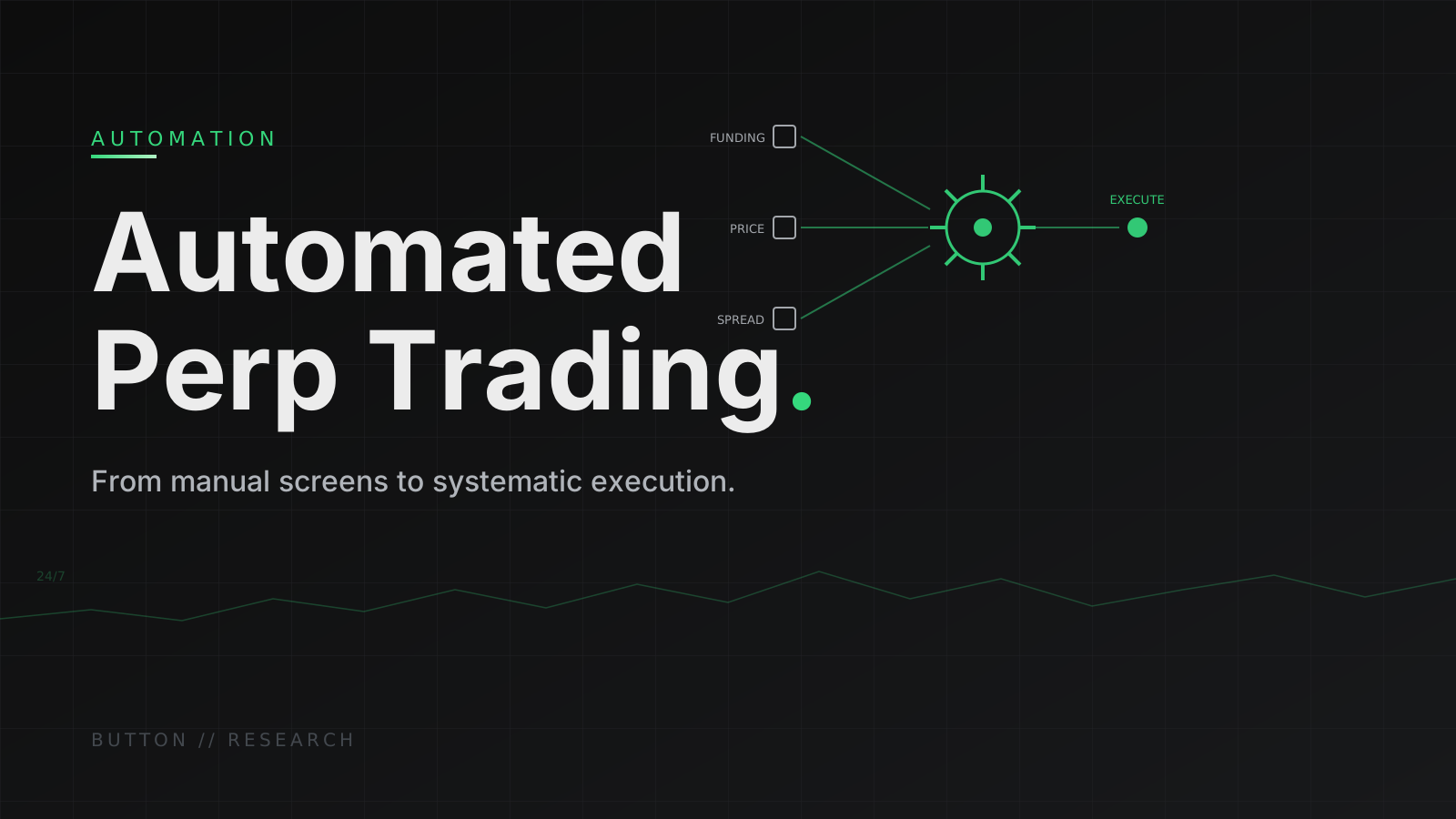
Automated Perp Trading: The Complete Guide
How to automate perpetual futures trading — strategy types, infrastructure, risk controls, and the shift from manual to systematic execution.
Manual perp trading has a ceiling. You can watch one screen, monitor one exchange, and manage a handful of positions. You sleep 8 hours, eat, and step away from the screen. During those hours, funding rates spike, liquidation cascades create buying opportunities, and cross-exchange spreads open and close — all while you're absent.
Automated perpetual futures trading removes the human bottleneck. A system that monitors 100+ pairs across 4 exchanges simultaneously, executes within milliseconds of a signal, and manages risk 24/7 captures opportunities that manual traders structurally cannot.
This guide covers the full automation spectrum — from simple alert-based execution to fully autonomous agentic AI systems — with the practical details: what to automate, what infrastructure you need, how to manage risk, and where the breakeven points are.
The Automation Spectrum
Not everything needs to be automated. And not everything should be manual. The spectrum:
Level 1: Alerts only. The system monitors conditions and sends you an alert (Telegram, Discord, email). You decide whether to act and execute manually. No code execution risk. Latency: minutes to hours (depends on when you see the alert).
Level 2: Semi-automated. The system identifies opportunities and proposes trades. You approve with one click. The system executes the approved trade via API. Human judgment on entry, machine execution. Latency: seconds.
Level 3: Fully automated. The system identifies, decides, and executes without human intervention. Pre-defined strategy rules and risk limits govern behavior. You monitor performance but don't approve individual trades. Latency: milliseconds.
Level 4: Autonomous/agentic. The system not only executes but adapts — adjusting strategy parameters, position sizing, and venue selection based on changing market conditions. See agentic AI trading for how this works.
Most traders should start at Level 2 and progress to Level 3 after building confidence in their strategy and infrastructure.
What to Automate First
Some strategies benefit dramatically from automation. Others gain little. Prioritize by the ratio of automation benefit to implementation complexity:
High Automation Benefit
Carry/basis trades: Monitoring funding rates across exchanges, entering when spreads exceed thresholds, managing margin, exiting when funding compresses. The signals are quantitative, the execution is mechanical, and the strategy runs 24/7. A carry bot captures 20-40% more yield than manual execution because it never misses a funding settlement or a spread opportunity. See basis trade crypto.
Grid trading: Placing and managing 20-40 limit orders across price levels requires constant adjustment as prices move. Humans can't maintain a grid manually — every fill needs a replacement order. Bots handle this natively. On Hyperliquid, the maker rebate (-0.02%) means every grid fill earns fees, making grid automation especially profitable.
Cross-exchange arbitrage: Monitoring funding rate and price spreads between Hyperliquid, Binance, dYdX, and OKX simultaneously requires processing 4+ data streams in real-time. Spreads open for minutes to hours. A bot that detects and captures a 0.05% price discrepancy on $100K notional earns $50 per occurrence. Over 20 occurrences per month, that's $1,000 — with near-zero directional risk.
Moderate Automation Benefit
Trend following: Signal generation (moving average crossovers, breakouts) is easily automated. But trend following involves long holding periods where the bot mostly monitors. The automation benefit comes from consistent stop management — humans move stops, cancel them, or ignore them under emotional pressure.
Mean reversion: Identifying extreme readings (RSI >80, price at 2-sigma band) and entering counter-trend. Automation ensures every signal gets executed, but the strategy has fewer trades per month (5-15) compared to grid or carry.
Low Automation Benefit
Discretionary event trading: Anticipating market reactions to news, regulatory announcements, or exchange listings. Human judgment adds value here. Automate the execution (speed of entry/exit), keep the decision manual.
Macro directional: Multi-week positions based on fundamental analysis. One trade per month doesn't require automation. Focus on position sizing and stop discipline instead.
Infrastructure Requirements
Exchange Connectivity
Minimum viable setup:
- WebSocket connection to Hyperliquid API for real-time data
- REST API for order management
- Python or Node.js runtime on a cloud server
Production setup:
- WebSocket connections to 2-4 exchanges (Hyperliquid, Binance, dYdX, OKX)
- Database for historical data and trade logging (PostgreSQL or TimescaleDB)
- Monitoring dashboard (Grafana or custom)
- Alerting system (PagerDuty, Telegram bot, or similar)
Infrastructure cost: $20-50/month for basic cloud VPS (DigitalOcean, AWS Lightsail). $100-300/month for production-grade with database and monitoring. For most traders, a $40/month VPS running Python is sufficient.
Latency Considerations
Carry and grid bots: Latency doesn't matter much. Funding settlements happen every 8 hours. Grid fills are on a seconds-to-minutes timescale. A 200ms latency is fine.
Arbitrage bots: Latency matters. Cross-exchange price discrepancies close within seconds. Sub-50ms to each exchange is ideal. Co-location near exchange servers ($200-500/month) provides an edge.
Trend and signal bots: Moderate importance. Entering on a breakout benefits from sub-second execution, but the trade timeframe (hours to days) means 100ms vs 10ms is immaterial.
Hyperliquid's WebSocket provides 50-100ms latency from most cloud regions. The API guide covers connection optimization.
Risk Controls for Automated Systems
Automated systems execute faster than humans can intervene. This makes pre-programmed risk controls essential — a bug or unexpected market condition can cause significant losses in seconds.
Pre-Trade Checks
Every order the bot generates should pass through a validation layer before reaching the exchange:
- Size check: Is this order within the maximum position size limit? Reject if too large.
- Leverage check: Would this order push portfolio leverage above the defined ceiling? Reject or reduce size.
- Margin check: Is there sufficient free margin for this order? Reject if margin is insufficient.
- Duplicate check: Is there already an identical order pending? Reject duplicates.
- Rate check: Has the bot placed too many orders in the last minute? Throttle if rate seems anomalous (could indicate a bug).
Runtime Limits
- Maximum daily loss: If daily P&L drops below -2% of equity, close all positions and pause for 24 hours. This prevents a losing streak from compounding into a catastrophic drawdown.
- Maximum position per asset: Cap exposure to any single asset at 20-30% of equity. Prevents concentration risk.
- Maximum open positions: Limit the total number of concurrent positions. An unconstrained bot might open 50 positions during a volatility spike — each individually sized but collectively exceeding risk limits.
- Liquidation buffer: Maintain minimum distance between current price and liquidation price. If the buffer drops below 25%, reduce the position automatically.
Kill Switch
A mechanism to instantly:
- Cancel all open orders
- Close all positions (market orders)
- Pause all strategy logic
The kill switch should be accessible via:
- A command in the bot's interface (Telegram command, API endpoint)
- The exchange interface (cancel all + close all)
- An automated trigger (if equity drops 15%+ from peak)
Test the kill switch monthly. A kill switch you've never tested is a kill switch that might not work when you need it.
Building vs Buying
Build Your Own
Pros: Complete control over strategy logic, risk parameters, and execution. No dependency on third-party infrastructure. Lower ongoing cost (infrastructure only, no subscription).
Cons: Significant development time (2-6 months for a production-quality system). You maintain everything — bugs, exchange API changes, infrastructure failures. Technical skills required (Python/TypeScript, API integration, database management).
Best for: Traders with engineering backgrounds running custom strategies that need precise control. Capital: $50K+ to justify the development investment.
Use Pre-Built Solutions
Pros: Deploy in hours or days instead of months. Professional infrastructure, monitoring, and risk management built in. Strategy updates and exchange integration handled by the provider.
Cons: Monthly subscription cost. Less customization of strategy logic. Dependency on provider's infrastructure and uptime.
Best for: Traders who want automation benefits without building from scratch. Strategies that fit standard templates (grid, carry, trend). Capital: $5K+ (the subscription needs to be small relative to expected returns).
The AI Trading Agent
The AI trading agent represents a middle path — autonomous execution with agentic capabilities (adaptive sizing, venue optimization, regime awareness) without requiring you to build the system. It connects directly to Hyperliquid and executes carry, grid, and directional strategies with built-in risk controls.
Measuring Automation Success
Track these metrics before and after automating:
Trade capture rate: How many valid signals did you act on? Manual traders typically capture 40-60% of their strategy's signals (missed during sleep, distraction, hesitation). Automated systems capture 95-100%.
Execution quality: Average slippage, fill rate on limit orders, maker vs taker ratio. Automated limit-order routing on Hyperliquid should achieve 80%+ maker fills, earning the -0.02% rebate on most volume.
Consistency: Standard deviation of daily returns. Automated execution should reduce variance — no revenge trades, no FOMO entries, no skipped stops.
Time savings: Hours per week spent on manual execution and monitoring. Automation typically saves 20-40 hours/week for active traders. The freed time can go into strategy research and development.
FAQ
Is automated perp trading profitable?
Automation itself doesn't create profitability — it improves the execution of profitable strategies. If your manual strategy has an edge, automation captures more of that edge more consistently. If your strategy doesn't have an edge, automating it just loses money faster with less emotional pain.
How much capital do I need to start?
$5,000 minimum for a single-strategy bot on Hyperliquid. The maker rebate means even small automated volume is fee-positive. $20,000+ for multi-strategy automation. $50,000+ for cross-exchange setups. See the Hyperliquid bot guide for strategy-specific minimums.
Can I automate on multiple exchanges?
Yes. Cross-exchange automation (carry arbitrage, price arbitrage, venue-optimal routing) is one of the highest-value automation use cases. It requires capital on each exchange and separate API connections but captures opportunities unavailable to single-venue traders.
What happens if the bot crashes?
Open positions remain on the exchange. Orders stay active until filled or cancelled. When the bot restarts, it should: 1) read current positions, 2) read open orders, 3) reconcile against expected state, 4) resume or adjust. Build crash-recovery logic before deploying capital.
Will automation make me a better trader?
It makes you more consistent. Automation eliminates emotional decisions (revenge trades, FOMO, moved stops) and ensures every signal gets executed. For perps traders with a defined edge, consistency is what converts a good strategy into good returns.
Start Systematic
The gap between manual and automated execution widens with every trade. On 100 trades, the difference is marginal. On 10,000 trades, it's transformational — compounded fee savings, captured opportunities, and eliminated emotional errors.
Automate perp trading with the agent: the AI trading agent connects to Hyperliquid, executes multiple strategies simultaneously, optimizes maker-rebate capture, and manages risk with hard circuit breakers. Connect wallet and move from manual to systematic.
Related: Autonomous trading bot for agent architecture. Hyperliquid bot for Hyperliquid-specific setup. AI crypto trading bot for the bot landscape.