AI Crypto Trading Bots: How They Work and How to Pick One
How AI crypto trading bots actually work, where they fail, and how to evaluate one before trusting it with capital.
Most "AI trading bots" aren't AI. They're rule-based scripts with a marketing budget. A grid bot that buys at $60,000 and sells at $61,000 isn't making intelligent decisions — it's executing a static instruction. The label "AI" gets slapped onto anything automated because it converts better on landing pages.
This matters because traders choosing a bot based on the wrong criteria lose money. The difference between a rule-based bot and an agentic AI system is the difference between a thermostat and a trader. One reacts to a threshold. The other reads context, weighs risk, and adapts.
Here's how to evaluate crypto trading bots by what they actually do, not what they claim.
The Bot Landscape: Four Categories
Every crypto trading bot falls into one of four categories. Understanding which category a product occupies tells you more than any feature list.
1. Signal Bots
Signal bots generate trade alerts based on technical indicators — RSI crossovers, MACD divergences, moving average crosses. You receive the signal; you execute the trade manually or through a connected exchange.
What they are: Alert systems with conditional logic. If RSI drops below 30 and MACD crosses up, send notification.
What they aren't: They don't execute, don't manage risk, and don't adapt to changing conditions. The signal is the same whether the market is trending, ranging, or crashing.
Typical cost: $20–$100/month for signal subscriptions. Most offer backtested results that look better than live performance because of curve-fitting and survivorship bias.
The problem: Signal accuracy of 55% sounds good until you factor in slippage, fees, and the 3-second delay between receiving the alert and placing the trade. In perpetual futures markets moving 2-3% daily, that delay erodes edge.
2. Grid Bots
Grid bots place a ladder of buy and sell orders across a price range. If BTC is at $65,000, the bot might place buys every $500 below and sells every $500 above. It profits from oscillation within the range.
What they are: Mechanical order placement. No prediction, no adaptation. Pure mean-reversion assumption.
Strengths: Simple to configure. Work well in ranging markets. Consistent small profits when volatility stays within the grid.
Weaknesses: Catastrophic in trending markets. If BTC drops from $65,000 to $50,000, every buy order fills and keeps filling — you're accumulating a massive losing position. Grid bots have no concept of regime change.
Typical cost: Free to $50/month. Most exchanges (Binance, Bybit) offer built-in grid bots at no extra cost.
3. Execution Bots (DCA, TWAP, VWAP)
Execution bots optimize how you enter and exit positions, not when. A TWAP (Time-Weighted Average Price) bot splits a large order across hours to minimize market impact. A DCA bot buys fixed amounts at regular intervals.
What they are: Order execution algorithms. They assume you've already decided the direction; they handle the mechanics.
Strengths: Reduce slippage on large orders. DCA smooths entry price over time. VWAP bots match volume patterns to minimize footprint.
Weaknesses: No edge generation. They don't tell you what to trade or when to stop. A DCA bot will keep buying into a 50% crash if you don't set a kill switch.
Typical cost: Built into most exchange APIs. Third-party TWAP tools run $50–$200/month.
4. Agentic AI Bots
Agentic AI represents a fundamentally different architecture. Instead of executing predefined rules, an agentic system reasons about market state, evaluates multiple data sources, and makes autonomous decisions across a multi-step workflow.
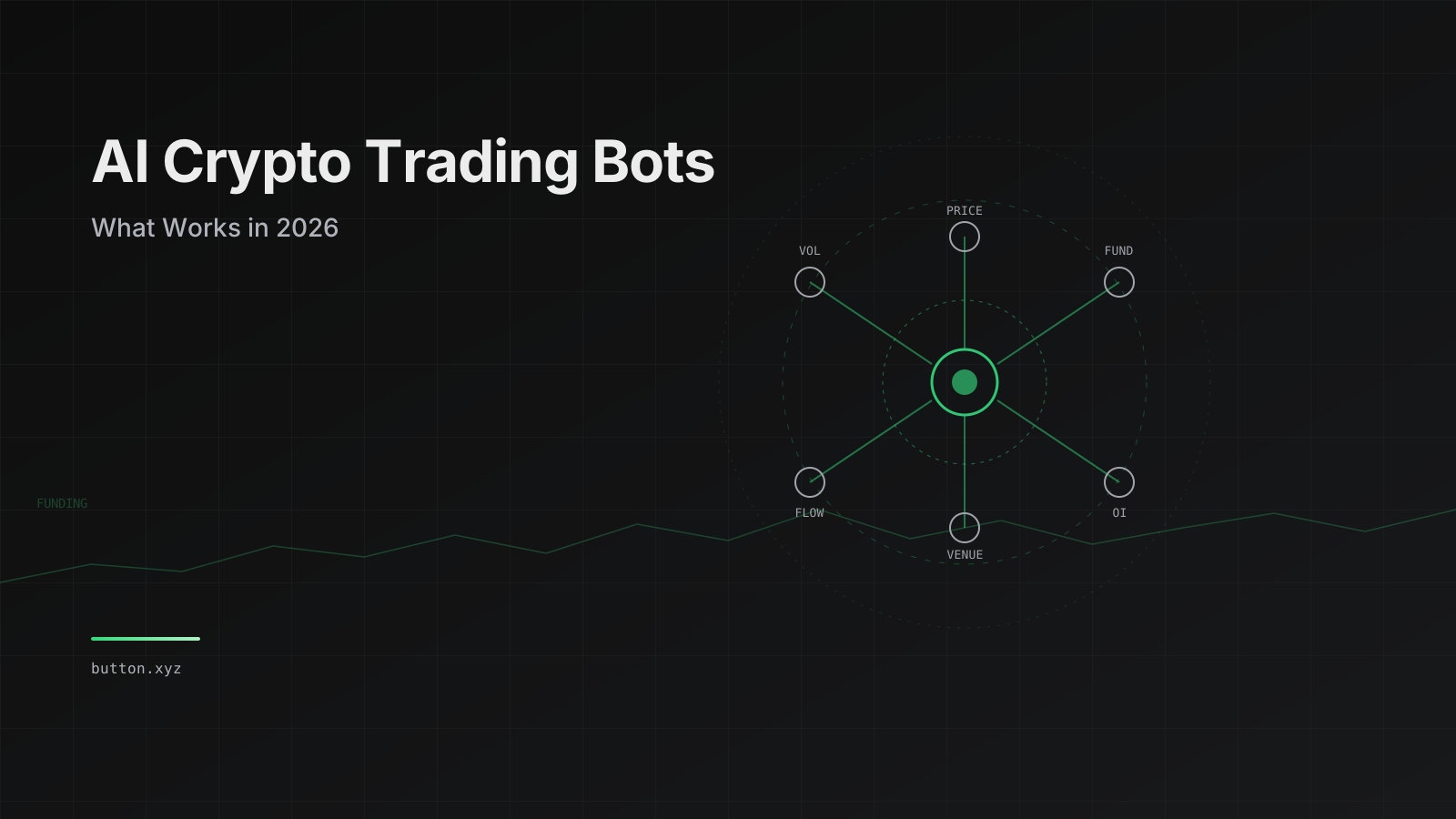
What they are: Autonomous agents that observe market conditions (funding rates, open interest, order flow, volatility regime), evaluate strategy fitness, size positions based on current risk, execute across venues, and adjust or exit based on evolving conditions.
How they differ from rule-based bots:
- A grid bot sees price at $65,000 and places orders. An agentic bot sees price at $65,000, checks that funding is 0.08% (extremely elevated), notes open interest is at a 30-day high, recognizes this as a leverage peak, and decides to short rather than grid.
- A signal bot fires when RSI hits 30. An agentic bot evaluates whether RSI 30 means the same thing in a trending bear market (it doesn't) versus a bull pullback (it might).
- An execution bot splits your order over 4 hours. An agentic bot decides whether to execute on Hyperliquid (lower fees, thinner depth) or Binance (higher fees, deeper book) based on your order size and current spread.
The tradeoff: Agentic AI requires more trust in the system's reasoning. You're delegating not just execution but judgment. This only works if the agent's risk management is transparent and constrained.
What "AI" Actually Means in Most Trading Bots
Here's the uncomfortable truth: 90%+ of products marketed as "AI trading bots" use no machine learning at all. They use:
- If-then rules dressed up as "strategy AI"
- Parameter optimization (backtesting hundreds of indicator combos and picking the best one — this is curve-fitting, not intelligence)
- Sentiment scrapers that count positive vs. negative tweets (correlation to price is near zero on any actionable timeframe)
- ChatGPT wrappers that generate trade ideas from prompts (language models are not price prediction engines)
Real AI in trading means the system improves its decision-making based on outcomes. It means the agent adapts position sizing when volatility regime changes, shifts venue allocation when liquidity conditions move, and recognizes when its own signals are degrading.
The bar for "AI" should be: does the system make a different decision tomorrow than it would today, based on what it learned from execution? If the answer is no, it's automation, not intelligence.
Evaluation Framework
When comparing trading bots, assess these five dimensions:
Latency and execution quality. How fast does the bot place orders after generating a signal? On perps markets where 50ms matters, a bot running through a third-party API adds latency. Bots with direct exchange integration (WebSocket connections, batch orders) execute faster. Hyperliquid's API supports 100 requests/second with ~50-100ms WebSocket latency — bots optimized for this venue have a structural advantage.
Strategy flexibility. Can the bot run multiple strategy types, or is it locked into one approach (grid only, DCA only)? Agentic systems can switch between directional, market-neutral, and carry strategies based on regime. Rule-based bots can't.
Risk management. Does the bot have hard position limits, portfolio-level heat tracking, and drawdown circuit breakers? A bot that can go 10x long with no max-loss parameter is a liquidation waiting to happen. The best systems enforce risk constraints that the user can configure but not disable.
Venue support. Does the bot connect to the venues where you trade? For perp traders, Hyperliquid and Binance coverage is table stakes. Some bots only support spot exchanges, making them useless for perpetual futures trading.
Transparency. Can you see why the bot made a decision? Agentic systems that log their reasoning chain — "funding is elevated, OI rising, entering short at 3x" — give you auditability. Black-box systems that just show trades without context make it impossible to evaluate whether the bot's logic is sound.
Why Hyperliquid Is the Optimal Venue for Bot Trading
Most trading bots are venue-agnostic in theory but not in practice. The venue's fee structure, API quality, and market microstructure determine whether a bot strategy is profitable.
Hyperliquid offers structural advantages for automated trading:
Maker rebates (-0.02%) mean market-making bots earn fees instead of paying them. A bot placing 1,000 maker orders per day on $10M notional earns $2,000/day in rebates alone — before P&L.
No taker fee penalty at Tier 3 (0.025%) makes aggressive strategies viable. On Binance, a 0.10% taker fee means your strategy needs 20 bps of edge just to break even on round-trips.
API quality — WebSocket connections, batch order support, and sub-100ms latency — lets bots react to funding rate changes, liquidation events, and order flow shifts in near-real-time.
On-chain transparency means bots can read the full order book state, insurance fund balance, and open interest data directly from the chain. No hidden information asymmetry.
For a detailed breakdown of Hyperliquid's API and bot support, see the Hyperliquid review.
Limitations and Risks
No trading bot — AI or otherwise — eliminates risk. Here's what can go wrong:
Overfitting. Bots optimized on historical data perform well in backtests and poorly live. The past doesn't predict the future in markets. Look for bots that use walk-forward optimization or out-of-sample testing, not just in-sample backtests.
API failures. Exchange APIs go down. WebSocket connections drop. If your bot can't handle disconnections gracefully (close positions, cancel open orders), a 5-minute outage during a 10% move can be catastrophic.
Liquidity illusion. A bot backtested on BTC with deep liquidity won't perform the same on a thin altcoin. Slippage on live execution eats theoretical profits. Always test with small position sizes on the actual venue.
Correlation in tail events. Every market-neutral strategy has a scenario where both legs move against you. March 2020, May 2021, November 2022 — these events don't show up in backtests that only cover calm periods.
Delegation risk. Giving a bot access to your capital requires trust in both the code and the operator. Non-custodial setups (bot trades through your wallet, never holds your funds) reduce this risk. Custodial bot services that hold your funds add exchange-level counterparty risk on top of strategy risk.
FAQ
Do AI crypto trading bots actually make money?
Some do, most don't. The bots that consistently profit tend to be funding rate arbitrage strategies, market-making bots on venues with maker rebates, and execution optimization tools that reduce slippage. Directional bots — the ones claiming 200% annual returns — almost always degrade in live conditions due to overfitting, regime change, and slippage. Evaluate any bot by its live track record (not backtests), risk-adjusted returns (Sharpe ratio, max drawdown), and fee structure.
What's the difference between a trading bot and an AI trading agent?
A bot executes predefined rules. An agent reasons about context and makes autonomous decisions. A crypto trading bot that runs a grid strategy will place the same orders regardless of market regime. An AI agent evaluates funding rates, volatility, liquidity conditions, and open interest before deciding whether to trade, how much to size, and on which venue. The agent adapts; the bot repeats.
Are trading bots legal?
Automated trading is legal in most jurisdictions. The regulatory concern is with the venue (trading unregistered derivatives) and the bot's marketing (claiming guaranteed returns). Using a bot on a DEX like Hyperliquid has different regulatory implications than using one on a regulated exchange. Consult local counsel.
How much capital do I need to run a trading bot?
Depends on the strategy. Grid bots on BTC need $5,000+ to set a meaningful grid range. Funding rate arbitrage requires $10,000+ to generate material carry income after fees. Market-making bots need $50,000+ to provide meaningful depth. Start with the minimum viable capital for your strategy and scale up as you validate performance.
Can a bot trade perpetual futures on Hyperliquid?
Yes. Hyperliquid's API supports full programmatic access to the perps order book — placing orders, managing positions, reading funding data, and tracking liquidation levels. The WebSocket API provides real-time fills and order updates. Most serious perp trading bots support Hyperliquid natively.
The Agent Approach
The trading bot market is converging on a truth: automation without intelligence is a timer on your capital. Rule-based bots work until the rules break. Signal bots work until the signals decay. Grid bots work until the market trends.
Agentic AI doesn't solve the fundamental uncertainty of markets. But it solves the adaptation problem: when conditions change, the agent changes with them. It doesn't keep buying into a crash because the grid says to. It doesn't hold a carry trade when funding inverts. It reasons, adjusts, and manages risk as a human trader would — but without fatigue, emotion, or 3 AM gaps in attention.
Deploy an AI perp strategy with the agent — define your risk parameters, choose your strategy type, and let the AI trading agent handle execution, sizing, and venue selection on Hyperliquid. No code required. Full transparency on every decision.