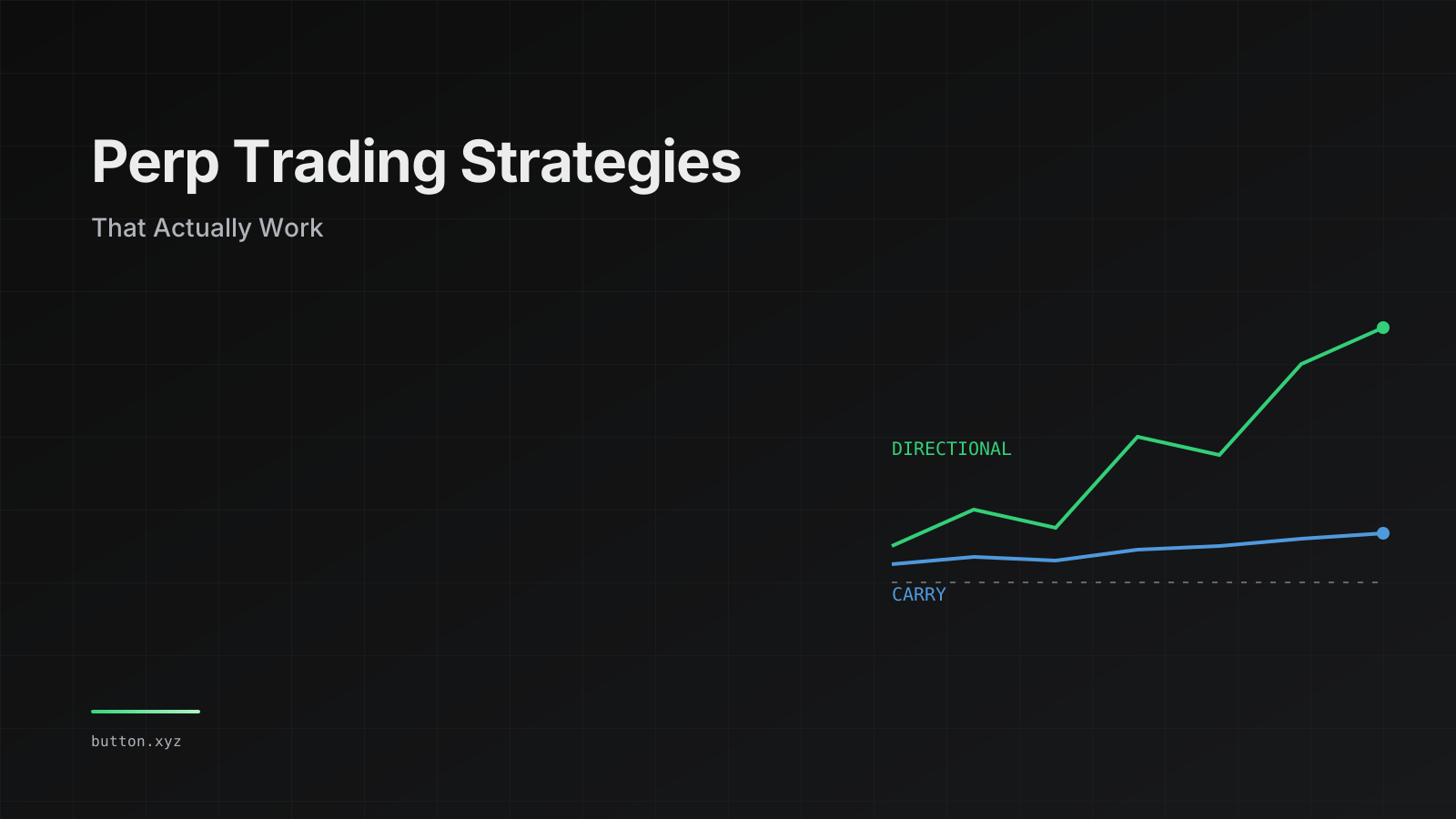
Perp Trading Strategies That Actually Work
Proven perpetual futures strategies — directional, carry, pairs, and event-driven approaches with sizing rules and risk frameworks.
Strategy without structure is gambling with extra steps. You might hit a directional call, but without a framework for sizing, risk, and exit — without a system — that win is noise. This page covers perpetual futures strategies that professional traders actually run, with the mechanics, the math, and the risk parameters that make them repeatable.
This isn't a list of "top 10 strategies." It's a framework for matching your edge, capital, and risk tolerance to a strategy bucket. If you're new to perpetual futures, start there first. If you understand the instrument and want to trade it systematically, this is the playbook.
Strategy Selection Framework
Before choosing a strategy, answer three questions:
What's your edge? Direction-calling, funding rate capture, execution speed, or volatility estimation? Your edge determines your strategy bucket. Most traders think their edge is direction-calling. Most are wrong — their P&L is dominated by sizing errors, not signal errors.
What's your capital? Strategies have minimum capital thresholds. A carry trade needs $20,000+ to generate meaningful yield. Market making needs $50,000+. Directional at low leverage works with $5,000. Choosing a strategy that doesn't match your capital is a structural disadvantage.
What's your time commitment? Scalps require screen time. Carry trades require weekly monitoring. Pairs trades require daily rebalancing. Match the strategy to your availability, or automate the parts you can't monitor.
Directional Strategies
Trend Following
Trade in the direction of the established trend. Long when price is above the 20-day moving average and momentum is positive. Short when below and negative.
Mechanics: Enter a leveraged long (2-3x) when BTC breaks above a defined level with volume confirmation. Set a stop loss at 1.5x your daily ATR below entry. Trail the stop as price advances. Exit when the trend reverses — defined as price closing below the 20-day MA for two consecutive periods.
Sizing: Risk 1-2% of total equity per trade. At 3x leverage on BTC, a stop at 5% below entry risks 15% of margin. If margin is $10,000 and total equity is $50,000, you're risking $1,500 (3% of equity). Acceptable.
Where it works: Trending markets. BTC has multi-week trending phases 40-50% of the time. ETH and SOL trend less cleanly but with higher magnitude moves.
Where it fails: Choppy, range-bound markets. Trend following gets whipsawed — entering long, getting stopped out, reversing short, getting stopped again. Expect 40-50% win rate. The edge comes from letting winners run further than losers cut.
Best venue: Hyperliquid for lower fees on the stop-out churn. Maker rebates reduce the cost of re-entry after stops trigger.
Mean Reversion
Trade against extreme moves, betting on price returning to a mean. Short when RSI > 80, long when RSI < 20. Or more sophisticatedly: short when price is 2+ standard deviations above the 20-day VWAP, long when 2+ below.
Mechanics: Enter counter-trend at 2-3x leverage with a tight stop (1x ATR beyond the extreme). Target: return to the 20-day mean. Time limit: if the trade doesn't work within 48 hours, exit — the regime may have shifted.
Sizing: Smaller than trend following — mean reversion trades fail catastrophically when the extreme extends. Risk 0.5-1% of equity per trade.
Where it works: Range-bound markets, post-liquidation-cascade bounces, and assets near structural support/resistance.
Where it fails: Breakouts. If BTC is at RSI 80 because it just broke $100,000, shorting the "overbought" reading is fighting a regime change. Mean reversion requires confirming the range before fading the move.
Event-Driven Directional
Take leveraged positions ahead of known catalysts: network upgrades, token unlocks, regulatory announcements, exchange listings.
Mechanics: Identify the catalyst and expected market reaction. Enter 24-48 hours before the event with 3-5x leverage. Set a stop at 2x the expected daily move in the wrong direction. Target: 2-3x the stop distance.
Example: Ethereum upgrade scheduled for Tuesday. Historical pattern: ETH rallies 5-8% in the 3 days before major upgrades, then sells off 3-5% post-event ("sell the news"). Enter long Friday at 3x, stop at -5% ($3,400 on $68,000 notional = $10,200 risk). Target: +8% ($5,440 profit). Close before the upgrade or trail stop into the event.
Risk: Events are binary. If the outcome surprises — delayed upgrade, security incident, unexpected regulatory action — the move can exceed your stop by 2-3x (gap through your level). Only risk capital you can afford to lose entirely on event trades.
Carry Strategies
Spot-Perp Basis Trade
The most reliable carry strategy in crypto. Buy spot asset, short the perp at equal notional, collect funding rate payments.
Mechanics:
- Buy $50,000 of BTC spot
- Short $50,000 of BTC perp on Hyperliquid (limit order, post-only for maker rebate)
- Collect funding every 8 hours (positive funding = shorts receive)
- Close both legs when funding compresses below your break-even threshold
Yield calculation: At 0.02% per-8-hour funding (7.3% annualized) plus Hyperliquid maker rebate (-0.02% per fill), the all-in yield is approximately 7-9% annualized on a $100,000 combined position. That's $7,000-$9,000/year with near-zero directional risk.
Risk: Funding inversion (you pay instead of collect), basis expansion (mark-to-market loss on the short), spot custody risk, and smart contract risk. See funding rate arbitrage for the complete risk framework.
Minimum capital: $20,000 for meaningful yield. Professional carry operations run $500K+.
Cross-Exchange Carry
Exploit funding rate differences between venues. Long perp on the low-funding exchange, short perp on the high-funding exchange, pocket the spread.
Mechanics: Monitor BTC funding on Hyperliquid (6% annualized) vs. Binance (2% annualized). Short BTC perp on Hyperliquid, long BTC perp on Binance. Net carry: 4% annualized on combined notional.
Risk: Split capital reduces position size on each exchange. A sharp BTC move can liquidate one leg before the other compensates. Requires margin management across two venues and tolerance for basis divergence.
Market-Neutral Strategies
Pairs Trading
Long one asset, short another, betting on relative performance. Classic crypto pair: long ETH, short BTC (betting ETH outperforms). Or long SOL, short ETH (betting Solana ecosystem outperforms Ethereum).
Mechanics: Size both legs equally in dollar notional. Long $25,000 ETH perp, short $25,000 BTC perp. P&L depends entirely on the ratio — if ETH gains 5% and BTC gains 2%, you earn 3% on $25,000 = $750.
Edge: Pairs trades work when you understand the structural drivers of relative performance. ETH outperforms BTC during DeFi expansion phases. SOL outperforms during meme coin cycles. BTC outperforms during macro risk-off (flight to quality within crypto).
Funding consideration: The funding differential between legs becomes a carry component. If BTC funding is 0.02% and ETH funding is 0.04%, your long ETH / short BTC position pays net 0.02% per period in funding — a drag on the trade. Factor this into hold duration decisions.
Sizing: Lower leverage than directional (2-3x per leg). Correlation in tail events can blow both legs — during March 2020, both ETH and BTC crashed 40%+ on the same day, so the "hedge" provided no protection.
Delta-Neutral Funding Capture
Hold zero directional exposure while collecting funding from multiple assets simultaneously.
Mechanics: Short perps across 5-10 assets where funding is positive. Buy spot equivalents for each to neutralize directional exposure. Rebalance weekly as funding rates shift.
Portfolio example:
- Short $20K BTC perp + Long $20K BTC spot (funding: 6% annualized)
- Short $15K ETH perp + Long $15K ETH spot (funding: 8% annualized)
- Short $10K SOL perp + Long $10K SOL spot (funding: 15% annualized)
- Blended yield: ~8.5% annualized on $90K deployed
Risk: Correlation between assets means funding tends to invert on everything simultaneously during crashes. Diversification reduces pair-specific risk but not market-wide funding inversion risk. Keep 20-30% of capital as reserve for margin calls during drawdowns.
For the full delta-neutral framework, see perps trading playbook.
Risk Management Rules
These apply regardless of strategy:
Rule 1: Size to survive. No single trade should risk more than 2% of total equity. At 3x leverage with a 5% stop, your position should be ≤13% of equity. This means you can lose 15 consecutive trades before equity drops 30%.
Rule 2: Track portfolio heat. Sum of (notional × leverage) / total equity = portfolio leverage. Keep it under 3x for multi-position portfolios. A portfolio at 5x heat with correlated positions is one bad day from liquidation.
Rule 3: Define exit before entry. Every trade has a stop loss, a target, and a time limit. "I'll hold until it works" is how 20% drawdowns become 80%.
Rule 4: Monitor funding cost. A long perp position paying 0.05% per-8-hour funding loses 0.15%/day just in carry cost. Over 30 days, that's 4.5%. If your directional thesis hasn't played out in 30 days, the funding cost has probably eaten your edge.
Rule 5: Reduce during extremes. When open interest is at 30-day highs and funding is above 0.05%, liquidation cascades are statistically likely. Reduce leverage and tighten stops — even if your thesis is intact.
Backtesting and Validation
Never deploy capital on a strategy you haven't backtested. But backtesting in crypto is treacherous:
Survivorship bias: Backtesting on assets that exist today ignores the ones that went to zero. Your altcoin carry strategy would look different if you included Terra/Luna in the backtest.
Regime sensitivity: A strategy that worked in the 2021 bull market may fail in a bear. Always test across multiple market regimes (bull, bear, consolidation).
Fee and slippage realism: Backtests that assume zero fees and zero slippage overstate returns by 5-20%. Include realistic Hyperliquid fees (maker -0.02%, taker 0.05%) and slippage estimates (0.05-0.2% depending on pair and size).
Walk-forward testing: Don't optimize parameters on the full dataset and report the results. Split data into training (optimize) and testing (validate) periods. If the strategy works in both, it's more likely to work live.
FAQ
What's the most profitable perp trading strategy?
There's no universal answer — it depends on market regime, your capital, and your edge. Carry strategies (spot-perp basis) produce the most consistent returns (5-15% annualized) with the lowest risk. Directional trend following produces higher returns (20-50%+) in trending years but loses money in choppy markets. Pairs trades split the difference. The most profitable strategy is the one that matches your actual edge and that you can execute with discipline.
Can I combine multiple strategies?
Yes, and most professional traders do. A common portfolio: 50% of capital in carry (steady yield), 30% in directional trend following (asymmetric upside), 20% in pairs/event-driven (uncorrelated returns). The blend smooths the equity curve and reduces drawdowns during regime changes.
How much capital do I need for perp trading strategies?
Minimum by strategy: directional ($5,000+), carry ($20,000+), pairs ($15,000+), market making ($50,000+). These are minimums — the strategies become meaningfully profitable at 2-5x these levels. Below minimum, fees and margin constraints erode your edge.
Should I trade perps manually or use a bot?
Scalps and event-driven trades benefit from human judgment. Carry, grid, and market-making strategies benefit from automation — they require consistent execution, 24/7 monitoring, and speed that humans can't match. Most profitable traders automate the systematic parts and reserve manual execution for discretionary calls.
How do I know if my strategy has stopped working?
Track your Sharpe ratio (risk-adjusted return) on a rolling 30-day basis. If it drops below 0.5 for two consecutive months, the strategy's edge may have degraded. Also monitor: win rate drift (trending below expectation), average loss exceeding average win, and drawdown exceeding historical maximum. Any of these signals warrants reducing size and re-evaluating.
Systematize or Stop
Strategies work when they're systems — defined entries, exits, sizing rules, and risk limits executed consistently. Without the system, every trade is an ad-hoc decision influenced by emotion, FOMO, and fatigue.
Automate perp strategies with the agent: the AI trading agent executes carry, directional, and pairs strategies on Hyperliquid with defined risk parameters. Connect wallet, choose your strategy framework, and let systematic execution replace manual order management.
Related: Perps trading playbook for the decision framework. Funding rate arbitrage for carry strategy details. How to trade perps for execution mechanics.