Initial vs Maintenance Margin Explained
The difference between initial and maintenance margin for crypto perps — how each works, when they matter, and how to avoid liquidation.
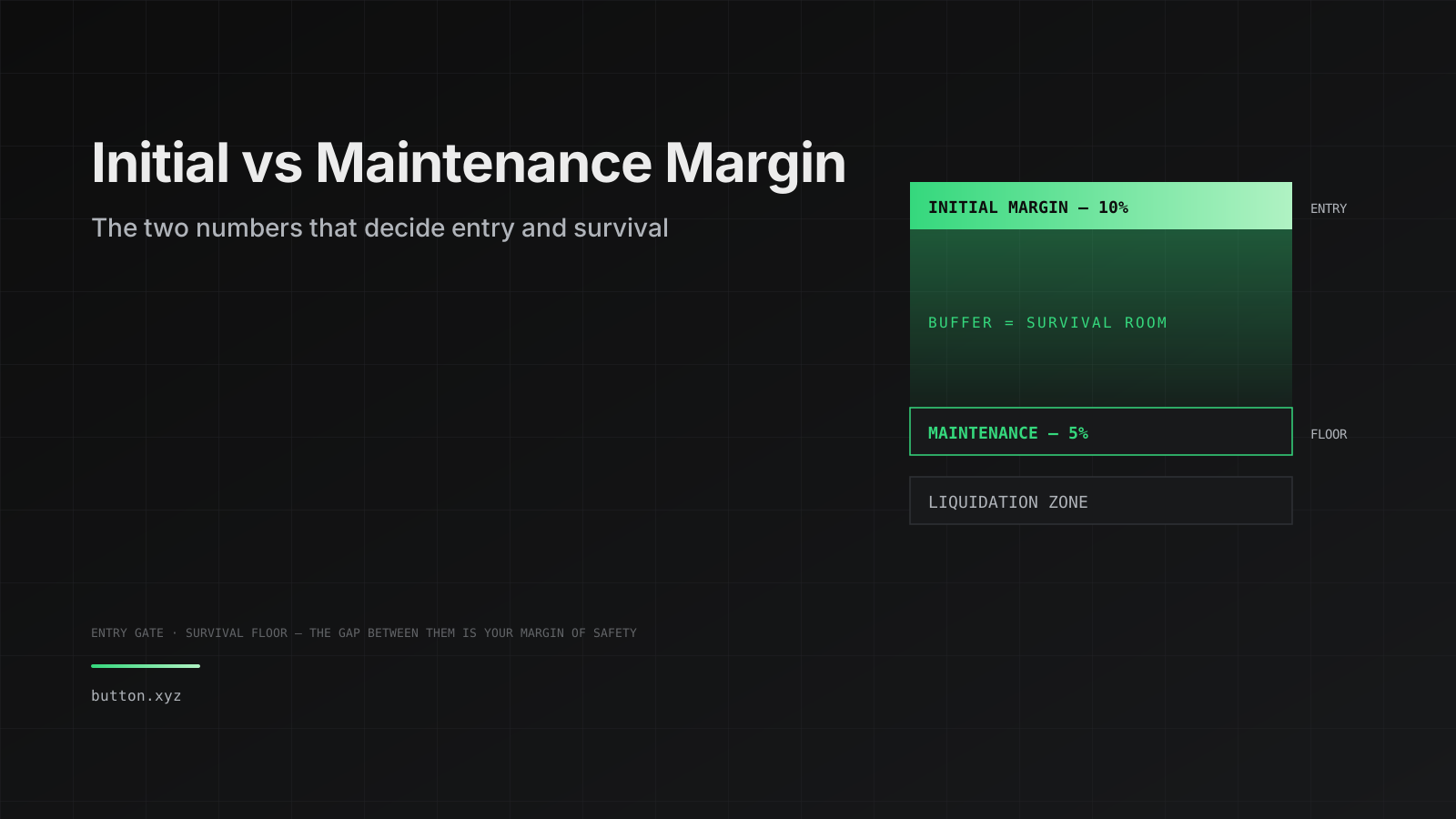
Two numbers control whether you can open a position and whether you can keep it open. Initial margin is the collateral required to open a trade. Maintenance margin is the minimum collateral required to keep it from being liquidated. They're related but different, and confusing them is how traders get surprised by liquidation calls they didn't see coming.
On Hyperliquid and every other perpetual futures exchange, these two margin thresholds work together to manage risk — both yours and the exchange's. Understanding exactly how they work prevents the most common leveraged trading mistakes.
Initial Margin
Definition
Initial margin is the amount of collateral you must deposit (or have available) to open a new position. It's calculated as:
Initial Margin = Position Notional / LeverageExample: You want to open a $100,000 BTC long at 10x leverage.
- Initial margin required: $100,000 / 10 = $10,000
- You need at least $10,000 in your account (cross margin) or allocated to this position (isolated margin) to open the trade.
What Initial Margin Does
Initial margin serves two purposes:
1. It sizes your leverage. Choosing 10x leverage is the same as saying you'll put up 10% of the position as collateral. Choosing 5x means 20%. Choosing 2x means 50%. The initial margin percentage is simply 1/leverage.
| Leverage | Initial Margin % | Initial Margin on $100K |
|---|---|---|
| 2x | 50% | $50,000 |
| 5x | 20% | $20,000 |
| 10x | 10% | $10,000 |
| 20x | 5% | $5,000 |
| 50x | 2% | $2,000 |
2. It prevents immediately risky positions. By requiring upfront collateral proportional to leverage, the exchange ensures you have some skin in the game. Without initial margin requirements, traders could open arbitrarily large positions with zero collateral — which would create massive counterparty risk.
When Initial Margin Matters
Opening new positions. If your available margin is less than the initial margin requirement, the order is rejected. This is the most common encounter with initial margin — you try to place an order and it fails because you don't have enough free margin.
Adding to existing positions. Increasing your position size requires additional initial margin. If you have a $50K BTC long and want to add $50K more, you need the additional initial margin for the increment.
After withdrawals. If you withdraw funds and your remaining balance drops below the initial margin required for your open positions, you can't open new positions (but existing ones remain open as long as they stay above maintenance margin).
Maintenance Margin
Definition
Maintenance margin is the minimum collateral that must remain backing your position. If your effective margin falls below this level, the exchange liquidates your position.
Maintenance margin is always lower than initial margin — typically 50-75% lower. This creates a buffer between opening a position and being liquidated.
Example on Hyperliquid:
- BTC at 10x leverage: Initial margin = 10%, Maintenance margin ≈ 5%
- You open a $100K position with $10,000 initial margin
- You won't be liquidated until your effective margin drops to ~$5,000
- That means you can absorb ~$5,000 in unrealized losses before liquidation triggers
Maintenance Margin Tiers
On most exchanges including Hyperliquid, maintenance margin isn't a flat rate — it increases for larger positions. This tiered system protects the exchange and other traders from the market impact of liquidating very large positions.
Typical tier structure:
| Position Notional | Maintenance Margin Rate |
|---|---|
| Up to $1M | 0.5% |
| $1M - $5M | 1.0% |
| $5M - $10M | 1.5% |
| $10M - $25M | 2.0% |
| $25M+ | 3.0-5.0% |
What this means: A $500K BTC position at 0.5% maintenance margin needs $2,500 in margin to avoid liquidation. A $10M position at 1.5% needs $150,000. The larger the position, the higher the maintenance requirement — because larger positions are harder to liquidate without moving the market.
Practical impact: Traders with very large positions on Hyperliquid face lower effective leverage than the maximum nominal leverage would suggest. At 50x leverage, the initial margin is 2%, but if the maintenance margin for your tier is 1.5%, the buffer between entry and liquidation is only 0.5% — extremely tight.
The Critical Gap
The gap between initial margin and maintenance margin is your survival buffer when a trade goes against you.
Buffer = Initial Margin - Maintenance MarginOn a $100K position at 10x:
- Initial margin: $10,000 (10%)
- Maintenance margin: $5,000 (5%)
- Buffer: $5,000 — your position can absorb $5,000 in unrealized losses before liquidation
This $5,000 corresponds to a 5% adverse price move on your $100K notional. BTC moves 5% in a single day roughly 15-20 times per year. At 10x leverage with no additional margin, you're statistically likely to face a liquidation-threatening move within a few weeks.
This is why professional traders don't max out leverage. Using 5x instead of 10x doubles the buffer (10% instead of 5%), giving much more room to survive normal volatility.
How Margin Changes During a Trade
Once your position is open, your effective margin changes with every price tick:
Unrealized P&L Effect
Winning position: Unrealized profit increases your effective margin. If your $100K long gains $3,000, your effective margin grows from $10,000 to $13,000. You're further from liquidation and could even open additional positions.
Losing position: Unrealized loss decreases your effective margin. If your $100K long loses $3,000, your effective margin drops from $10,000 to $7,000. You're closer to the $5,000 maintenance threshold.
Funding Rate Effect
Funding payments directly impact your margin. If you're on the paying side, each settlement reduces your effective margin. At $100K notional paying 0.02% funding: $20 deducted per settlement, $60 per day.
Over a week, that's $420 in margin erosion from funding alone — 4.2% of your $10,000 initial margin. This slow bleed doesn't trigger immediate liquidation but it steadily compresses your buffer.
Fee Effect
Trading fees are deducted from margin. Taker fees (0.05% on Hyperliquid) reduce margin on entry. However, maker rebates (-0.02%) actually add to margin — every limit order fill increases your effective margin slightly.
Cross Margin vs Isolated: How Margin Pools Differ
Cross Margin
Your entire account balance acts as the margin pool for all positions. The maintenance margin requirement applies to the aggregate portfolio:
- $50K account, $100K BTC long, $50K ETH short
- BTC position loses $8K → effective margin drops to $42K
- But ETH position gains $3K → effective margin is actually $45K
- Portfolio-level maintenance margin based on total positions
Advantage: Winning positions automatically buffer losing positions. More capital-efficient.
Risk: A catastrophic loss on one position can drain the entire account, potentially liquidating profitable positions too.
Isolated Margin
Each position has its own dedicated margin pool. The maintenance margin for each position is calculated independently:
- $10K allocated to BTC long, $10K allocated to ETH short, $30K unallocated
- BTC position loses $6K → BTC effective margin = $4K (approaching maintenance)
- ETH effective margin and unallocated funds are completely unaffected
- Only the BTC position is at liquidation risk
Advantage: Risk is contained per position. Maximum loss is capped at the allocated amount.
Disadvantage: Less capital-efficient. Margin allocated to one position can't help another.
See isolated vs cross margin for the full comparison with strategy recommendations.
Practical Margin Management
Monitor Your Margin Ratio
The margin ratio is the key metric:
Margin Ratio = Maintenance Margin / Effective Margin- Below 50%: Healthy. Plenty of buffer.
- 50-75%: Caution. Consider reducing leverage or adding margin.
- 75-90%: Danger. Reduce position size or add margin immediately.
- Above 90%: Imminent liquidation. The exchange may already be preparing to liquidate.
Adding Margin vs Reducing Position
When your margin is under pressure, you have two options:
Add margin: Deposit more USDC or allocate more from your unused balance. This pushes your liquidation price further away without changing your position size. Good if you still believe in the trade thesis.
Reduce position: Partially close the position. This reduces both the notional exposure and the margin requirement. Good if the trade thesis is weakening or volatility has increased beyond your comfort level.
Which is better? Reducing position is generally safer because it reduces your risk regardless of what happens next. Adding margin lets you maintain the position but increases your total capital at risk.
Set Alerts
Most exchanges let you set margin ratio alerts. On Hyperliquid, use the API to monitor margin ratios programmatically. Set alerts at 60% and 75% margin ratio — this gives you time to act before liquidation becomes imminent.
The AI trading agent monitors margin ratios continuously and can automatically deleverage when buffers compress. See AI risk management for the automated approach.
FAQ
Why isn't initial margin equal to maintenance margin?
The gap exists to prevent immediate liquidation after opening a position. If initial and maintenance margin were equal, any adverse price tick after opening would trigger liquidation. The gap gives traders room to manage positions through normal price fluctuations.
Can I get liquidated even if I have money in my account?
In isolated margin mode, yes — if the margin allocated to a specific position falls below maintenance. Your unallocated balance doesn't help isolated positions. In cross margin, liquidation only occurs when your entire account equity falls below the aggregate maintenance requirement.
What happens to my margin when I'm liquidated?
The remaining margin at liquidation covers the closing trade and any fees. If there's a surplus after the position is closed, it's returned to your account. If there's a deficit (the position was closed at a worse price than the bankruptcy price), the exchange's insurance fund covers it.
Does maintenance margin change?
The rate can change based on position size tiers and exchange policy updates. If you scale into a larger position, you may cross into a higher maintenance margin tier — meaning your percentage requirement increases. Always check the current tier schedule for your position size.
How much buffer should I maintain?
At minimum, keep your effective margin at 2x the maintenance margin requirement — meaning a margin ratio below 50%. Conservative traders target 3-4x maintenance margin, which means using half (or less) of the maximum allowed leverage.
The Two Numbers That Matter Most
Initial margin gates your entry. Maintenance margin gates your survival. The spread between them is your margin of safety — and widening it by using less leverage is the simplest risk management tool available. Know your numbers, monitor your ratios, and never let a liquidation catch you by surprise.
Automate margin management with the agent: the AI trading agent monitors margin ratios across all positions on Hyperliquid, automatically adjusts leverage when buffers compress, and manages funding rate costs — keeping your positions safe while maximizing capital deployment.
Related: Crypto liquidation for what happens when maintenance margin is breached. Isolated vs cross margin for margin mode selection. Hyperliquid leverage guide for leverage specifics.