Hyperliquid Funding Rates: Data and Guide
Live Hyperliquid funding rate data — how rates compare to CEXs, why they run hotter, and how traders capture the spread.
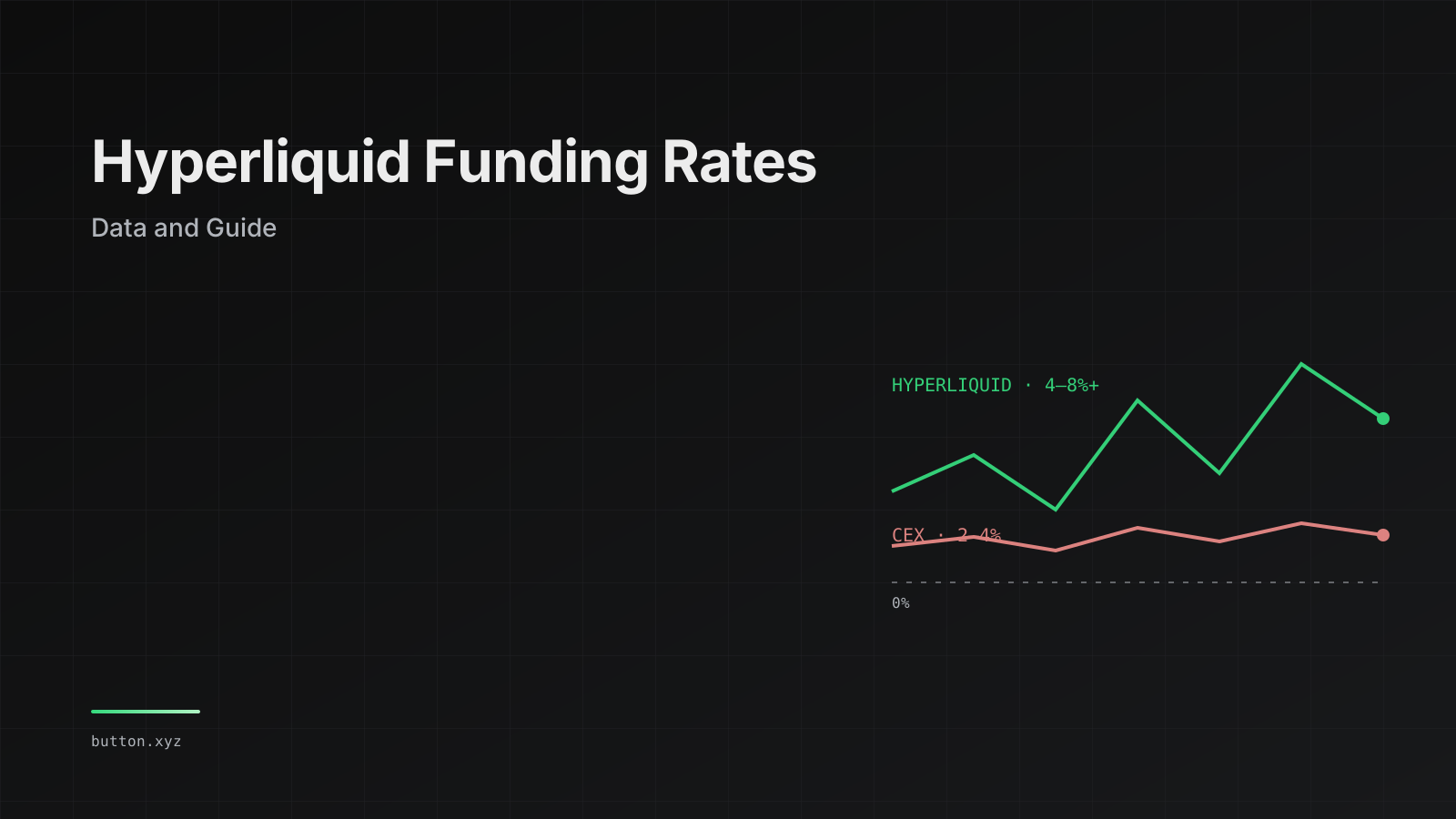
Hyperliquid funding rates consistently run 2-3x higher than centralized exchanges. BTC funding that averages 2-4% annualized on Binance runs 4-8% on Hyperliquid. Altcoins are more extreme — 10-30% annualized on Hyperliquid versus 5-15% on CEXs. For carry traders, that spread is the entire thesis.
This page covers Hyperliquid-specific funding rate data, why rates differ from other venues, and how to systematically capture the premium.
Current Funding Rate Overview
Funding rates on Hyperliquid settle every 8 hours, calculated from the time-weighted average basis (perp price minus spot index) over the settlement period.
Typical ranges by asset (annualized):
| Asset | Hyperliquid | Binance | Spread |
|---|---|---|---|
| BTC | 4-8% | 2-4% | +2-4% |
| ETH | 5-10% | 2-5% | +3-5% |
| SOL | 10-25% | 5-15% | +5-10% |
| Major alts | 10-30% | 5-15% | +5-15% |
| New listings | 20-50%+ | N/A | N/A |
These are averages over the past 12 months. Individual 8-hour periods can spike far higher — 0.10%+ per period (36%+ annualized) on altcoins during narrative-driven pumps, or dip negative during sharp corrections.
To check live rates, query the Hyperliquid API endpoint (`metaAndAssetCtxs`) or view them directly on the trading interface. For programmatic monitoring, the Hyperliquid API provides real-time funding data via WebSocket.
Why Hyperliquid Funding Runs Higher
Three structural factors drive Hyperliquid's funding premium over centralized exchanges:
Lower Order Book Depth
Hyperliquid's order book is 2-5x thinner than Binance on major pairs. When a directional wave of buying hits a thinner book, the perp price pushes further above spot — creating a wider premium that translates to higher funding.
On Binance, $20M of BTC depth within 0.5% of mid absorbs buying pressure without moving the mark price much. On Hyperliquid, $5M of depth at the same level means the same buying pressure creates 2-4x the premium. More premium equals higher funding.
Fewer Arb Participants
Centralized exchanges attract institutional arbitrage capital that compresses funding. When BTC funding spikes to 0.05% on Binance, dozens of arb desks short perps and buy spot, pushing funding back down within hours.
Hyperliquid has fewer arb participants due to the DeFi learning curve (wallet setup, bridging, smart contract interaction). The arb capital that does participate is smaller in aggregate, so funding extremes last longer and revert more slowly. This creates wider capture windows for manual traders.
Higher Leverage Caps on Smaller Assets
Some Hyperliquid pairs allow leverage that creates more long-side crowding relative to the available short interest. When a new altcoin lists at 10x max leverage and retail piles into longs, there aren't enough shorts to balance the funding equation. The result: funding rates of 0.10%+ per period until either the narrative fades or arb capital enters.
Funding Rate Calculation on Hyperliquid
Hyperliquid uses a standard premium-based funding calculation:
Funding Rate = Average Premium Index + clamp(Interest Rate − Premium Index, −0.05%, 0.05%)
Premium Index = Time-weighted average of (Mark Price − Index Price) / Index Price across the 8-hour period.
Interest Rate = 0.01% per period (negligible).
The clamp function limits the interest rate component's influence, so the premium index drives the rate. When the perp trades 0.03% above spot on average over 8 hours, the funding rate is approximately 0.03%.
Settlement timing: Funding settles at 00:00, 08:00, and 16:00 UTC. If you hold a position through a settlement timestamp, you pay or receive the full period's funding. Close before settlement and you avoid that period's charge.
Mark price vs. last trade: Hyperliquid uses a mark price (weighted average of best bid, best ask, and last trade) rather than last trade price for funding calculations. This prevents manipulation via single large trades at settlement time.
Funding Arbitrage Strategies on Hyperliquid
Basic Spot-Perp Carry
The simplest funding capture:
- Buy spot BTC on any exchange (Coinbase, Binance, or Hyperliquid spot)
- Short BTC perp on Hyperliquid (equal notional)
- Collect funding every 8 hours
P&L math (BTC example):
- Position: $100,000 notional each leg
- Hyperliquid funding: 0.02% per 8 hours (7.3% annualized)
- Spot holding cost: ~0% (no ongoing fee for holding BTC)
- Hyperliquid maker rebate on short: -0.02% per fill (income)
- Net yield: ~7-8% annualized with near-zero directional risk
The maker rebate is the kicker. On Binance, the same carry trade earns 2-4% annualized funding but costs 0.02-0.10% in fees. On Hyperliquid, you earn the rebate on top of funding. For detailed strategy mechanics, see funding rate arbitrage.
Cross-Exchange Funding Arb
When Hyperliquid BTC funding is 6% annualized and Binance is 2%, the spread is 4%. Capture it:
- Long BTC perp on Binance (paying 2% funding)
- Short BTC perp on Hyperliquid (collecting 6% funding)
- Net carry: 4% annualized on combined notional
Risks: You need margin on both exchanges, so capital is split. A sharp BTC move can liquidate one leg before the other profits enough to compensate. Size conservatively (3-5x max on each leg) and maintain sufficient margin buffers on both sides.
This strategy requires $50,000+ across venues to generate meaningful income after accounting for margin requirements and basis risk.
Altcoin Funding Capture
The highest funding rates are on altcoins — 20-50% annualized on new Hyperliquid listings. The carry trade is the same (short perp, hold spot), but the risks are amplified:
- Altcoin spot liquidity may be thin (can't exit the long leg quickly)
- Funding can invert rapidly when narrative shifts
- Gap risk on altcoins is 3-5x BTC's (a 30% gap wipes a 3x short)
Sizing rule: Never allocate more than 5-10% of your carry portfolio to a single altcoin pair. Spread across 5-10 assets to diversify funding rate mean-reversion risk.
Historical Funding Patterns on Hyperliquid
Bull Market Periods
During sustained uptrends (Q4 2024, Q1 2025):
- BTC funding: 0.03-0.05% per period (11-18% annualized)
- ETH funding: 0.04-0.08% per period (15-29% annualized)
- Alt funding: 0.05-0.15% per period (18-55% annualized)
- Carry traders earn peak income during these phases
- Funding spikes often precede local tops by 1-3 days
Correction Events
During sharp selloffs:
- Funding inverts (goes negative) within hours as longs liquidate
- Negative funding persists for 24-72 hours depending on severity
- Carry traders holding short perps face mark-to-market drawdowns as shorts profit on the directional move but pay negative funding
- Recovery to positive funding typically happens within a week
Consolidation Periods
During range-bound markets:
- BTC funding: 0.01-0.02% per period (3.6-7.3% annualized)
- Carry income is lower but steadier
- Less funding volatility means less basis risk
- Optimal for conservative carry strategies
Monitoring Hyperliquid Funding
API Approach
The `metaAndAssetCtxs` endpoint returns current funding rates for all assets alongside mark price, index price, open interest, and 24-hour volume. Poll this every few minutes for monitoring, or subscribe via WebSocket for real-time updates.
Build alerts for:
- Funding exceeding 0.05% per period (opportunity to enter carry)
- Funding going negative (signal to reduce or exit carry)
- Funding divergence vs. Binance exceeding 3x (cross-exchange arb signal)
Dashboard Tools
Third-party aggregators like Coinglass display Hyperliquid funding alongside CEX rates. The Hyperliquid trading interface shows current funding and next settlement countdown on each pair's page.
For systematic monitoring across 50+ pairs, the API approach is necessary. Manual dashboard checking works for 5-10 pairs but doesn't scale.
Risks of Funding Rate Trading on Hyperliquid
Funding inversion. The primary risk. If you're short perps collecting positive funding and the market crashes, funding goes negative — you pay instead of collect. Meanwhile, your short profits on the direction but the carry thesis breaks. The net P&L depends on how long funding stays negative versus the directional profit.
Basis expansion. Even if funding stays positive, the basis (perp premium over spot) can widen. Your short perp is marked at a higher price, creating unrealized loss. This is temporary (basis converges over time) but can trigger margin pressure.
Smart contract risk. Your collateral sits in Hyperliquid's smart contract. Audited doesn't mean risk-free. A contract vulnerability could expose funds. Diversify carry capital across venues — don't put 100% on any single platform.
Slippage on entry/exit. Opening and closing large carry positions on thinner Hyperliquid pairs can cost 0.1-0.3% in slippage. Factor this into your yield calculation — if annual carry is 8% but entry/exit costs 0.6% round-trip, your effective yield is 7.4%.
FAQ
What are typical Hyperliquid funding rates?
BTC: 4-8% annualized. ETH: 5-10%. SOL: 10-25%. Altcoins: 10-30%+. New listings can spike above 50% annualized in the first week. Rates are consistently 2-3x higher than Binance due to lower depth, fewer arb participants, and higher leverage-driven crowding.
How often does Hyperliquid funding settle?
Every 8 hours at 00:00, 08:00, and 16:00 UTC. You must hold through the settlement timestamp to pay or receive funding. Closing before settlement avoids that period's charge. Some traders time entries and exits around settlement to optimize funding capture.
Can I see historical Hyperliquid funding rates?
Yes. The Hyperliquid API provides historical funding data. Third-party tools like Coinglass also archive Hyperliquid funding history. Historical data is essential for backtesting carry strategies — use at least 6 months of data to capture both bull and correction environments.
Why is Hyperliquid funding higher than Binance?
Three reasons: thinner order book depth (less capital absorbing directional flow), fewer institutional arb participants (DeFi barrier reduces arb capital), and higher leverage utilization on smaller-cap pairs. The crypto funding rates guide covers cross-exchange dynamics in detail.
Is funding rate arbitrage risk-free?
No. It's low-risk, not risk-free. Funding inversion, basis expansion, smart contract risk, and slippage all reduce or can eliminate returns. The strategy has a positive expected value over long periods but can have negative months. Size appropriately and diversify across assets and venues.
Capture the Hyperliquid Funding Premium
Hyperliquid's structural funding premium is the clearest edge available to carry traders in crypto. Higher rates, maker rebates, and non-custodial execution create a carry opportunity that centralized exchanges can't match.
Automate funding rate capture with the agent: the AI trading agent monitors Hyperliquid funding across all pairs, enters carry positions when rates exceed your threshold, and exits when funding compresses — without manual monitoring or 3 AM settlement checks.
Related: Funding rates explained for the core mechanics. Funding rate arbitrage for strategy implementation. Hyperliquid overview for platform fundamentals.