Best Perpetual Futures Exchanges (2026)
Ranked comparison of the best perpetual futures exchanges — fees, depth, funding rates, custody, and which traders each one serves.
The exchange you trade on shapes your P&L more than most traders realize. A 0.05% fee difference across 200 trades per month is 10% of capital. A 2x funding rate spread between venues is thousands of dollars in carry income. Depth differences determine whether your $100K order fills clean or slips 0.3%.
This ranking compares the exchanges where professional perpetual futures traders actually operate — scored on fees, depth, funding rates, custody model, and API quality. No affiliate rankings. No pay-to-play placements.
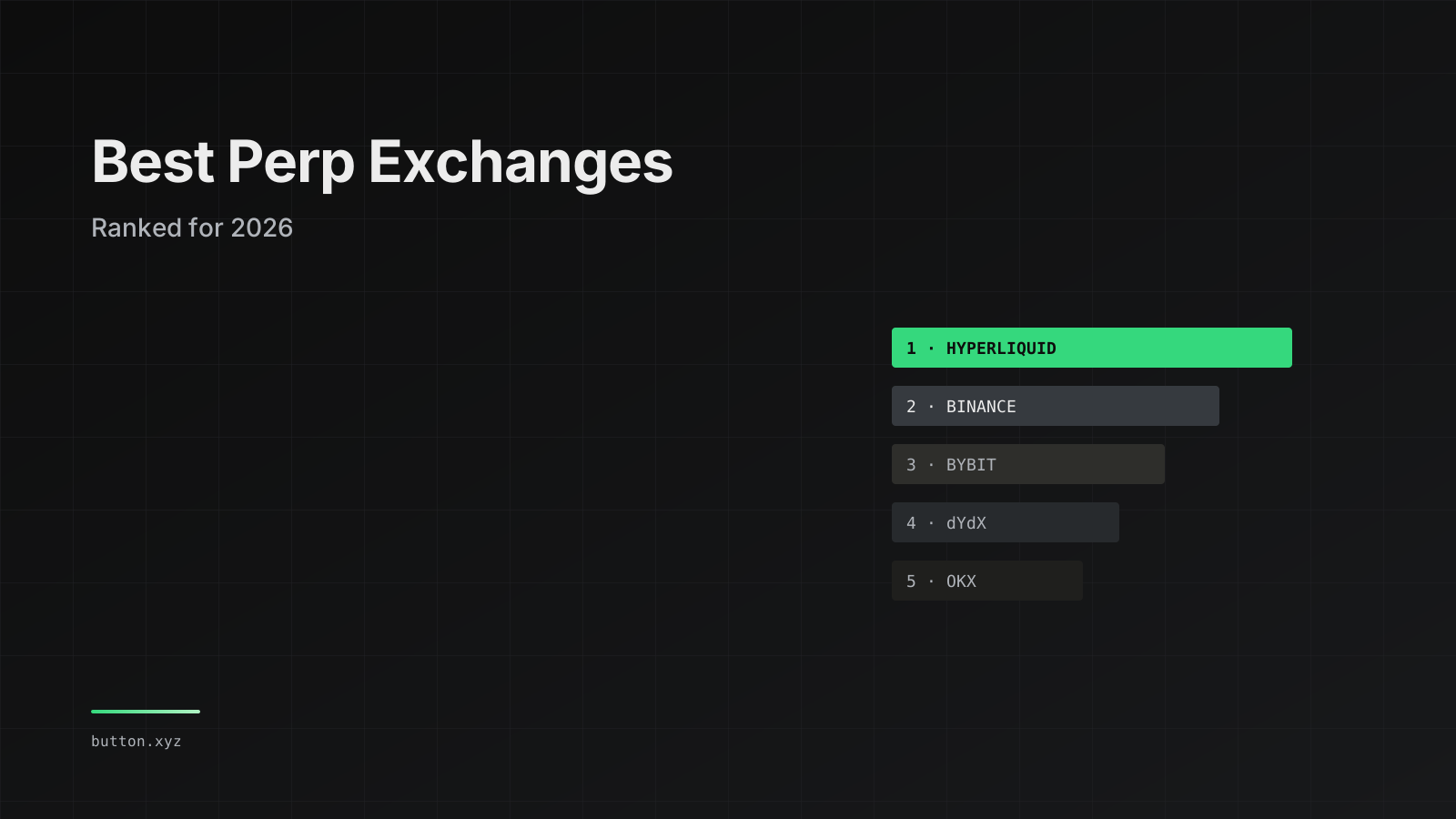
1. Hyperliquid — Best Overall for Active Traders
- Type: Decentralized (own L1)
- Custody: Non-custodial (smart contract)
- Maker Fee: -0.02% (rebate)
- Taker Fee: 0.05% (standard), 0.025% (Tier 3)
- Max Leverage: 50x BTC/ETH, 20x alts
- Pairs: 100+ perpetuals
- Funding: Settles every 8 hours
Hyperliquid is the default venue for fee-sensitive traders. The maker rebate (-0.02% across all tiers) means market-making and limit-order strategies earn fees instead of paying them. Self-custody eliminates exchange bankruptcy risk. Sub-second fills and a clean API make it bot-friendly.
Strengths:
- Lowest effective fees for makers in the industry
- Non-custodial: your USDC stays in an audited smart contract
- Early altcoin listings (weeks before CEXs)
- Funding rates 2-3x higher than CEXs, creating carry trade opportunities
- WebSocket API with 50-100ms latency, batch order support
Weaknesses:
- Order book depth is 2-5x thinner than Binance on BTC
- No fiat on-ramp (requires USDC on Arbitrum)
- Limited spot market
- Validator set is more centralized than Ethereum
Best for: Active traders, bot operators, carry traders, anyone who wants self-custody without sacrificing speed. Full assessment in our Hyperliquid review.
2. Binance — Best for Depth and Feature Set
- Type: Centralized
- Custody: Custodial
- Maker Fee: -0.01% (VIP 9), 0.02% (standard)
- Taker Fee: 0.10% (standard), 0.03% (VIP 9)
- Max Leverage: 50x BTC/ETH, varies by pair
- Pairs: 200+ perpetuals
- Funding: Every 8 hours
Binance has the deepest order book in crypto. For positions above $500K notional, there's no substitute — the depth absorbs large orders with minimal slippage. The feature set is the broadest: isolated and cross margin per position, portfolio margin, options alongside perps, and a massive spot market for basis trades.
Strengths:
- Deepest liquidity globally ($10-20M+ within 0.5% on BTC)
- Full feature set: isolated/cross margin, portfolio margin, options
- Fiat on-ramps (bank transfer, credit card)
- Largest altcoin perp selection
- Institutional-grade infrastructure and uptime
Weaknesses:
- Standard taker fees are 0.10% — 2x Hyperliquid's
- Custodial: your funds are on Binance's balance sheet
- KYC required for full access
- Regulatory pressure in multiple jurisdictions
- VIP tier fees require $10M+ monthly volume to access best rates
Best for: Large position traders, institutional desks, traders who need fiat on-ramps, anyone prioritizing depth over fees.
3. Bybit — Best CEX Alternative to Binance
- Type: Centralized
- Custody: Custodial
- Maker Fee: -0.01% (VIP 3+), 0.02% (standard)
- Taker Fee: 0.06% (standard), 0.03% (VIP 3)
- Max Leverage: 100x BTC, varies by pair
- Pairs: 300+ perpetuals
- Funding: Every 8 hours
Bybit has carved a niche as the second-largest CEX for perps, with competitive fees and aggressive altcoin listings. The platform offers up to 100x leverage on BTC (higher than most competitors) and has a strong copy-trading feature for retail.
Strengths:
- Second-deepest CEX order book after Binance
- Lower standard taker (0.06%) than Binance (0.10%)
- Aggressive altcoin listing pace
- Copy trading and bot marketplace
- Strong in Asian markets with localized support
Weaknesses:
- Custodial with regulatory uncertainty
- API quality below Binance and Hyperliquid
- Historical controversy over platform practices
- VIP tiers require significant volume for best fees
Best for: Retail-to-intermediate traders who want CEX convenience with slightly better fees than Binance.
4. dYdX — Best for Governance-Aligned Traders
- Type: Decentralized (Cosmos appchain)
- Custody: Non-custodial
- Maker Fee: 0.02% (standard), -0.011% (top tier)
- Taker Fee: 0.05% (standard), 0.02% (top tier)
- Max Leverage: 20x on most pairs
- Pairs: 50+ perpetuals
- Funding: Hourly
dYdX was the first major on-chain perps exchange and pioneered the decentralized order book model. It now runs on a Cosmos-based appchain with its own validator set. The 1-hour funding settlement creates faster funding rate adjustments than 8-hour competitors.
Strengths:
- Established non-custodial exchange with long track record
- 1-hour funding settlements (faster rebalancing)
- Governance token with protocol revenue sharing
- Strong documentation and developer ecosystem
Weaknesses:
- Lower volume and depth than Hyperliquid on most pairs
- Standard maker fees are positive (0.02%) — you pay, not earn
- Fewer altcoin listings
- Migration from StarkEx to Cosmos created UX friction
Best for: Governance-focused traders, those who want non-custodial with a longer operational history than Hyperliquid. See our Hyperliquid vs dYdX comparison.
5. OKX — Best for Portfolio Margin
- Type: Centralized
- Custody: Custodial
- Maker Fee: -0.005% (VIP 5+), 0.02% (standard)
- Taker Fee: 0.08% (standard), 0.03% (VIP 5)
- Max Leverage: 100x BTC
- Pairs: 200+ perpetuals
- Funding: Every 8 hours
OKX offers the most sophisticated portfolio margin system among CEXs. Multi-leg strategies with offsetting positions receive reduced margin requirements, making it capital-efficient for pairs trades and basis strategies.
Strengths:
- Best portfolio margin calculation (reduced requirements for hedged positions)
- Strong options market alongside perps
- Competitive fees at higher tiers
- Good API for structured products
Weaknesses:
- Lower global volume than Binance
- KYC required
- Custodial
- Standard taker fees (0.08%) higher than Hyperliquid
Best for: Sophisticated multi-leg strategy traders who need portfolio margin, options + perps on one platform.
Fee Comparison Table
| Exchange | Maker (Standard) | Taker (Standard) | Maker (Best Tier) | Taker (Best Tier) |
|---|---|---|---|---|
| Hyperliquid | -0.02% | 0.05% | -0.025% | 0.025% |
| Binance | 0.02% | 0.10% | -0.01% | 0.03% |
| Bybit | 0.02% | 0.06% | -0.01% | 0.03% |
| dYdX | 0.02% | 0.05% | -0.011% | 0.02% |
| OKX | 0.02% | 0.08% | -0.005% | 0.03% |
Key insight: Hyperliquid offers the best maker rates at every volume tier. The -0.02% rebate doesn't require VIP status — it applies from trade one. For makers, this is $4,000/year better than Binance standard on $10M annual volume.
For takers, dYdX and Hyperliquid tie at 0.05% standard. Binance's 0.10% is the most expensive standard tier among major venues.
Funding Rate Comparison
Funding rates vary across venues and directly impact carry strategy profitability:
| Exchange | BTC Funding (annualized) | ETH Funding (annualized) | Alt Funding (annualized) |
|---|---|---|---|
| Hyperliquid | 4-8% | 5-10% | 10-30% |
| Binance | 2-4% | 2-5% | 5-15% |
| Bybit | 2-5% | 3-6% | 6-16% |
| dYdX | 3-5% | 4-7% | 8-20% |
| OKX | 2-4% | 2-5% | 5-15% |
Hyperliquid's higher funding rates create the widest carry windows. A basis trader collecting 6% annualized BTC funding on Hyperliquid versus 2% on Binance earns 3x the carry income on the same capital. For carry-focused operations, venue selection is the first alpha decision.
The tradeoff: higher funding means higher cost if you're on the wrong side. Long BTC perps on Hyperliquid cost 2-3x more in funding than the same position on Binance. Active directional traders who hold longs through elevated funding should consider Binance for lower carry cost.
Cross-exchange funding arbitrage — shorting on the high-funding venue and longing on the low-funding venue — captures the spread directly. This requires capital split across exchanges but is one of the most consistent strategies for traders with $100K+ across venues. See crypto funding rates for the full cross-exchange analysis.
How to Choose
- Prioritize fees → Hyperliquid. If you trade actively (50+ trades/month) and can use limit orders, the maker rebate alone shifts your P&L.
- Prioritize depth → Binance. If your typical position exceeds $500K notional, depth matters more than fees. Slippage on thin books costs more than the fee savings.
- Prioritize self-custody → Hyperliquid or dYdX. If exchange bankruptcy risk is non-negotiable, these are your choices. Hyperliquid has more volume; dYdX has a longer track record.
- Prioritize portfolio margin → OKX. If you run multi-leg strategies and need margin netting, OKX's portfolio margin is best-in-class.
- Prioritize simplicity → Bybit. For traders who want a CEX that's slightly cheaper than Binance with a clean interface and good altcoin coverage.
Most professional perps traders maintain accounts on 2-3 venues and allocate capital based on strategy. Carry strategies on Hyperliquid. Large directional on Binance. Pairs on OKX.
FAQ
Which exchange has the lowest perp trading fees?
Hyperliquid, by a significant margin for makers. The -0.02% rebate applies at all volume tiers. For takers, Hyperliquid and dYdX tie at 0.05% standard. Binance's standard taker (0.10%) is the most expensive among major venues, though VIP tiers bring it down to 0.03%.
Is it safe to trade on decentralized exchanges?
DEXs eliminate exchange custody risk (no FTX-style collapse). The risks shift to smart contract bugs, validator behavior, and bridge vulnerabilities. These are different risks, not zero risk. Start with small capital on any DEX and scale up as you validate the platform.
Do I need accounts on multiple exchanges?
For optimal execution, yes. Different strategies perform better on different venues. Carry trades earn more on Hyperliquid. Large directional trades execute better on Binance. Cross-exchange arbitrage requires accounts on both. Most active traders run 2-3 venues.
Which exchange is best for beginners?
Bybit or Binance for the simplest onboarding (fiat deposits, familiar UX). Hyperliquid for traders already comfortable with wallets and DeFi. Beginners should start with low leverage (2-3x) on BTC/ETH regardless of venue. See how to trade perps for a step-by-step guide.
How do exchange insurance funds work?
Insurance funds absorb losses from liquidations where the remaining margin doesn't cover the position. Binance has the largest fund ($1B+). Hyperliquid's fund is on-chain and smaller but publicly auditable. dYdX has a protocol-level insurance mechanism. These funds prevent socialized losses (where winning traders get clipped to cover losers) during normal market conditions. In extreme events, auto-deleveraging may still trigger.
Start Trading
Venue selection is a strategic decision, not a brand preference. Fees, depth, custody, and funding rates all feed into your strategy's expected value. Choose deliberately.
Run perp strategies with the agent: the AI trading agent connects to Hyperliquid and executes across strategy types — carry, directional, and pairs — with optimized venue selection and position sizing built in.
Related: Hyperliquid review for in-depth analysis. Hyperliquid vs dYdX for the head-to-head. What is Hyperliquid? for the DEX explained.