Hyperliquid Bot: Automate Your Perp Trading
How to run a trading bot on Hyperliquid — strategy types, API setup, maker rebate optimization, and why bots earn more on this DEX.
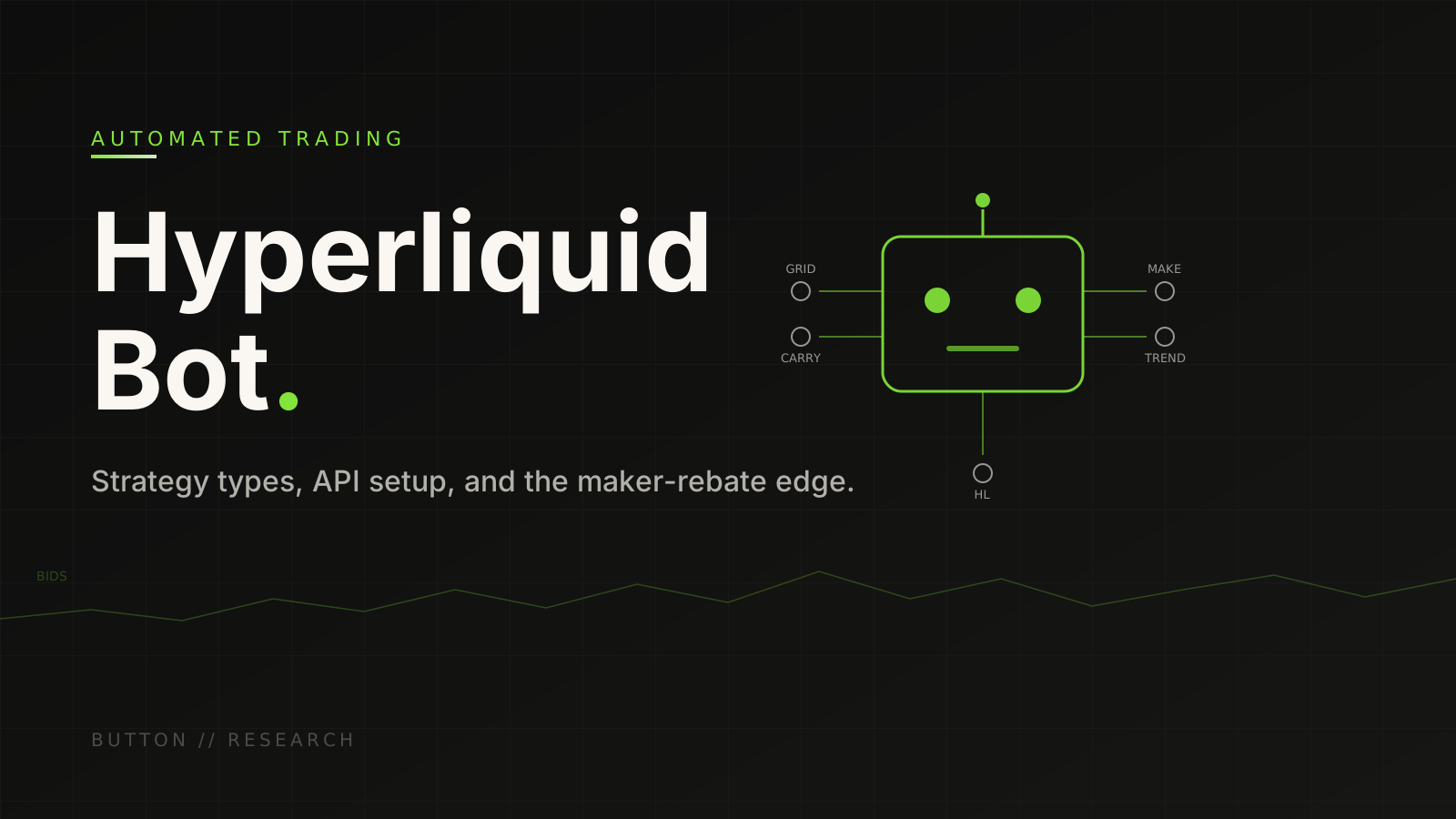
Hyperliquid is the most bot-friendly exchange in crypto. The maker rebate (-0.02%) means every automated limit order fill earns fees instead of paying them. The API rate limit (100 req/s) is available from day one — no VIP tier required. And the WebSocket feeds provide sub-100ms market data for real-time decision making.
This structural advantage makes Hyperliquid the default venue for automated perpetual futures trading. A bot running the same strategy on Hyperliquid versus Binance starts with a 0.04% fee advantage per maker fill (earning 0.02% vs paying 0.02%). Over 1,000 monthly fills on $50K average notional, that's $2,000/month in fee alpha — before the strategy itself generates a single dollar.
Why Bots Earn More on Hyperliquid
Maker Rebate Economics
Every limit order that adds liquidity to Hyperliquid's order book earns 0.02% of the trade's notional value. For bots that execute primarily via limit orders (market making, grid trading, carry trade entry/exit), this rebate compounds into substantial income:
| Monthly Maker Volume | Rebate Income | Annualized |
|---|---|---|
| $1M | $200 | $2,400 |
| $5M | $1,000 | $12,000 |
| $10M | $2,000 | $24,000 |
| $50M | $10,000 | $120,000 |
A grid bot placing 20 buy and sell limit orders daily at $25K average fill = $500K daily maker volume = $15M monthly. Rebate income: $3,000/month before strategy P&L. On Binance standard tier, the same volume costs $3,000/month in fees. That's a $72,000/year swing.
No Volume Requirements
Binance reserves its best API rate limits for VIP traders ($10M+ monthly volume). Hyperliquid's 100 req/s applies to everyone. A new bot with $5,000 in capital gets the same API performance as a fund running $5M. This levels the playing field for smaller automated traders.
Higher Funding Rates
Bots running funding rate arbitrage or carry strategies capture more yield on Hyperliquid. BTC funding rates average 4-8% annualized versus 2-4% on Binance. For a carry bot managing $200K in basis trades, that's $8,000-$16,000/year on Hyperliquid versus $4,000-$8,000 on Binance.
Bot Strategy Types
Grid Bot
Places buy limit orders below the current price and sell limit orders above it, creating a "grid" that profits from range-bound price action. Each filled buy is paired with a sell above it, capturing the spread plus the maker rebate.
Hyperliquid advantage: Every grid fill earns 0.02%. On a tight grid with 50-100 fills per day, rebate income alone generates 3-5% monthly on deployed capital. The grid's spread profit is additional alpha on top.
Parameters: Grid range (how wide), grid levels (how many orders), order size, leverage (typically 1-3x). Wider grids capture larger moves but fill less frequently. Tighter grids fill more but risk getting directionally caught in a trending market.
Works best: Consolidation periods on BTC/ETH. When 30-day volatility drops below 30%, grid bots outperform directional strategies.
Market Making Bot
Continuously quotes two-sided liquidity (bids and asks) around the current mid-price, earning the bid-ask spread plus maker rebates on every fill.
Hyperliquid advantage: Market making is inherently a maker activity — every fill earns the 0.02% rebate. The spread profit (0.02-0.10% per round trip on BTC) stacks on top. Combined yield: 0.04-0.12% per round trip.
Risk: Adverse selection — your resting orders get picked off by informed flow during sharp moves. Managing this requires fast quote updates (WebSocket feeds) and inventory limits (maximum directional exposure before the bot pauses one side).
Works best: High-volume pairs with tight spreads (BTC, ETH). Requires $50K+ capital and understanding of inventory risk.
Carry/Basis Bot
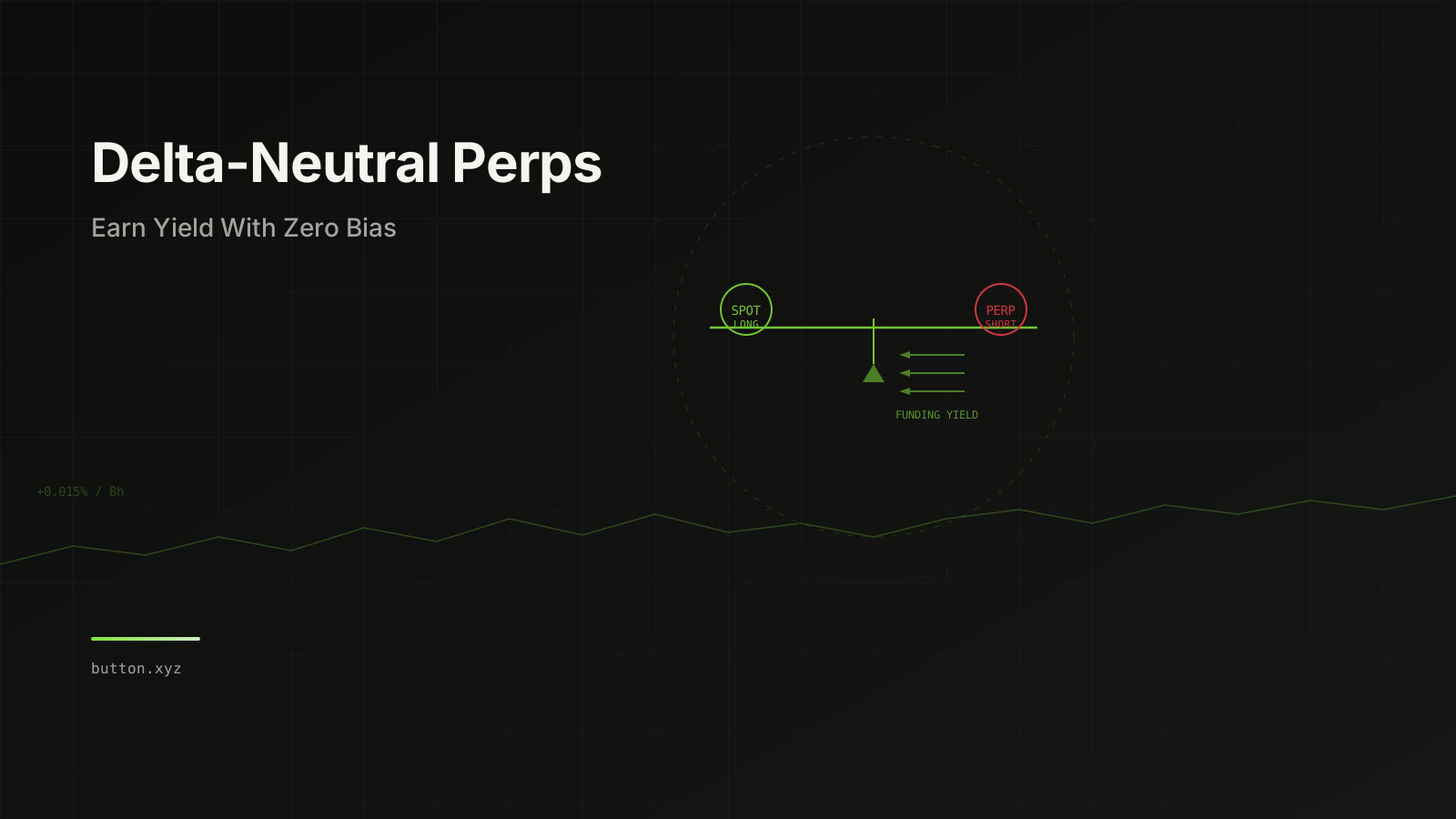
Automates the basis trade: monitors funding rates across exchanges, enters carry positions (long spot + short perp) when rates exceed a threshold, manages margin, and exits when funding compresses.
Hyperliquid advantage: 2-3x higher funding rates mean more carry income per dollar deployed. Maker rebates on entry and exit add to the total yield. The bot can monitor all 100+ Hyperliquid pairs simultaneously and rotate into whichever asset has the highest carry.
Parameters: Funding entry threshold (minimum annualized yield to enter), exit threshold (when to close), leverage (1-2x on the short), maximum position per asset, reserve margin %.
Works best: All market conditions where funding is positive. Most consistent strategy for bots — carry accrues regardless of price direction.
Trend Following Bot
Enters positions in the direction of the trend when momentum signals trigger, trails stops as the trend develops, and exits on reversal signals.
Hyperliquid advantage: Trend following involves frequent stop-outs in choppy markets. On Binance, each stop-out costs 0.10% (market taker). On Hyperliquid, 0.05%. Over 20 stop-outs per month on $50K positions, that's $500 saved ($1,000 vs $500). The re-entries via limit orders earn rebates rather than costing fees.
Parameters: Trend detection method (moving average crossover, breakout, momentum score), leverage (2-3x), stop distance (1.5-2x ATR), trail method.
Works best: Trending markets. Expect 40-50% win rate with winners 2-3x larger than losers.
Liquidation Sniper Bot
Monitors open interest and funding to predict liquidation cascades, then enters positions to capture the forced selling/buying. When open interest drops sharply (cascade in progress), the bot buys the dip (for long liquidation cascades) or sells the rally (for short liquidation cascades).
Hyperliquid advantage: On-chain transparency means liquidation data is publicly available in real-time. The bot can monitor liquidation levels across all pairs simultaneously and respond within seconds.
Risk: Cascades can extend further than expected. Buying a liquidation dip that extends another 10% means holding a losing position. Strict stop losses and small sizing are essential.
Technical Setup
API Connection
Hyperliquid's API requires an API wallet — a separate key pair that you authorize to trade on your behalf. This is different from your main wallet and can be revoked at any time.
Setup steps:
- Generate an API wallet on the Hyperliquid interface
- Authorize it with your main wallet signature
- Export the private key to your bot environment
- Connect via WebSocket for real-time data and REST for order management
For a full walkthrough of strategy automation, see the Hyperliquid trading bot guide.
Order Placement
Post-only orders are critical for bots. The post-only flag guarantees maker execution — if your limit would cross the book (fill immediately), the order rejects instead of executing as a taker. This ensures every fill earns the -0.02% rebate.
Batch orders let you place or cancel up to 20 orders in a single API request. For a grid bot managing 20 price levels, one batch call replaces 20 individual calls — reducing latency and staying well within rate limits.
Infrastructure Requirements
Minimum: A VPS or cloud instance near Hyperliquid's infrastructure (Tokyo or Singapore typically provide lowest latency). Python or Node.js runtime. 1 GB RAM, 1 CPU core.
Recommended: Co-located server for sub-10ms latency (market making). 4 GB RAM, 2+ cores. Database for historical data storage and strategy backtesting. Monitoring and alerting (Grafana, PagerDuty, or similar).
Cost: $20-50/month for basic VPS. $100-300/month for co-located infrastructure. The maker rebate income typically covers infrastructure costs within the first month.
Risk Controls
Every bot needs hard-coded risk limits that override all strategy logic:
Maximum position size: Cap the largest position the bot can take on any single asset. Prevents runaway accumulation during unusual market conditions.
Maximum portfolio leverage: Total notional / account equity ceiling (typically 3-5x). The bot pauses new entries if this limit is approached.
Daily loss limit: If the bot's daily P&L drops below a threshold (e.g., -2% of equity), all positions close and the bot pauses until the next day. Prevents compounding losses during adverse conditions.
Margin buffer: The bot maintains minimum margin ratio at all times. If the liquidation buffer drops below a threshold (e.g., 30% of position notional), the bot reduces position size automatically.
Kill switch: A manual override that closes all positions and cancels all orders instantly. Test this before deploying capital. You need to be able to shut everything down in seconds.
Performance Tracking
Track these metrics to evaluate your bot's performance:
Fee-adjusted P&L: Strategy P&L + maker rebates - taker fees - infrastructure costs. The rebates are a real revenue line on Hyperliquid — don't ignore them in tracking.
Fill rate: Percentage of limit orders that fill before being cancelled. Low fill rates (below 30%) suggest your pricing is too conservative. High fill rates (above 80%) suggest you're pricing too aggressively and may be experiencing adverse selection.
Uptime: Percentage of time the bot is connected and active. Target 99%+. Exchange maintenance windows and API disconnections are the primary downtime causes. Build reconnection logic with exponential backoff.
Sharpe ratio: Risk-adjusted return. Grid and market-making bots should target 2.0+. Trend following: 0.8-1.5. Carry: 1.5-3.0.
FAQ
How much money do I need to run a Hyperliquid bot?
Minimum $1,000 for a simple grid or trend bot. $5,000+ for meaningful maker rebate income. $20,000+ for carry strategies. $50,000+ for market making. The maker rebate means even small bots earn from fees, but absolute returns scale with capital.
Do I need coding skills?
For custom bots, yes — Python or TypeScript are the most common. The Hyperliquid API has community SDKs that simplify integration. For traders without coding skills, the AI trading agent provides pre-built autonomous strategies.
Can my bot get liquidated?
Yes. Bots that use leverage face the same liquidation risk as manual trades. The bot should monitor margin ratio and reduce positions before liquidation triggers. Hard-coded risk limits (maximum leverage, margin buffer) are essential.
What's the difference between a Hyperliquid bot and a crypto trading bot?
A Hyperliquid bot is optimized for Hyperliquid's specific advantages — maker rebates, API structure, and higher funding rates. Generic crypto trading bots connect to multiple exchanges but don't capture Hyperliquid-specific alpha (rebates, post-only routing, batch orders).
How much can a bot earn on Hyperliquid?
Highly variable. Grid bots in favorable conditions: 5-15% monthly. Market making: 2-8% monthly. Carry: 5-15% annualized. Trend following: -10% to +50% depending on market conditions. Maker rebates add 2-5% annually on top of strategy returns for active bots.
Start Automating
The Hyperliquid fee structure is designed for automated perps trading. Maker rebates, accessible API limits, and higher funding rates create a venue where bots earn more than on any other exchange. The question isn't whether to automate — it's which strategy to automate first.
Deploy automated strategies with the agent: the AI trading agent runs carry, grid, and directional strategies on Hyperliquid with built-in risk controls, maker-rebate optimization, and 24/7 monitoring. Connect wallet and let automation capture the fee advantage.
Related: Hyperliquid trading bot for strategy details. AI trading agent for the automation framework. Crypto trading bots for the broader landscape.