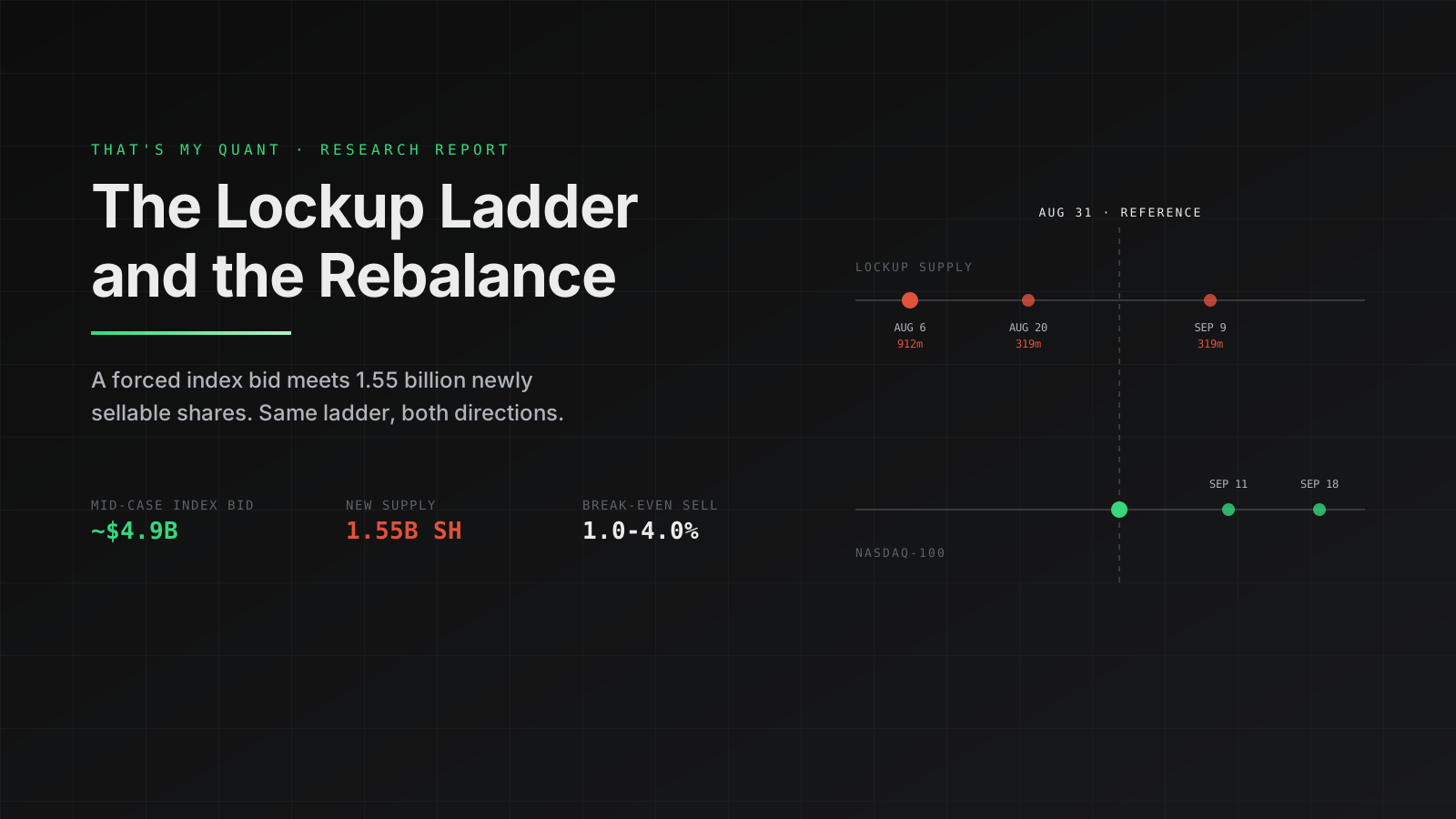
Delta-Neutral Perps: Earn Yield With Zero Bias
How to build delta-neutral perpetual futures positions — collect funding across multiple assets while eliminating directional exposure.
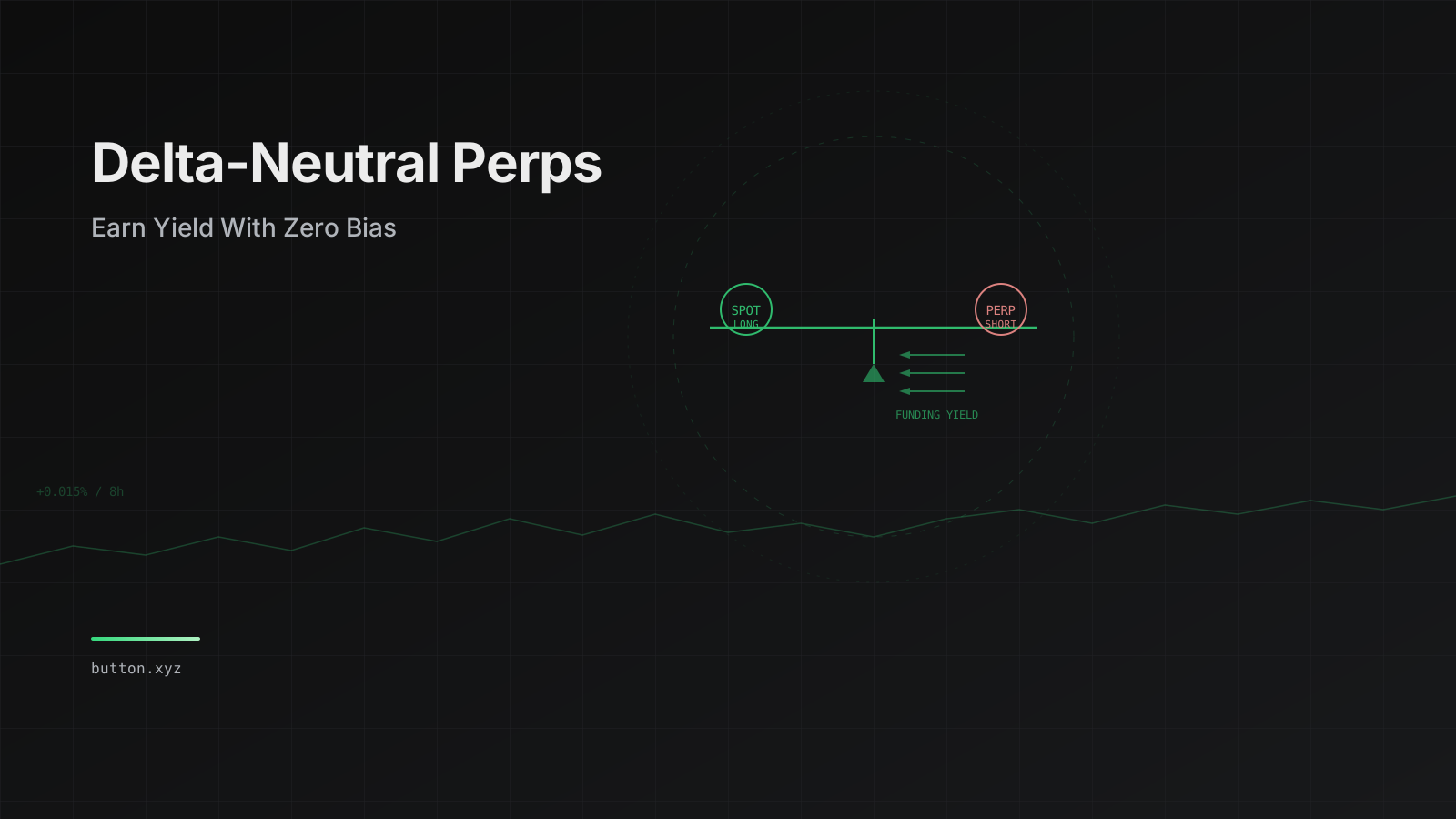
Delta-neutral means zero directional exposure. The market can go up 30% or down 30% and your portfolio's value stays roughly the same. What changes is the carry income — the funding rate payments that accrue every 8 hours on your perpetual futures positions.
This is the strategy institutional crypto funds use to generate 5-15% annualized yield without taking a view on price direction. The mechanics are straightforward: for every dollar of perp exposure, hold an equal and opposite position that cancels out price movement. What remains is the funding yield — a structural feature of the perpetual futures mechanism that pays shorts when the market is net long.
Note: perp trading involves substantial risk. Delta-neutral strategies reduce directional exposure but do not eliminate all risk. Funding inversion, liquidation on leveraged legs, and execution risk can produce losses. Never deploy capital you cannot afford to lose.
How Delta-Neutral Works
The core position is simple: long spot + short perp at equal notional.
If BTC is at $68,000 and you hold 1 BTC spot ($68,000) and short 1 BTC perp ($68,000 notional):
- BTC rises to $78,000: Spot gains $10,000. Perp short loses $10,000. Net P&L: $0.
- BTC drops to $58,000: Spot loses $10,000. Perp short gains $10,000. Net P&L: $0.
- Funding payment at 0.02% per 8 hours: You collect $68,000 × 0.0002 = $13.60 every 8 hours regardless of price movement.
That $13.60 per period equals $40.80/day, $285.60/week, $14,892/year — a 10.9% annualized yield on $136,000 deployed capital (spot + margin), with no directional bet.
Single-Asset Delta-Neutral
The simplest delta-neutral setup uses one asset:
BTC Basis Trade:
- Long $100,000 BTC spot
- Short $100,000 BTC perp on Hyperliquid (1-2x leverage on the short)
- Collect funding every 8 hours
Expected yield at average funding (0.015% per 8h): $100,000 × 0.00015 × 3 × 365 = $16,425/year on $200K total capital = 8.2% annualized.
Hyperliquid advantage: Maker rebate of -0.02% on entry and exit adds ~$80 per round trip on $200K notional. Funding rates run 2-3x higher than CEXs — BTC averages 0.015-0.025% on Hyperliquid versus 0.005-0.015% on Binance. Same strategy, 2x the yield.
Multi-Asset Delta-Neutral Portfolio
The real power of delta-neutral emerges when you run the strategy across multiple assets simultaneously. Diversification smooths your yield curve — when BTC funding compresses, ETH or SOL funding may still be elevated.
Sample Portfolio: $300K Deployed
| Asset | Spot Long | Perp Short | Avg 8h Funding | Annual Yield |
|---|---|---|---|---|
| BTC | $75,000 | $75,000 | 0.015% | $12,319 |
| ETH | $60,000 | $60,000 | 0.022% | $14,454 |
| SOL | $30,000 | $30,000 | 0.035% | $11,498 |
| DOGE | $15,000 | $15,000 | 0.040% | $6,570 |
| Reserve | $45,000 | — | — | — |
| Total | $225,000 | $180,000 | — | $44,841 |
Blended yield: $44,841 on $300K capital = 14.9% annualized.
The reserve ($45,000 / 15% of capital) covers margin calls during volatile periods when perp shorts face unrealized losses from sharp price rallies. Without reserve, a 30% rally could liquidate the perp short even though the spot long offsets it economically.
Why Multi-Asset Outperforms Single-Asset
Diversified funding: BTC funding might compress to 0.005% during a consolidation, but SOL and meme coins often maintain elevated funding due to speculative long demand. A multi-asset portfolio captures funding from whichever assets have the strongest carry.
Rebalancing alpha: When BTC funding drops and ETH funding spikes, rotate capital from BTC to ETH. This active rebalancing captures 2-4% additional annual yield compared to static allocation.
Reduced correlation risk: Funding inversion (shorts pay longs) tends to hit all assets simultaneously during market crashes. But the magnitude differs — BTC might invert to -0.01% while ETH inverts to -0.005%. Multi-asset reduces the severity of portfolio-wide inversions.
Sizing and Leverage
Perp Short Sizing
Match notional exactly between spot and perp. Any mismatch creates directional exposure:
- $100,000 spot BTC + $95,000 short BTC perp = $5,000 net long (you're exposed to 5% of a BTC move)
- $100,000 spot BTC + $105,000 short BTC perp = $5,000 net short
Recheck sizing daily. As BTC price moves, your spot value changes but the perp notional adjusts automatically (perpetual contracts are denominated in the underlying). No rebalancing needed on a single-asset position.
Leverage on the Short
Use 1-3x leverage on the perp short. The lower the leverage, the larger your liquidation buffer:
| Leverage | Margin Required | Liquidation Buffer |
|---|---|---|
| 1x | $100,000 | ~100% rally |
| 2x | $50,000 | ~50% rally |
| 3x | $33,333 | ~33% rally |
| 5x | $20,000 | ~20% rally |
At 2x leverage, BTC would need to rally 50% before your short approaches liquidation. Your spot gains offset this, but the exchange only sees the short margin. During the March 2024 BTC rally from $42K to $73K (74%), a 2x short would have been liquidated. At 1.5x, it survives.
Recommendation: 2x for BTC/ETH, 1.5x for alts. Alts can rally 100%+ in days during speculative cycles.
Risk Management
Funding Inversion
When market sentiment turns bearish, funding flips negative — shorts pay longs. Your delta-neutral position goes from earning carry to bleeding it.
Historical frequency: BTC funding is negative roughly 20-30% of the time. ETH is negative 15-25%. Alts vary more widely.
Mitigation strategy: Set exit thresholds. If 24-hour average funding drops below -0.005% on an asset, close that pair and hold cash. Re-enter when funding turns positive for 48+ consecutive hours. This "funding switch" approach keeps you in the trade during positive carry and out during inversions.
Portfolio-level rule: If 3 or more of your 4 assets show negative 24h average funding, reduce all positions by 50%. Synchronized inversions signal broad deleveraging — risk is elevated across the board.
Liquidation Risk
A sharp rally reduces your perp short margin while increasing your spot value. The exchange only sees the short:
- Monitor daily: Check margin ratio on every short position.
- Add margin proactively: If liquidation buffer drops below 25%, add margin from your reserve or reduce position size.
- Cross margin vs isolated: Using cross margin on Hyperliquid means your entire account balance backs the short — more buffer but more risk if you run multiple positions. Isolated margin caps the damage per position.
Basis Expansion
If the perp premium widens (perp price moves above spot), your short shows unrealized losses even though funding income is increasing. This is mark-to-market noise — the premium will eventually converge. But it temporarily reduces available margin.
Mitigation: Size positions so a 3% basis expansion doesn't trigger margin pressure. This means keeping effective leverage below 2x after accounting for potential basis moves.
Rebalancing Costs
As prices move, you may need to adjust position sizes to maintain delta neutrality. Each adjustment incurs trading fees. On Hyperliquid, maker rebates offset this — rebalancing via limit orders actually earns fees. On CEXs, rebalancing costs compound.
Rebalance frequency: Weekly for BTC/ETH (low volatility drift). Daily for alts (higher drift). Rebalance when notional mismatch exceeds 5% of target.
Tracking Performance
Key Metrics
Yield rate: Total funding collected / total capital deployed, annualized. Target: 8-15%.
Sharpe ratio: Yield / standard deviation of daily returns. Delta-neutral should produce Sharpe >2.0. If it drops below 1.5, the strategy is underperforming risk-adjusted.
Maximum drawdown: The largest peak-to-trough decline. For well-run delta-neutral, max drawdown should stay below 5%. Drawdowns above this signal sizing or leverage issues.
Funding capture rate: Percentage of total available funding you actually captured. If BTC funding averaged 0.02% but you earned 0.015% per period (after accounting for closures during inversions), your capture rate is 75%. Target: 70-85%.
Attribution
Track yield by source:
- Funding income per asset
- Maker rebate income (Hyperliquid)
- Rebalancing costs
- Unrealized basis P&L
This tells you which assets drive returns and whether the Hyperliquid venue advantage (higher funding + maker rebates) is materializing in your actual numbers.
Advanced: Cross-Exchange Delta-Neutral
Instead of long spot + short perp on one venue, go long perp on a low-funding exchange and short perp on a high-funding exchange. This captures the funding rate spread between venues.
Example: Long BTC perp on Binance (funding: 0.005%) + Short BTC perp on Hyperliquid (funding: 0.020%). Net carry: 0.015% per 8h on the combined notional, without holding any spot. Capital requirement is lower because both legs are margin-based.
Risk: This position is delta-neutral in aggregate but each leg has full directional exposure on its respective exchange. A sharp move liquidates one side before the other compensates. Requires active margin management on both venues and capital split that reduces size per exchange.
Minimum capital: $50,000+ to manage margin adequacy on both venues during volatile periods.
FAQ
What's the realistic yield for delta-neutral perps?
5-15% annualized on BTC. 8-20% on ETH. 15-40%+ on alts (but with higher risk of funding inversion and liquidation). Multi-asset portfolios typically blend to 10-15% annualized across market conditions.
Can I run delta-neutral with $5,000?
Technically yes, but the absolute yield ($500-750/year) barely justifies the monitoring effort. $20,000 is the practical minimum for meaningful returns. Professional operations deploy $200K+.
How often do I need to check my positions?
Daily at minimum. Check margin ratios, funding rate trends, and notional match. Weekly rebalancing for BTC/ETH pairs. A trading bot or the AI agent can automate monitoring and rebalancing.
What happens during a market crash?
Your spot drops in value but your perp short gains equally — you're protected from the price move. The risk is funding inversion: during crashes, funding often flips negative and you pay instead of collect. Well-managed delta-neutral exits negative-funding positions quickly, limiting the damage to a few days of carry cost.
Is delta-neutral the same as basis trading?
A basis trade is one type of delta-neutral strategy (single-asset, long spot + short perp). "Delta-neutral" is the broader category that includes multi-asset portfolios, cross-exchange funding arbitrage, and options-based hedges. All basis trades are delta-neutral; not all delta-neutral is a basis trade.
Capture Funding, Not Direction
Delta-neutral perps trading converts a speculative instrument into a yield product. The market can do anything — rally, crash, chop sideways — and your portfolio earns carry as long as funding remains positive. The discipline is in execution: matching notional precisely, maintaining margin buffers, and exiting during inversions instead of hoping they reverse.
Run delta-neutral strategies with the agent: the AI trading agent manages multi-asset delta-neutral portfolios on Hyperliquid — automated position matching, funding monitoring across venues, margin management, and inversion exits. Connect wallet and let systematic carry replace directional guessing.
Related: Funding rate arbitrage for cross-exchange carry. Perps trading playbook for the full strategy framework. Funding rates explained for the carry mechanics.