The Retail Investor's Real Edge
Institutions have more money, more analysts, and better access than you do. But they work under constraints you don't, and every constraint they carry is a potential edge for you.
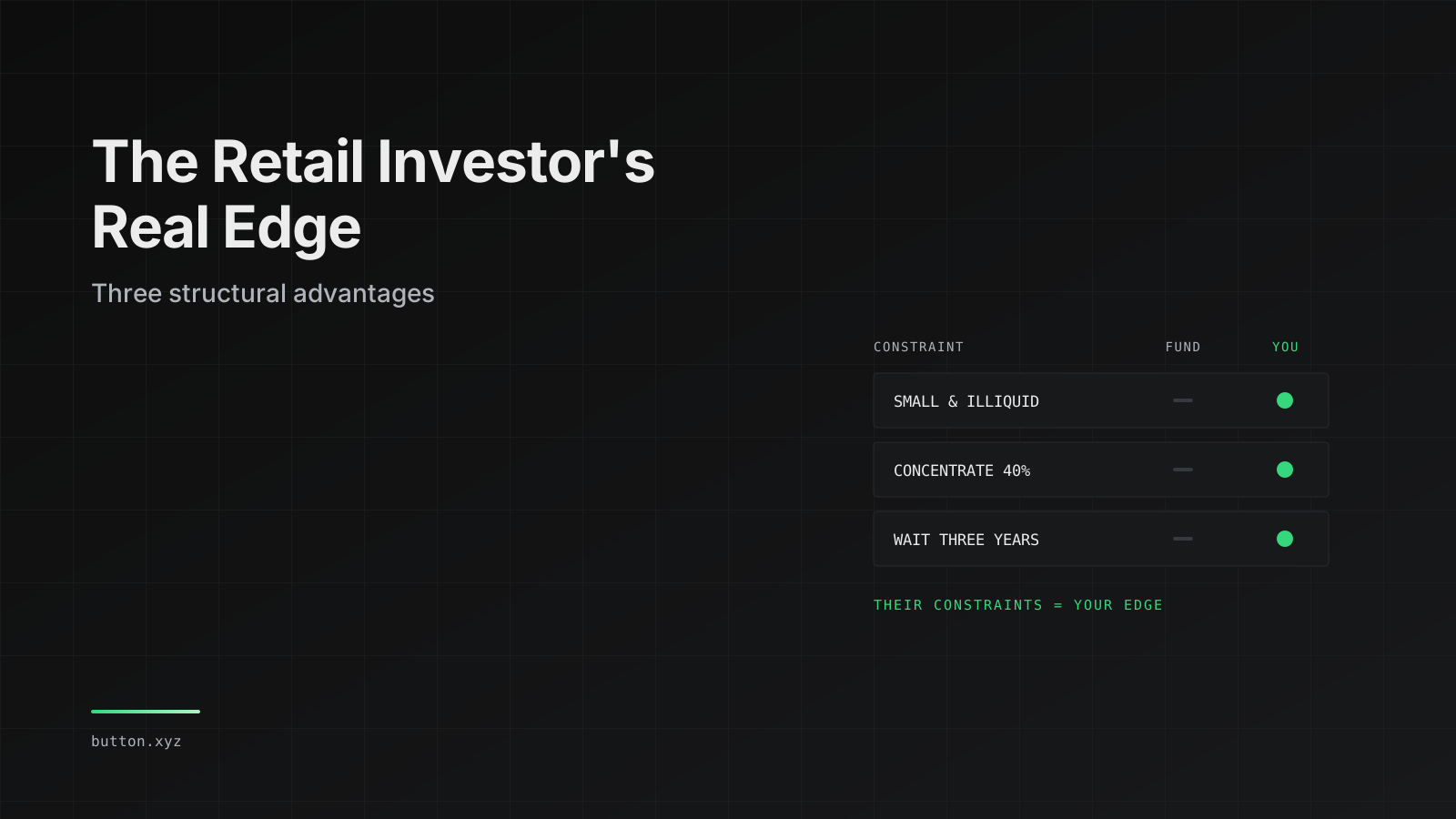
When I first started investing in stock markets, I cloned the institutions closely: if a big fund was buying, I bought. I read the famous fund managers cover to cover, treated their word as gospel, and tracked their holdings rigorously. Once I had learnt a decent amount of fundamental analysis, I took my first independent bet. The company had little to no institutional holding or brokerage coverage, which gave me the sense I was doing something wrong. It ended up being a multi-bagger, and the institutions only showed up somewhere around the 3-4x mark. I kept wondering why they were so late. Around the same time, I was watching anonymous Twitter accounts call individual stocks better than fund managers did. These accounts didn't have research teams, but they knew their sectors closely and got to the story early. Four years in, it made sense to me. Institutions have more money, analysts, data, and direct access to management. I can't beat them on those. But they work under constraints I don't have, and those constraints leave things on the table. Every constraint they carry is a potential edge for me. The point isn't to do better research than a professional, but to buy what a professional can't. Three of those edges are worth naming. All three are real, and almost nobody uses them on purpose.
Edge 1: You're small, and small is fast
You can buy small, illiquid companies. Most professionals can't. It's not that they missed them, it's that the size of their fund limits the universe of names they can invest in, or even cover. A $10 billion fund can't build a meaningful position in a $300 million company. Even the biggest stake it could reasonably take is too small to matter. The stock could triple and the fund's returns would barely move. And a position big enough to actually matter would push the price up on the way in and be hard to get out of. That's not just a micro-cap problem either. It shows up in reasonably liquid names too, once you're managing big enough money. So entire corners of the market, from micro-caps to thinly traded names, are effectively off-limits to large pools of capital no matter how attractive the opportunity looks. You can move in and out of those names without moving the price much against yourself. That's probably most of why nobody was in my first bet.
Edge 2: You answer to no one
A fund manager's job isn't only to generate returns. It's also to gather assets, and that means answering to a lot of people and showing decent numbers every quarter. Everything else follows from that. A mandate telling them what they can own. Tracking error limits keeping them close to a benchmark. Position size caps stopping them from concentrating. And then career risk, which is bigger than all of them put together. A manager who strays from the herd and underperforms for two years usually doesn't get to year three, even if the thesis was right and year three is when it pays off. There's an old line that nobody ever got fired for buying IBM. If a famous blue chip collapses, the client blames the company. If an obscure small-cap collapses, the client blames the manager who bought it. So the safe names get crowded and everything else gets ignored. You carry none of this. You can put 40% of your portfolio into your single best idea, sit in cash when nothing looks attractive, or buy things that fit no mandate at all. But the freedom that actually matters is time. You can hold through a drawdown, or look wrong for three straight years, as long as the thesis is intact. A fund can't. When clients pull their money, the manager sells at the bottom whether they want to or not.
Edge 3: You know things the market doesn't care to learn
This is the edge everyone talks about, and it's the weakest of the three, because unlike the other two it isn't structural. It doesn't come from being a principal. It comes from being you, and a fund manager who spent a decade in semiconductors has it just as much. It is still real. In your own corner of the world, whether that's the industry you work in, the hobby you've spent a decade on, or the product you watched take over your office months before any analyst wrote about it, you may know more than anyone else looking at the stock. That's what Peter Lynch meant when he told amateurs to invest in what they know, and it's what those anonymous Twitter accounts were doing. It's strongest in small, uncovered companies that no institution bothers researching, which is where it compounds with the first edge. But having a view is not the same as having an edge. The market is full of unique opinions and ignores most of them for good reason. A differentiated view only pays if it is also correct and not already in the price. And if your corner of the world happens to be an industry that genuinely isn't growing, your circle of competence may have nothing in it worth buying.
What the retail edge is not
It is worth being honest about the other side of this. Your edge is not risk appetite; hedge funds take leverage and risks you never could. It is not speed. It is not better information on large, well-covered companies, where you are the least informed person at the table. And it is not the mere fact of having your own viewpoint. The edge is structural, and it comes down to one sentence: you are a principal managing your own money, with no clients, no benchmark, and no boss. Everything else flows from that. Looking back, my first bet worked for exactly these reasons. The company was too small for the big funds to care about and nobody was covering it. The institutions came in later, and by then the work was already done. I have found the same setup several times since. The mistake most retail investors make is throwing all of this away: trading fast, chasing large-cap momentum, and competing with institutions at exactly the game institutions are built to win. The winning move is the opposite. Go small, go patient, go where you actually know something, and let the professionals' constraints do the work for you.