For over a century, history has repeatedly rewarded those who recognized transformative assets before they went mainstream, whether it was buying farmland during the Industrial Revolution, snapping up shares of fledgling railroads, investing in U.S. equities after the Great Depression, or getting into tech stocks before the internet boom. Each of these opportunities began on the fringes: misunderstood, dismissed, or deemed too risky by the establishment, until undeniable utility, institutional validation, and mass adoption turned early conviction into generational wealth.
Today, Bitcoin stands at that same inflection point. Once written off as digital noise, it has now cleared the highest barriers to legitimacy: enshrined in corporate balance sheets, backed by regulated ETFs, secured by trillions in global hash power, and increasingly viewed as "digital gold" in an era of currency debasement and geopolitical uncertainty. The infrastructure is built, the gatekeepers have opened the doors, and the world's smartest capital is moving in. Just like those once-in-a-century opportunities of the past, Bitcoin isn't just another asset, it's the next great leap in how humanity stores and transfers value. And the window to participate before it becomes universally obvious is narrowing fast.
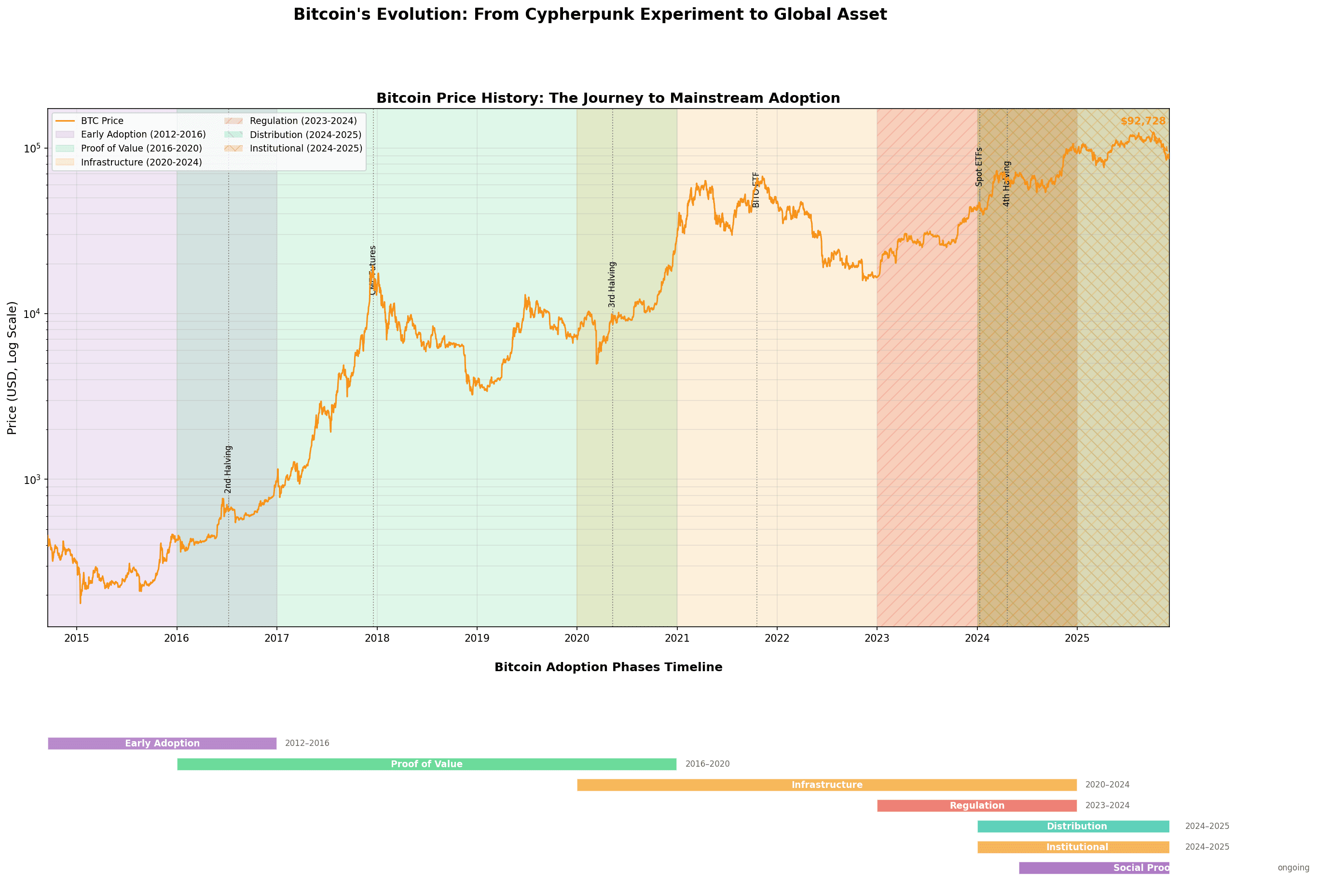
Bitcoin price and adoption phases BTC in 2025: Stage 8 → Institutional Adoption, Heading Toward Stage 9 Stage Market Data Milestones Time 1. Innovation No exchanges; OTC trades on forums; Price ~$0.003 → $10; Near-zero liquidity Whitepaper released (2008); Genesis block mined (2009) 2009–2012 2. Early Adoption First real exchanges (Mt. Gox); Volume increases 100×; Price rises to ~$1,000; High volatility Cypherpunks; early miners; libertarians 2012–2016 3. Proof of Value Volatility decreases vs prior cycles; CME futures begin; Market cap surpasses $100B Survived hacks & forks; SegWit; Institutions begin research 2016–2020 4. Infrastructure ETFs begin filing attempts; Massive growth in stablecoins → BTC liquidity improves Fidelity, BlackRock, CME, Coinbase prime brokers 2020–2024 5. Regulation 2024 U.S. BTC Spot ETF approval → structural regime shift; Record inflows Legal clarity triggers flows 2023–2024 6. Distribution Spot BTC ETFs on BlackRock, Fidelity, ARK/21Shares; BTC in retirement accounts; fintech integration Google Trends rising; Stable ETF inflows 2024–2025 7. Social Proof Media normalizes BTC; narrative becomes "digital gold," "macro hedge," "sovereign asset" Sentiment-driven moves Ongoing 8. Institutional Tens of billions in ETF inflows; Daily liquidity rivaling mega-cap equities; Deep derivative markets Big players commit 2024–2025 9. Network Effects Durable trend; Pullbacks bought 10. Mainstream Index inclusion; Steady, low-vol
To be continued…
About Button Button is a discretionary trading interface for perpetual futures. We route orders into Hyperliquid’s fully on-chain order book for 150+ crypto perpetuals and into trade.xyz for real-world asset perps — equity indices like the S&P 500 and KR200, single-name stocks like NVDA, TSLA, MSFT, GOOGL, META, and AAPL, commodities including gold, silver, copper, crude oil, and natural gas, and major FX pairs. Every market is USDC-margined, settled on-chain, and reachable without opening a brokerage account, completing KYC at the protocol layer, or handing collateral to a custodian.
The trading workflow is short. Fund a wallet with USDC on a supported network, bridge to Hyperliquid, and the bridged balance becomes your margin account. Open a market on Button, set direction and leverage within the per-market cap, and the order ticket shows your live liquidation price before the transaction is signed. Funding accrues hourly at the rate displayed on the market page — paid or earned depending on which side of the book you sit. Closing is symmetric: one signed transaction, USDC settlement on-chain, no withdrawal queue and no custodian to ask for permission.
The Button blog exists to give traders a clearer mental model of the venues, mechanics, and markets the product touches every day. Posts cover Hyperliquid’s architecture and how it differs from centralised exchanges, the funding and basis regimes that show up in real on-chain order flow, the longer arc of Bitcoin’s transition from a fringe asset into a mainstream allocation, the research behind specific trade setups, and the company’s own thinking on where self-custodial perp trading is headed. Browse the full archive , jump to a topic via the Hyperliquid , perpetual futures , Bitcoin , or strategy tags, or skip straight to the live market list to see what Button actually routes orders into.
A note on what Button is not, since it shows up in nearly every reader question. Button does not run its own matching engine, does not custody user funds at any point, does not require an email signup or KYC at the protocol layer, and does not charge a markup on top of the standard Hyperliquid maker/taker fee schedule. There is no Button-issued token, no points program gating product access, and no centralised back office holding collateral overnight. The product is a workflow layer on top of two on-chain venues; the venues handle the matching, the settlement, and the funding. That intentional thinness is what lets us focus the blog on the things that actually move P&L for the people using the product — funding regimes, basis, liquidity behaviour, leverage choice, security hygiene, and the specific market structure of Hyperliquid and trade.xyz.
If you want to keep up with new pieces, the full RSS feed lives at /feed.xml . Team announcements and shorter updates are on @buttonxyz on X and on LinkedIn . Open engineering, trading, and operations roles are listed on Ashby .
Standard disclaimer, since the writing on this blog touches leverage, liquidation, and active trading. Nothing in this article is investment advice, a solicitation, or a recommendation to take a specific position. Perpetual futures are leveraged instruments and can lose more than the cost of the position depending on funding accrued and on how a liquidation engine resolves a given move. Local laws and tax treatments around self-custodial derivatives vary widely; readers are responsible for understanding the rules that apply in their jurisdiction. Button does not provide tax, legal, or accounting advice, and the team writing this post is not your fiduciary. The product is a workflow layer on top of permissionless on-chain venues — your trades, your risk, your responsibility.
A short note on security, which applies to every post on this site whether the piece is explicitly about security or not. Self-custodial trading shifts the security perimeter from a centralised exchange to the wallet on your machine. That is usually a feature — no custodian can be hacked into draining your account, and no withdrawal queue stands between you and your collateral — but it puts the operational burden on you. The standard hygiene matters: a hardware wallet for any meaningful balance, careful review of every transaction before signing, never re-using a seed phrase across multiple wallets, and a healthy suspicion of any link, DM, or support request that arrives unsolicited. The security archive on this blog covers the patterns we see most often and the practical guidance we give Button users who are trading through our interface every day.